THE ADVENTURE COLLECTIVE® · Independent discovery and booking for outdoor travel

Walk centuries of history with a government-licensed guide through Todaiji, Kasuga Taisha and Nara Park’s famously tame deer. This private 6-hour tour mixes cultural context with efficient routing so you see the highlights without the guesswork.
Walk centuries of history with a government-licensed guide through Todaiji, Kasuga Taisha and Nara Park’s famously tame deer. This private 6-hour tour mixes cultural context with efficient routing so you see the highlights without the guesswork.
You arrive under an open sky where deer drift through temple gates like locals with no schedule. Footsteps on flagstone lead past low wooden buildings and lantern-lined paths; the city feels both lived-in and ancient in the same breath.
Verified experiences and guided adventures in the surrounding area.
Operated by Japan Guide Agency · Nara, Nara
You arrive under an open sky where deer drift through temple gates like locals with no schedule. Footsteps on flagstone lead past low wooden buildings and lantern-lined paths; the city feels both lived-in and ancient in the same breath.
Nara was Japan’s capital in the 8th century, and its streets still carry that scale: monumental temples built of wood, compact merchant lanes, and a park where sika deer—once messengers of the gods—move between visitors and priests. Geologically the area sits on gentle plains that rise to the low, grassy Wakakusayama (≈350 m), whose slopes give a sweeping vantage over the compact city below.
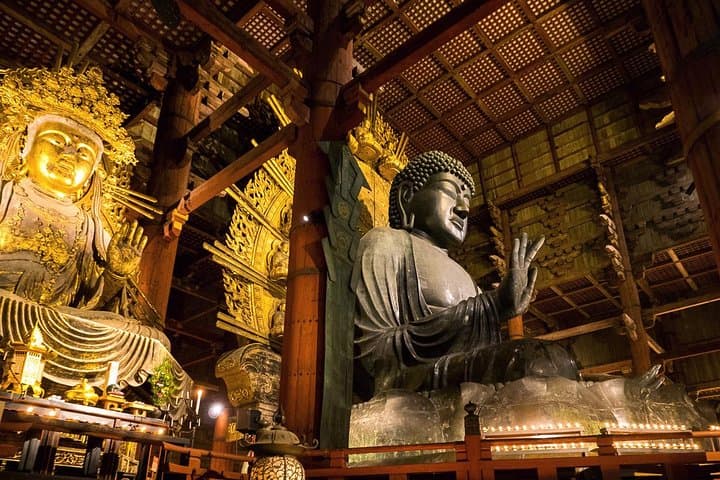
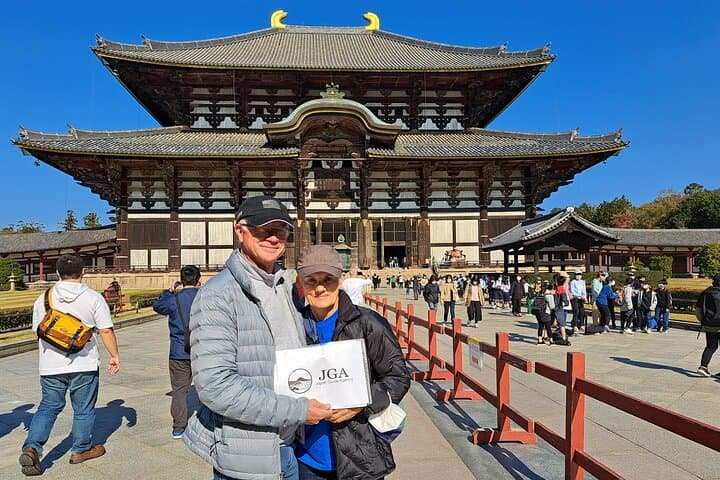
A government-licensed guide will thread history, architecture and ritual together: Todaiji’s massive Daibutsuden and bronze Vairocana Buddha, the thousands of lanterns at Kasuga Taisha, the quiet machiya alleys of Naramachi, and the tucked-away gardens of Isuien and Yoshikien.
Practically: expect mostly flat walking with paved and packed-earth surfaces, 4–7 km of combined walking depending on chosen stops, and one steeper 15–30 minute ascent if you opt for Wakakusayama’s plateau. Wear grippy shoes, carry water, and bring cash for small garden or shrine fees. If you want photos without crowds, aim for early morning or late afternoon—your licensed guide times routes to minimize waits and explain what you’re seeing and why it mattered to courtly Japan.
The private format lets you select 3–4 sites from a curated list, so whether your interest is architecture, deer behavior, or tea gardens, the day can be paced to suit curiosity and comfort.
easy.
6 hours.
Suitable for most fitness levels; light walking across flat terrain with optional short climb to Wakakusayama
The tour notes wheelchair and stroller accessibility for most central areas; your guide can select fully accessible routes but some temple inner precincts may include steps.
Admission is generally not included; the private tour’s inclusion list specifies meeting and guide services—plan for small entrance fees at gardens or shrine inner areas.
Yes—the private format lets you pick 3–4 must-see spots from the provided list when booking to tailor pacing and interests.
Tipping is not customary in Japan; a polite thank-you or small souvenir is appreciated but not required.
Nara served as Japan’s first permanent capital from 710–794 (Heijō-kyō); many surviving temples and layout elements date from that formative era.
Respect wildlife rules—feed only designated crackers and avoid disrupting deer behavior; many sites are UNESCO-listed or protected, so stay on paths and follow signage to minimize wear.
Japan Guide Agency operates guided outdoor trips and adventures with an emphasis on safety, stewardship, and memorable experiences.


You arrive under an open sky where deer drift through temple gates like locals with no schedule. Footsteps on flagstone lead past low wooden buildings and lantern-lined paths; the city feels both lived-in and ancient in the same breath.
You arrive under an open sky where deer drift through temple gates like locals with no schedule. Footsteps on flagstone lead past low wooden buildings and lantern-lined paths; the city feels both lived-in and ancient in the same breath.
Nara was Japan’s capital in the 8th century, and its streets still carry that scale: monumental temples built of wood, compact merchant lanes, and a park where sika deer—once messengers of the gods—move between visitors and priests. Geologically the area sits on gentle plains that rise to the low, grassy Wakakusayama (≈350 m), whose slopes give a sweeping vantage over the compact city below.
A government-licensed guide will thread history, architecture and ritual together: Todaiji’s massive Daibutsuden and bronze Vairocana Buddha, the thousands of lanterns at Kasuga Taisha, the quiet machiya alleys of Naramachi, and the tucked-away gardens of Isuien and Yoshikien.
Practically: expect mostly flat walking with paved and packed-earth surfaces, 4–7 km of combined walking depending on chosen stops, and one steeper 15–30 minute ascent if you opt for Wakakusayama’s plateau. Wear grippy shoes, carry water, and bring cash for small garden or shrine fees. If you want photos without crowds, aim for early morning or late afternoon—your licensed guide times routes to minimize waits and explain what you’re seeing and why it mattered to courtly Japan.
The private format lets you select 3–4 sites from a curated list, so whether your interest is architecture, deer behavior, or tea gardens, the day can be paced to suit curiosity and comfort.