THE ADVENTURE COLLECTIVE® · Independent discovery and booking for outdoor travel

Explore the Giza Plateau on a private half-day guided tour — see Khufu, Khafre and Menkaure up close, hear the history from an expert guide, and return to your Cairo hotel with bottled water and comfortable transport.
Explore the Giza Plateau on a private half-day guided tour — see Khufu, Khafre and Menkaure up close, hear the history from an expert guide, and return to your Cairo hotel with bottled water and comfortable transport.
You step from the air-conditioned car onto a sun-warmed plateau and the three pyramids lift like geometric islands from the sand. A warm breeze carries the dust and call of distant traffic; the Great Pyramid stands nearest, ancient blocks stacked with a quiet, monumental patience while the Sphinx keeps its stone gaze on the eastern horizon.
Verified experiences and guided adventures in the surrounding area.
Operated by Camel Ride at Giza Pyramids · Giza, Giza Governorate
You step from the air-conditioned car onto a sun-warmed plateau and the three pyramids lift like geometric islands from the sand. A warm breeze carries the dust and call of distant traffic; the Great Pyramid stands nearest, ancient blocks stacked with a quiet, monumental patience while the Sphinx keeps its stone gaze on the eastern horizon.
The plateau at Giza holds Khufu’s Grand Pyramid (c. 2580–2560 BC), Khafre’s slightly smaller monument with its surviving casing stones, and Menkaure’s compact complex, each linked to valley temples and causeways now partly buried by modern habitations. The bedrock here is Eocene limestone; quarried Tura limestone and basalt paving appear in temple remains, and the Solar Boat Museum preserves an impressive wooden funerary vessel recovered near Khufu’s pyramid.
Culture and modern life press close: local vendors and camel handlers work the visitor routes, and the skyline of Cairo forms a surprising backdrop to millennia-old masonry. Your private guide frames the architecture, pharaonic rituals and later reuse of the site, making the layers of history readable.
Practically: the tour covers roughly 1–3 km of walking on uneven limestone and compacted sand with minimal elevation gain, so bring sturdy shoes, sun protection and a camera. Basic area entry is usually included, while inside-the-pyramid access and special exhibitions require extra tickets. Expect 3–4 hours door-to-door with hotel pickup and bottled water provided; avoid midday in summer and plan morning or late-afternoon visits for cooler light and softer shadows for photography.
easy.
4 hours.
Suitable for anyone who can walk short distances (1–3 km) on uneven ground and stand for moderate periods.
The pickup-to-drop-off duration is approximately four hours, including transport time and a guided walk of about 1–3 km around the plateau.
Basic area access is generally included, but access inside pyramids or to special exhibits typically requires additional tickets or fees.
Interior access to certain pyramids is limited and subject to extra fees; the Sphinx enclosure is viewable from the public walkways but some adjacent areas are restricted.
The tour involves uneven walking and heat exposure; organizers note it is not recommended for pregnant travelers or those with serious spinal or heart conditions.
The three principal pyramids date to Egypt’s Fourth Dynasty; Khufu’s complex originally included valley and mortuary temples and a causeway, while the Sphinx is commonly associated with Khafre’s reign.
Erosion, pollution and mass tourism strain the site; visitors should avoid climbing monuments, follow marked paths, and respect signage to limit wear and protect fragile archaeological remains.
Camel Ride at Giza Pyramids operates guided outdoor trips and adventures with an emphasis on safety, stewardship, and memorable experiences.
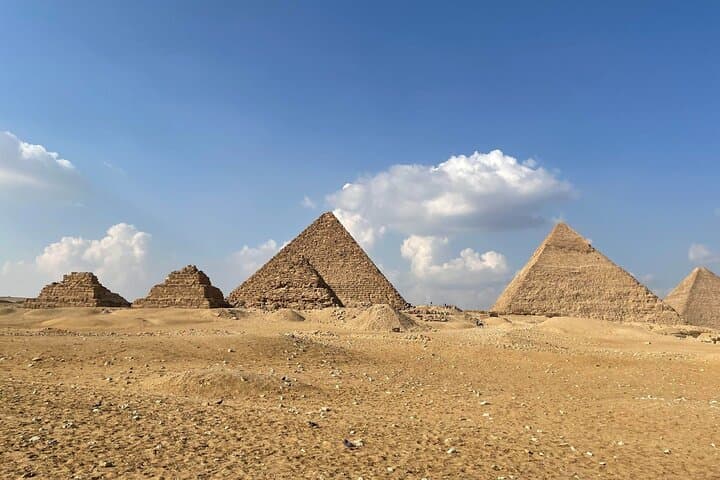
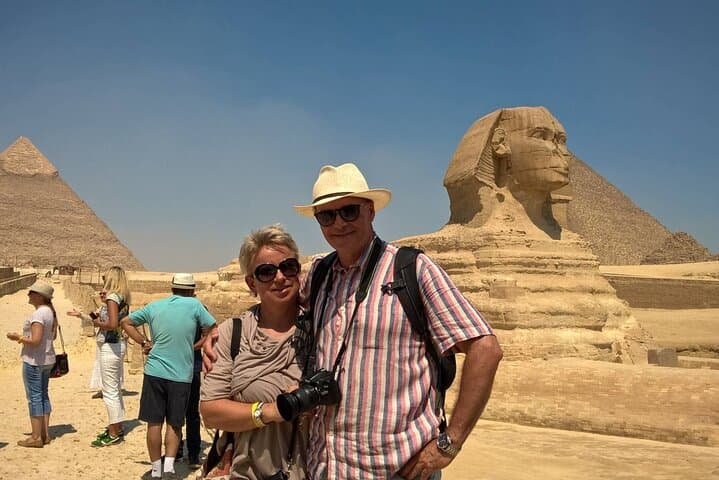


You step from the air-conditioned car onto a sun-warmed plateau and the three pyramids lift like geometric islands from the sand. A warm breeze carries the dust and call of distant traffic; the Great Pyramid stands nearest, ancient blocks stacked with a quiet, monumental patience while the Sphinx keeps its stone gaze on the eastern horizon.
You step from the air-conditioned car onto a sun-warmed plateau and the three pyramids lift like geometric islands from the sand. A warm breeze carries the dust and call of distant traffic; the Great Pyramid stands nearest, ancient blocks stacked with a quiet, monumental patience while the Sphinx keeps its stone gaze on the eastern horizon.
The plateau at Giza holds Khufu’s Grand Pyramid (c. 2580–2560 BC), Khafre’s slightly smaller monument with its surviving casing stones, and Menkaure’s compact complex, each linked to valley temples and causeways now partly buried by modern habitations. The bedrock here is Eocene limestone; quarried Tura limestone and basalt paving appear in temple remains, and the Solar Boat Museum preserves an impressive wooden funerary vessel recovered near Khufu’s pyramid.
Culture and modern life press close: local vendors and camel handlers work the visitor routes, and the skyline of Cairo forms a surprising backdrop to millennia-old masonry. Your private guide frames the architecture, pharaonic rituals and later reuse of the site, making the layers of history readable.
Practically: the tour covers roughly 1–3 km of walking on uneven limestone and compacted sand with minimal elevation gain, so bring sturdy shoes, sun protection and a camera. Basic area entry is usually included, while inside-the-pyramid access and special exhibitions require extra tickets. Expect 3–4 hours door-to-door with hotel pickup and bottled water provided; avoid midday in summer and plan morning or late-afternoon visits for cooler light and softer shadows for photography.