THE ADVENTURE COLLECTIVE® · Independent discovery and booking for outdoor travel

Explore Nairobi’s civic core on a focused half-day walking tour that moves from markets and mosques to the KICC rooftop and the August 7th Memorial Park. Guides fuse local history with practical tips, making this an efficient introduction to the city’s culture.
Explore Nairobi’s civic core on a focused half-day walking tour that moves from markets and mosques to the KICC rooftop and the August 7th Memorial Park. Guides fuse local history with practical tips, making this an efficient introduction to the city’s culture.
Mid-morning sunlight cuts across Nairobi’s plazas as a small group steps away from the central business district and into the city’s layered stories. A guide navigates the press of vendors, leads through shaded park paths and up to the KICC rooftop, where the skyline opens and the city’s heat gives way to a clean wind.
Verified experiences and guided adventures in the surrounding area.
Operated by Gracepatt Ecotours Kenya · Nairobi, Nairobi County
Mid-morning sunlight cuts across Nairobi’s plazas as a small group steps away from the central business district and into the city’s layered stories. A guide navigates the press of vendors, leads through shaded park paths and up to the KICC rooftop, where the skyline opens and the city’s heat gives way to a clean wind.
This compact route visits Uhuru Park’s grassy lakefront, the cylindrical silhouette of the Kenyatta International Conference Centre with its panoramic helipad, and the August 7th Memorial Park, a sober place marking the 1998 bombing and the city’s resilience. Nairobi’s origin as a railway depot in 1899 set the grid and mixing of cultures; buildings and markets reflect colonial-era planning and rapid post-independence growth rather than dramatic geology.
Expect a mosaic of commerce and calm: City Market’s craft stalls, Jamia Mosque’s call to prayer, and street food stands offering mandazi and nyama choma. Urban trees and birds push back against asphalt—hadada ibis call from eaves; vervet monkeys sometimes patrol green edges.
Practicalities are simple: the tour covers roughly 3–4 miles on mostly paved surfaces with intermittent stair climbs to viewpoints. Comfortable shoes, sun protection and a small daypack keep the walk enjoyable. Guides handle entrance logistics and local context, and they can adjust pacing for quieter moments in Uhuru Park or the Memorial.
This half-day is ideal for first-time visitors wanting an efficient overview of Nairobi’s civic heart, blending history, culture and actionable local knowledge into one walk.
easy.
4 hours.
Suitable for most fitness levels; expect 3–4 miles of urban walking with short stair sections
Most routes use paved streets but there are stairs and uneven sidewalks; check with the operator for a tailored accessible itinerary.
Yes — the tour notes that entry to featured sites such as the KICC and August 7th Memorial Park is included.
The tour lists pick up and drop off within Nairobi; confirm your pick-up point when booking.
Tipping is customary for good service; a modest cash amount at the end of the tour is appreciated.
Nairobi began in 1899 as a railway depot and grew through colonial era planning into Kenya’s capital; the tour highlights post-independence civic architecture like the KICC.
Avoid feeding urban wildlife and stick to marked paths in parks; support local guides and vendors to keep cultural tourism economically sustainable.
Gracepatt Ecotours Kenya operates guided outdoor trips and adventures with an emphasis on safety, stewardship, and memorable experiences.


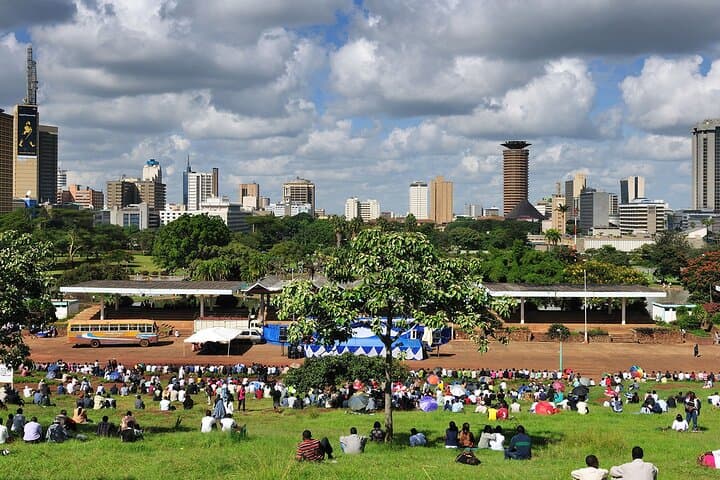

Mid-morning sunlight cuts across Nairobi’s plazas as a small group steps away from the central business district and into the city’s layered stories. A guide navigates the press of vendors, leads through shaded park paths and up to the KICC rooftop, where the skyline opens and the city’s heat gives way to a clean wind.
Mid-morning sunlight cuts across Nairobi’s plazas as a small group steps away from the central business district and into the city’s layered stories. A guide navigates the press of vendors, leads through shaded park paths and up to the KICC rooftop, where the skyline opens and the city’s heat gives way to a clean wind.
This compact route visits Uhuru Park’s grassy lakefront, the cylindrical silhouette of the Kenyatta International Conference Centre with its panoramic helipad, and the August 7th Memorial Park, a sober place marking the 1998 bombing and the city’s resilience. Nairobi’s origin as a railway depot in 1899 set the grid and mixing of cultures; buildings and markets reflect colonial-era planning and rapid post-independence growth rather than dramatic geology.
Expect a mosaic of commerce and calm: City Market’s craft stalls, Jamia Mosque’s call to prayer, and street food stands offering mandazi and nyama choma. Urban trees and birds push back against asphalt—hadada ibis call from eaves; vervet monkeys sometimes patrol green edges.
Practicalities are simple: the tour covers roughly 3–4 miles on mostly paved surfaces with intermittent stair climbs to viewpoints. Comfortable shoes, sun protection and a small daypack keep the walk enjoyable. Guides handle entrance logistics and local context, and they can adjust pacing for quieter moments in Uhuru Park or the Memorial.
This half-day is ideal for first-time visitors wanting an efficient overview of Nairobi’s civic heart, blending history, culture and actionable local knowledge into one walk.