THE ADVENTURE COLLECTIVE® · Independent discovery and booking for outdoor travel

Leave Agadir for a half-day jeep tour through Souss-Massa National Park, where estuaries, dunes and volcanic plateaus focus large bird colonies and coastal life. Expect guided wildlife viewing, short walks and local insights into conservation and culture.
Leave Agadir for a half-day jeep tour through Souss-Massa National Park, where estuaries, dunes and volcanic plateaus focus large bird colonies and coastal life. Expect guided wildlife viewing, short walks and local insights into conservation and culture.
The Atlantic wind pushes salt across low dunes as an air-conditioned jeep slides away from Agadir toward a ribbon of scrub and river mouth. Within minutes the city recedes and you are surrounded by open plains, sandy beaches and the reed-lined estuary of Oued Massa where birds wheel and land with casual authority.
Verified experiences and guided adventures in the surrounding area.
Operated by Aga Reisen · Agadir, Souss-Massa
The Atlantic wind pushes salt across low dunes as an air-conditioned jeep slides away from Agadir toward a ribbon of scrub and river mouth. Within minutes the city recedes and you are surrounded by open plains, sandy beaches and the reed-lined estuary of Oued Massa where birds wheel and land with casual authority.
Souss-Massa National Park was created to protect these fragile coastal ecosystems and the last wild flocks of the northern bald ibis. Geologically the park is a meeting of river-sculpted floodplain, coastal sand and low volcanic plateaus; culturally it sits between Amazigh farming villages and the Atlantic fishing tradition of southern Morocco. Guides point out traditional irrigation terraces and explain how seasonal rains shape the shoreline.
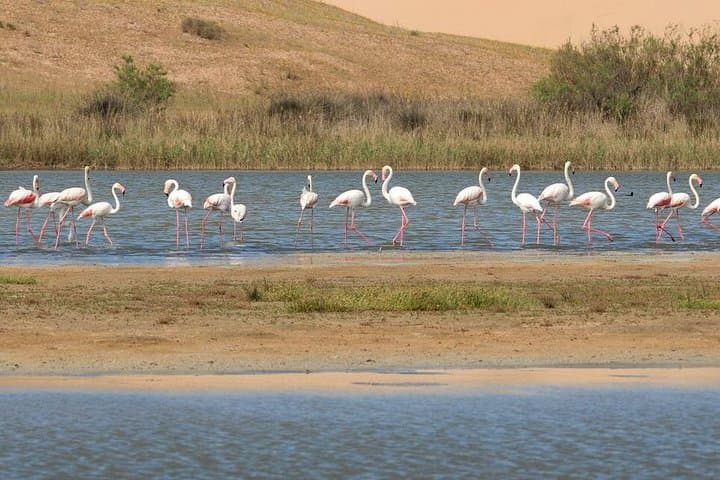
On a half-day tour you can expect a relaxed vehicle-based wildlife loop with short stops for views, photos and light walking. The itinerary favors the Oued Massa estuary, dune runs and lookout points where flamingos, herons and ibis concentrate. The guide’s local knowledge speeds sightings and explains behavior, making the most of a limited window.
Practical: bring sun protection, water and a good pair of binoculars. Morning light is best for birds and cooler temperatures; late afternoon brings warmer tones but stronger wind. Wear closed shoes for dune edges and be ready to board and disembark from a jeep several times. Respect fenced areas and follow your guide — these protections keep endangered species like the bald ibis on the landscape for future visits.
easy.
5 hours.
Suitable for most fitness levels; mostly vehicle-based with brief flat walks.
Yes; the tour includes hotel pickup and drop-off in Agadir, usually by air-conditioned jeep or minibus.
Entrance fee is included in this tour’s listed inclusions, but confirm at booking in case of policy changes.
Sightings are common at known feeding sites and estuary viewpoints, but wildlife is never guaranteed; the guide maximizes chances.
The trip is vehicle-based with short flat walks and is generally suitable for families and guests with limited mobility, but confirm specific needs when booking.
Souss-Massa was designated to conserve coastal habitats and one of the last breeding groups of the northern bald ibis, integrating local Amazigh grazing and fishing practices.
Park zones protect breeding colonies and marshes; stick to trails, avoid litter and support local guides who contribute to monitoring and community projects.
Aga Reisen operates guided outdoor trips and adventures with an emphasis on safety, stewardship, and memorable experiences.
The Atlantic wind pushes salt across low dunes as an air-conditioned jeep slides away from Agadir toward a ribbon of scrub and river mouth. Within minutes the city recedes and you are surrounded by open plains, sandy beaches and the reed-lined estuary of Oued Massa where birds wheel and land with casual authority.
The Atlantic wind pushes salt across low dunes as an air-conditioned jeep slides away from Agadir toward a ribbon of scrub and river mouth. Within minutes the city recedes and you are surrounded by open plains, sandy beaches and the reed-lined estuary of Oued Massa where birds wheel and land with casual authority.
Souss-Massa National Park was created to protect these fragile coastal ecosystems and the last wild flocks of the northern bald ibis. Geologically the park is a meeting of river-sculpted floodplain, coastal sand and low volcanic plateaus; culturally it sits between Amazigh farming villages and the Atlantic fishing tradition of southern Morocco. Guides point out traditional irrigation terraces and explain how seasonal rains shape the shoreline.
On a half-day tour you can expect a relaxed vehicle-based wildlife loop with short stops for views, photos and light walking. The itinerary favors the Oued Massa estuary, dune runs and lookout points where flamingos, herons and ibis concentrate. The guide’s local knowledge speeds sightings and explains behavior, making the most of a limited window.
Practical: bring sun protection, water and a good pair of binoculars. Morning light is best for birds and cooler temperatures; late afternoon brings warmer tones but stronger wind. Wear closed shoes for dune edges and be ready to board and disembark from a jeep several times. Respect fenced areas and follow your guide — these protections keep endangered species like the bald ibis on the landscape for future visits.