THE ADVENTURE COLLECTIVE® · Independent discovery and booking for outdoor travel

Experience Luang Prabang on foot: witness the morning alms, browse the local market, and visit Wat Xieng Thong and the Royal Palace in a four-hour guided walk. This small-group tour pairs cultural context with practical tips for respectful, low-effort exploration.
Experience Luang Prabang on foot: witness the morning alms, browse the local market, and visit Wat Xieng Thong and the Royal Palace in a four-hour guided walk. This small-group tour pairs cultural context with practical tips for respectful, low-effort exploration.
Before the sun rises over the Mekong, the streets of Luang Prabang hum with a quiet ritual: saffron-robed monks moving down narrow lanes, locals kneeling to offer sticky rice, and the river mist lifting off the water. A half-day guided walk threads through that living scene — from the peninsula where the Nam Khan meets the Mekong to the carved roofs of Wat Xieng Thong and up Phousi Hill for a broad city sweep.
Verified experiences and guided adventures in the surrounding area.
Operated by Manifa travel · Luang Prabang, Luang Prabang Province
Before the sun rises over the Mekong, the streets of Luang Prabang hum with a quiet ritual: saffron-robed monks moving down narrow lanes, locals kneeling to offer sticky rice, and the river mist lifting off the water. A half-day guided walk threads through that living scene — from the peninsula where the Nam Khan meets the Mekong to the carved roofs of Wat Xieng Thong and up Phousi Hill for a broad city sweep.
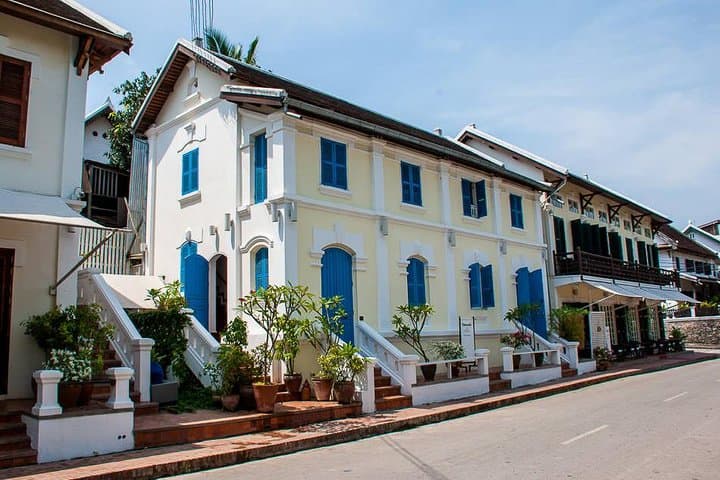
Luang Prabang’s streets keep layers of history: traditional Lao wooden homes, French-colonial mansions turned museums, and 16th–19th century wats whose mosaics and murals hold Buddhist narratives. Geologically the peninsula is a low, river-carved platform; the surrounding hills are eroded sandstone and limestone that rise green and close, framing the town’s compact scale.
Culturally, the morning alms (tak bat) is a living practice, not a photo op — guides emphasize protocol and modest participation. The Royal Palace (now a museum) preserves royal regalia and colonial-era architecture; Wat Xieng Thong remains the ceremonial heart of the old kingdom.
Practically: this four-hour tour is mostly flat walking with some temple steps and a 150 m ascent to Phousi; expect streets, short alleys and paved riverside promenades. Bring modest clothing for temple visits, small bills for entrance fees (roughly 30,000–60,000 kip per site), and water. Morning departures catch the alms and market before crowds. A local English-speaking guide will narrate history and etiquette, easing navigation and ensuring respectful engagement. For travelers who want concentrated cultural immersion with minimal logistics, this half-day walk delivers context, views and meaningful encounters with Luang Prabang’s living traditions.
easy.
3–4 hours.
Suitable for most fitness levels; requires walking on paved streets and climbing ~150 m of steps to Phousi Hill.
Yes — when approached respectfully: observe quietly, stay seated or set back, do not use flash photography, and follow your guide’s instructions to avoid disrupting the ritual.
Entrance fees for Wat Xieng Thong, the Royal Palace museum and Phousi Hill are typically not included; bring local currency (approx. 30,000–60,000 kip per site) unless noted otherwise.
Yes — the walk is gentle with short distances; Phousi Hill involves a 150 m ascent via steps, which may be skipped or paced slowly if needed.
Ask at booking — guides can advise and most small-group tours accommodate mobility limitations by adjusting the route; notify operators about dietary needs for any included offerings.
Luang Prabang was the royal capital of Laos and is a UNESCO World Heritage site; its French colonial buildings sit alongside centuries-old wats that preserve Buddhist art and royal regalia.
Tourism in Luang Prabang emphasizes cultural preservation and low-impact visits—avoid single-use plastics, decline wildlife souvenirs, and follow site rules to reduce wear on temples.
Manifa travel operates guided outdoor trips and adventures with an emphasis on safety, stewardship, and memorable experiences.



Before the sun rises over the Mekong, the streets of Luang Prabang hum with a quiet ritual: saffron-robed monks moving down narrow lanes, locals kneeling to offer sticky rice, and the river mist lifting off the water. A half-day guided walk threads through that living scene — from the peninsula where the Nam Khan meets the Mekong to the carved roofs of Wat Xieng Thong and up Phousi Hill for a broad city sweep.
Before the sun rises over the Mekong, the streets of Luang Prabang hum with a quiet ritual: saffron-robed monks moving down narrow lanes, locals kneeling to offer sticky rice, and the river mist lifting off the water. A half-day guided walk threads through that living scene — from the peninsula where the Nam Khan meets the Mekong to the carved roofs of Wat Xieng Thong and up Phousi Hill for a broad city sweep.
Luang Prabang’s streets keep layers of history: traditional Lao wooden homes, French-colonial mansions turned museums, and 16th–19th century wats whose mosaics and murals hold Buddhist narratives. Geologically the peninsula is a low, river-carved platform; the surrounding hills are eroded sandstone and limestone that rise green and close, framing the town’s compact scale.
Culturally, the morning alms (tak bat) is a living practice, not a photo op — guides emphasize protocol and modest participation. The Royal Palace (now a museum) preserves royal regalia and colonial-era architecture; Wat Xieng Thong remains the ceremonial heart of the old kingdom.
Practically: this four-hour tour is mostly flat walking with some temple steps and a 150 m ascent to Phousi; expect streets, short alleys and paved riverside promenades. Bring modest clothing for temple visits, small bills for entrance fees (roughly 30,000–60,000 kip per site), and water. Morning departures catch the alms and market before crowds. A local English-speaking guide will narrate history and etiquette, easing navigation and ensuring respectful engagement. For travelers who want concentrated cultural immersion with minimal logistics, this half-day walk delivers context, views and meaningful encounters with Luang Prabang’s living traditions.