THE ADVENTURE COLLECTIVE® · Independent discovery and booking for outdoor travel

Combine two of northern Arizona’s signature sights in a half-day outing from Page: walk the narrow, photogenic corridors of Lower Antelope Canyon with a Navajo guide, then stand above the dramatic sweep of the Colorado River at Horseshoe Bend. This guide covers what to expect, when to go, and how to prepare.
Combine two of northern Arizona’s signature sights in a half-day outing from Page: walk the narrow, photogenic corridors of Lower Antelope Canyon with a Navajo guide, then stand above the dramatic sweep of the Colorado River at Horseshoe Bend. This guide covers what to expect, when to go, and how to prepare.
You step from the parking lot into a desert of iron-red fins and sudden shadow. Lower Antelope Canyon’s ribboned walls close in like a cathedral of stone—light slices between narrow ceilings, dust motes turning into shafts of gold in the right hour. A short drive later, Horseshoe Bend opens like a map: the Colorado River tracing a perfect U, the cliff’s edge pulling you to the lip for a vertiginous view.
Verified experiences and guided adventures in the surrounding area.
You step from the parking lot into a desert of iron-red fins and sudden shadow. Lower Antelope Canyon’s ribboned walls close in like a cathedral of stone—light slices between narrow ceilings, dust motes turning into shafts of gold in the right hour. A short drive later, Horseshoe Bend opens like a map: the Colorado River tracing a perfect U, the cliff’s edge pulling you to the lip for a vertiginous view.
Geology here reads like a slow-motion film: eons of wind and flash floods carving Navajo sandstone into slot canyons and sculpting the meander that exposes 1,000 feet of river-cut cliff face. Both sites sit on or near Navajo Nation land; local guides operate canyon tours, and the landscape has deep cultural resonance and practical rules—permits, timed entries, and respect for sacred places.
Practically, expect a half-day rhythm: a guided Lower Antelope Canyon visit (roughly 45–75 minutes inside, narrow passages and stairs) plus a short hike to the Horseshoe Bend overlook (about 1–1.5 miles round-trip over sandy, exposed terrain). Summer brings intense heat and the spectacular midday light in the canyon; spring and fall offer cooler temperatures and softer lighting. Bring sturdy shoes, sun protection, plenty of water, and a camera with quick-access settings; tripods may be restricted inside the canyon. Pay attention to weather—flash floods can close slots quickly. Arrive early or mid-morning for better light and smaller crowds, and allow time for photo stops and loading between sites.
moderate.
4 hours.
You should be comfortable walking on uneven, sandy trails and climbing stairs; basic mobility is required for slot-canyon passages.
This half-day option runs about 4 hours, including drive time, a guided Lower Antelope visit (roughly 45–75 minutes inside), and the short hike to Horseshoe Bend.
Yes—photography is allowed on most guided tours, but tripods and commercial equipment may be restricted; check with the operator before bringing large gear.
No—it's a short out-and-back on sandy trail roughly 1–1.5 miles round-trip with some incline; exposure at the overlook requires caution near the rim.
Lower Antelope Canyon includes narrow passages and stairs, so it’s generally not wheelchair accessible; Horseshoe Bend has limited accessibility from the parking area but uneven ground near the overlook can be challenging.
These canyons form on Navajo Nation land; slot canyons were carved by flash floods through Navajo sandstone and tours are run under Navajo jurisdiction and guidance.
The area is ecologically fragile—stay on designated paths, avoid touching delicate walls, pack out all trash, and follow Navajo Nation rules to minimize impact.
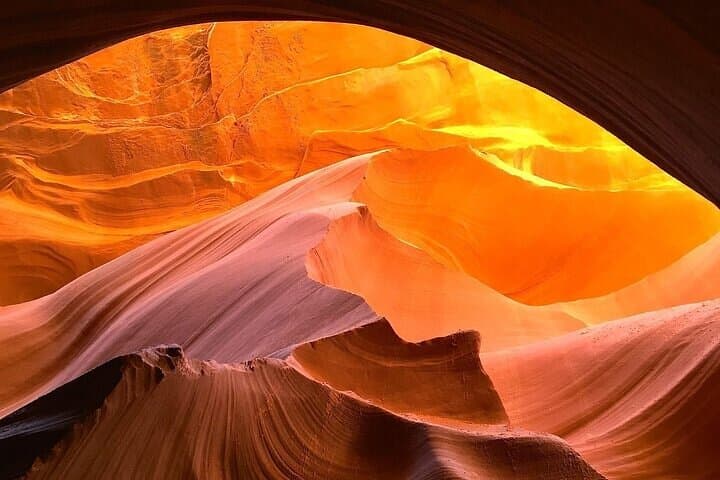
You step from the parking lot into a desert of iron-red fins and sudden shadow. Lower Antelope Canyon’s ribboned walls close in like a cathedral of stone—light slices between narrow ceilings, dust motes turning into shafts of gold in the right hour. A short drive later, Horseshoe Bend opens like a map: the Colorado River tracing a perfect U, the cliff’s edge pulling you to the lip for a vertiginous view.
You step from the parking lot into a desert of iron-red fins and sudden shadow. Lower Antelope Canyon’s ribboned walls close in like a cathedral of stone—light slices between narrow ceilings, dust motes turning into shafts of gold in the right hour. A short drive later, Horseshoe Bend opens like a map: the Colorado River tracing a perfect U, the cliff’s edge pulling you to the lip for a vertiginous view.
Geology here reads like a slow-motion film: eons of wind and flash floods carving Navajo sandstone into slot canyons and sculpting the meander that exposes 1,000 feet of river-cut cliff face. Both sites sit on or near Navajo Nation land; local guides operate canyon tours, and the landscape has deep cultural resonance and practical rules—permits, timed entries, and respect for sacred places.
Practically, expect a half-day rhythm: a guided Lower Antelope Canyon visit (roughly 45–75 minutes inside, narrow passages and stairs) plus a short hike to the Horseshoe Bend overlook (about 1–1.5 miles round-trip over sandy, exposed terrain). Summer brings intense heat and the spectacular midday light in the canyon; spring and fall offer cooler temperatures and softer lighting. Bring sturdy shoes, sun protection, plenty of water, and a camera with quick-access settings; tripods may be restricted inside the canyon. Pay attention to weather—flash floods can close slots quickly. Arrive early or mid-morning for better light and smaller crowds, and allow time for photo stops and loading between sites.