THE ADVENTURE COLLECTIVE® · Independent discovery and booking for outdoor travel

Walk among monumental colonnades and royal courts on a private half-day tour of Karnak and Luxor Temples. This East Bank experience pairs deep history with practical, low-impact touring—ideal for travellers who want context, shade and short walks.
Walk among monumental colonnades and royal courts on a private half-day tour of Karnak and Luxor Temples. This East Bank experience pairs deep history with practical, low-impact touring—ideal for travellers who want context, shade and short walks.
Morning light slices between rows of stone pillars as you step into Karnak, the columns towering like a forest of carved memory. Dust shifts along flagstones under a sky that can bruise to cobalt by noon; the Nile murmurs not far to the west, an ever-present force that shaped the temples' siting and ritual life.
Verified experiences and guided adventures in the surrounding area.
Operated by The Opulence of Egypt · Luxor, Luxor Governorate
Morning light slices between rows of stone pillars as you step into Karnak, the columns towering like a forest of carved memory. Dust shifts along flagstones under a sky that can bruise to cobalt by noon; the Nile murmurs not far to the west, an ever-present force that shaped the temples' siting and ritual life.
Karnak grew over 1,500 years as an accreting complex devoted mainly to Amun-Re, Mut and Khonsu, while Luxor Temple—rebuilt by Amenhotep III and Ramesses II—served as the ceremonial heart for royal rejuvenation and the Opet Festival. The buildings sit on a floodplain of Nile-deposited silt and quarried sandstone; erosion and salt crystallization are ongoing conservational challenges that give the stone a worn, tactile honesty.
Today the East Bank is both archaeological site and living city: local merchants, mosque calls and the occasional farmer moving livestock keep the urban edge close. A guide will root the monuments in pharaonic ritual and modern life, noting features like the Sacred Lake at Karnak and the sculpted colonnades that once marked processional routes.
Practically, this half-day private tour covers both complexes in about three hours with on-site admissions included and air-conditioned transfers. Expect flat but uneven stone surfaces and short flights of steps; comfortable, closed-toe shoes and hat, sun protection and a refillable water bottle are essential. Early morning or late afternoon slots reduce heat and crowds. Photography is normally allowed but avoid flash in lit interiors and follow your guide’s cue around sensitive reliefs. Respect restricted barriers, carry small local currency for tips and market purchases, and leave nothing behind—these sites are fragile and best enjoyed with care.
easy.
3 hours.
Suitable for most fitness levels; involves walking up to 2–3 km over uneven stone and short flights of steps.
This private half-day tour includes admissions to Karnak and Luxor Temples; confirm any special exhibitions or photography fees with your operator beforehand.
The listing notes wheelchair-accessible transport and sites, but accessibility within temple complexes is limited by ancient thresholds and uneven ground—check specific needs with the operator in advance.
Photography is generally allowed, but flash and tripods may be restricted in some areas to protect reliefs; follow your guide’s instructions at all times.
Tipping is customary in Egypt; consider roughly 10–15% of the tour price split between driver and guide or a modest cash thank-you based on service quality.
Karnak is an accreting complex whose monumental phases span dynasties; Luxor Temple functioned as the coronation and rejuvenation stage for pharaohs and the Opet Festival.
Tourism accelerates wear on ancient stone; follow designated paths, avoid touching reliefs and support licensed guides who promote site preservation.
The Opulence of Egypt operates guided outdoor trips and adventures with an emphasis on safety, stewardship, and memorable experiences.
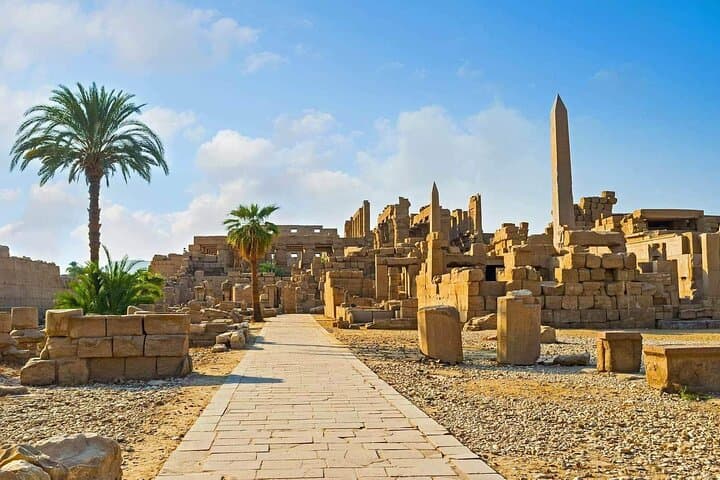
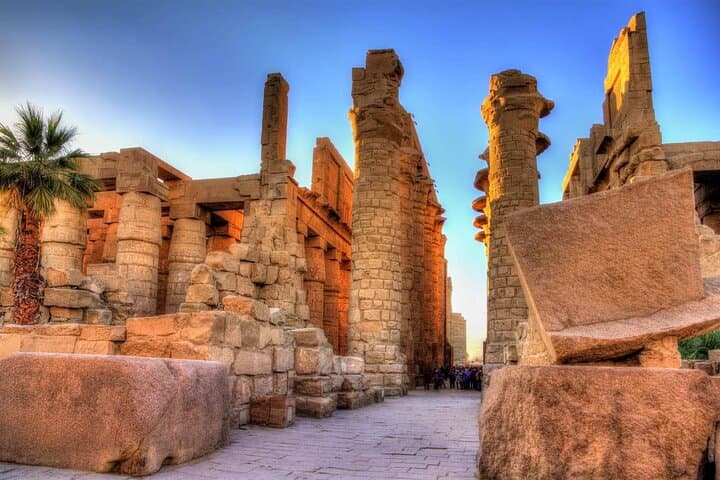
Morning light slices between rows of stone pillars as you step into Karnak, the columns towering like a forest of carved memory. Dust shifts along flagstones under a sky that can bruise to cobalt by noon; the Nile murmurs not far to the west, an ever-present force that shaped the temples' siting and ritual life.
Morning light slices between rows of stone pillars as you step into Karnak, the columns towering like a forest of carved memory. Dust shifts along flagstones under a sky that can bruise to cobalt by noon; the Nile murmurs not far to the west, an ever-present force that shaped the temples' siting and ritual life.
Karnak grew over 1,500 years as an accreting complex devoted mainly to Amun-Re, Mut and Khonsu, while Luxor Temple—rebuilt by Amenhotep III and Ramesses II—served as the ceremonial heart for royal rejuvenation and the Opet Festival. The buildings sit on a floodplain of Nile-deposited silt and quarried sandstone; erosion and salt crystallization are ongoing conservational challenges that give the stone a worn, tactile honesty.
Today the East Bank is both archaeological site and living city: local merchants, mosque calls and the occasional farmer moving livestock keep the urban edge close. A guide will root the monuments in pharaonic ritual and modern life, noting features like the Sacred Lake at Karnak and the sculpted colonnades that once marked processional routes.
Practically, this half-day private tour covers both complexes in about three hours with on-site admissions included and air-conditioned transfers. Expect flat but uneven stone surfaces and short flights of steps; comfortable, closed-toe shoes and hat, sun protection and a refillable water bottle are essential. Early morning or late afternoon slots reduce heat and crowds. Photography is normally allowed but avoid flash in lit interiors and follow your guide’s cue around sensitive reliefs. Respect restricted barriers, carry small local currency for tips and market purchases, and leave nothing behind—these sites are fragile and best enjoyed with care.