THE ADVENTURE COLLECTIVE® · Independent discovery and booking for outdoor travel

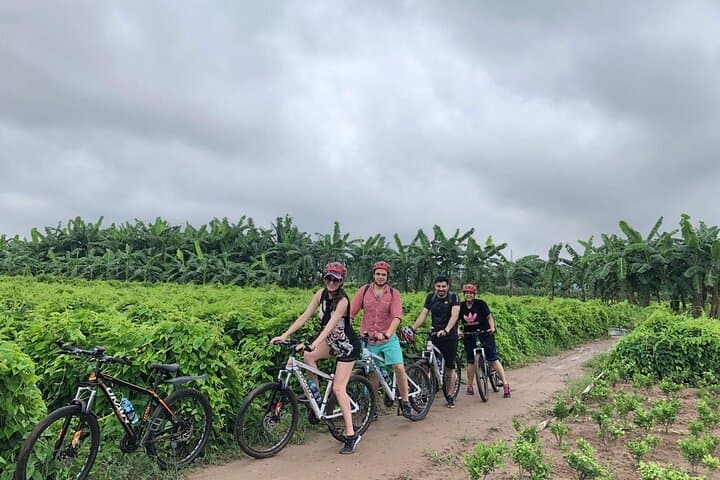
Ride from Hanoi’s frenetic Old Quarter across Long Bien Bridge to banana plantations and floating-pen villages. This 2–3 hour half-day bike tour mixes history, local markets, and riverside scenery for an eye-opening city-to-countryside loop.
Ride from Hanoi’s frenetic Old Quarter across Long Bien Bridge to banana plantations and floating-pen villages. This 2–3 hour half-day bike tour mixes history, local markets, and riverside scenery for an eye-opening city-to-countryside loop.
Morning light slices through Hanoi’s narrow alleys as you clip into a city bike and roll out from the Old Quarter.
You push past vendors setting up, the air smelling of coffee and frying dough, and the traffic hum parts around your group. Soon the city’s pulse loosens into the steady rhythm of Long Bien Bridge and the Red River, which seems to dare you to look up from the handlebars and keep going.
Verified experiences and guided adventures in the surrounding area.
Operated by Authentic HALONG · Hanoi, Hanoi
Morning light slices through Hanoi’s narrow alleys as you clip into a city bike and roll out from the Old Quarter.
You push past vendors setting up, the air smelling of coffee and frying dough, and the traffic hum parts around your group. Soon the city’s pulse loosens into the steady rhythm of Long Bien Bridge and the Red River, which seems to dare you to look up from the handlebars and keep going.
This half-day ride threads modern Hanoi with layers of history: the 1902 Long Bien Bridge—built by the same engineers behind iconic European ironwork—the thousand-year-plus Tran Quoc Pagoda, and tram-lined Reunification Train Street where residents live centimeters from the track. Geologically the route follows the Red River’s floodplain; soils and small canals feed the banana and vegetable plots you’ll pass on Banana Island and in Ngoc Ha flower village.
Culturally this is a front-row seat to daily Vietnamese life: market bargaining, shrine offerings, and riverside repair yards. Guides point out local rituals and the old colonial architecture framed by modern scooters.
Practical guidance: the tour is 2–3 hours over mostly flat, paved and compacted dirt paths with short, slow stretches through narrow alleys—basic bike handling and road awareness are required. Wear closed-toe shoes, carry sun protection, and expect quick weather changes in the wet season. Helmets are provided; bring a small camera and modest conduct when passing markets and homes. Plan for early morning starts to avoid midday heat and to catch the city in motion.
easy.
2–3 hours.
Suitable for most fitness levels; you should be comfortable riding a bike for several continuous kilometers and navigating slow urban traffic.
Yes—this tour assumes basic bicycle skills; guides will cover street-crossing and local rules but won’t provide continual one-on-one instruction.
Yes, helmets and bicycles are included and sized at the bike garage before departure.
The tour is family-friendly but depends on a child’s confidence on a bike; infants must sit on an adult’s lap and organizers will advise on safety options.
Short showers are common; the tour may proceed in light rain—check cancellation terms for heavy-weather policies and consider bringing a waterproof layer.
Long Bien Bridge (1902) and Tran Quoc Pagoda (over 1,500 years old) anchor a route where colonial, imperial, and modern Hanoi intersect.
Stay on designated paths, avoid tossing plastics near canals, and buy snacks from local vendors to support neighborhood livelihoods; the Red River floodplain is ecologically sensitive to litter and runoff.
Authentic HALONG operates guided outdoor trips and adventures with an emphasis on safety, stewardship, and memorable experiences.



Morning light slices through Hanoi’s narrow alleys as you clip into a city bike and roll out from the Old Quarter.
You push past vendors setting up, the air smelling of coffee and frying dough, and the traffic hum parts around your group. Soon the city’s pulse loosens into the steady rhythm of Long Bien Bridge and the Red River, which seems to dare you to look up from the handlebars and keep going.
Morning light slices through Hanoi’s narrow alleys as you clip into a city bike and roll out from the Old Quarter.
You push past vendors setting up, the air smelling of coffee and frying dough, and the traffic hum parts around your group. Soon the city’s pulse loosens into the steady rhythm of Long Bien Bridge and the Red River, which seems to dare you to look up from the handlebars and keep going.
This half-day ride threads modern Hanoi with layers of history: the 1902 Long Bien Bridge—built by the same engineers behind iconic European ironwork—the thousand-year-plus Tran Quoc Pagoda, and tram-lined Reunification Train Street where residents live centimeters from the track. Geologically the route follows the Red River’s floodplain; soils and small canals feed the banana and vegetable plots you’ll pass on Banana Island and in Ngoc Ha flower village.
Culturally this is a front-row seat to daily Vietnamese life: market bargaining, shrine offerings, and riverside repair yards. Guides point out local rituals and the old colonial architecture framed by modern scooters.
Practical guidance: the tour is 2–3 hours over mostly flat, paved and compacted dirt paths with short, slow stretches through narrow alleys—basic bike handling and road awareness are required. Wear closed-toe shoes, carry sun protection, and expect quick weather changes in the wet season. Helmets are provided; bring a small camera and modest conduct when passing markets and homes. Plan for early morning starts to avoid midday heat and to catch the city in motion.