THE ADVENTURE COLLECTIVE® · Independent discovery and booking for outdoor travel

Walk stretches of Hadrian’s Wall with a guide, visit a Milecastle and the Vindolanda Museum, and learn the Roman and native perspectives on Britain’s northern frontier—all in a focused half-day.
Walk stretches of Hadrian’s Wall with a guide, visit a Milecastle and the Vindolanda Museum, and learn the Roman and native perspectives on Britain’s northern frontier—all in a focused half-day.
You step out onto cold, wind-scrubbed moorland and the wall appears—a straight, deliberate cut across the horizon, stones laid by soldiers two millennia ago. The air smells of peat and metal; distant sheep punctuate the hush as your guide points to a low, square ruin where a Milecastle once watched the crossing.
Verified experiences and guided adventures in the surrounding area.
Operated by Ancient Britain · Bardon Mill, Northumberland
You step out onto cold, wind-scrubbed moorland and the wall appears—a straight, deliberate cut across the horizon, stones laid by soldiers two millennia ago. The air smells of peat and metal; distant sheep punctuate the hush as your guide points to a low, square ruin where a Milecastle once watched the crossing.
Hadrian’s Wall was ordered by Emperor Hadrian in AD 122 as the northern frontier of Roman Britain. The stones trace an ancient geopolitical line across Carboniferous sandstone and shale, riding the top of the Whin Sill—a hard dolerite intrusion that produces the crags and broad views characteristic of Northumberland.
Vindolanda, included on this half-day route, is one of the best-preserved Roman forts and a source of personal artifacts and writing tablets that illuminate everyday life at the frontier. Local culture still carries that borderland character: hardy farmers, small villages, and a museum that emphasizes archaeology and conservation.
Practical guidance: this is a walking-rich tour with vehicle transfers between viewpoints; expect uneven ground, short steep sections and open exposure to wind. Wear sturdy boots and layered clothing; bring water and a rain layer even in summer. Photography windows are frequent—your guide times stops for light and interpretation.
Timing matters: morning light lifts the moorland; late afternoon can be windy and low-angled. Transport between Cawfields and Vindolanda is not included—arrange a taxi or follow in your own vehicle. The tour balances vivid on-site storytelling with archaeology, making it efficient for anyone wanting a compact, interpretive encounter with Hadrian’s Wall.
moderate.
4–5 hours.
Moderate fitness needed for repeated short walks over uneven terrain; able to walk 3–5 miles with stops.
No—transport is not included; the operator can advise on local taxi services or you can follow in your own vehicle.
Yes, entry to Vindolanda is included with this tour’s ticket price.
Families and older travelers can join if they have moderate mobility; those with serious spinal, heart, or pregnancy-related restrictions are advised not to participate.
The tour may be cancelled for severe weather; full refunds are available if cancelled at least 24 hours before departure per the operator’s policy.
Hadrian’s Wall was begun in AD 122 as a Roman northern boundary; Vindolanda has yielded leather, letters and wooden artifacts that reveal daily life at the fort.
Stick to marked paths to limit erosion on fragile peat and stone; supporting the museum helps fund local digs and preservation.
Ancient Britain operates guided outdoor trips and adventures with an emphasis on safety, stewardship, and memorable experiences.
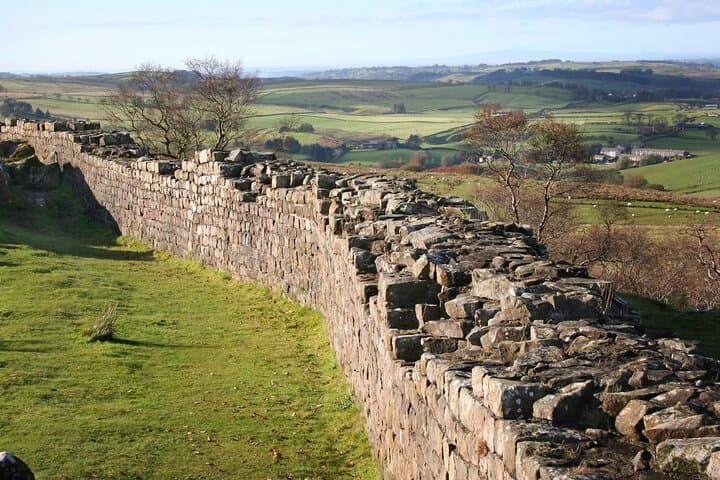
You step out onto cold, wind-scrubbed moorland and the wall appears—a straight, deliberate cut across the horizon, stones laid by soldiers two millennia ago. The air smells of peat and metal; distant sheep punctuate the hush as your guide points to a low, square ruin where a Milecastle once watched the crossing.
You step out onto cold, wind-scrubbed moorland and the wall appears—a straight, deliberate cut across the horizon, stones laid by soldiers two millennia ago. The air smells of peat and metal; distant sheep punctuate the hush as your guide points to a low, square ruin where a Milecastle once watched the crossing.
Hadrian’s Wall was ordered by Emperor Hadrian in AD 122 as the northern frontier of Roman Britain. The stones trace an ancient geopolitical line across Carboniferous sandstone and shale, riding the top of the Whin Sill—a hard dolerite intrusion that produces the crags and broad views characteristic of Northumberland.
Vindolanda, included on this half-day route, is one of the best-preserved Roman forts and a source of personal artifacts and writing tablets that illuminate everyday life at the frontier. Local culture still carries that borderland character: hardy farmers, small villages, and a museum that emphasizes archaeology and conservation.
Practical guidance: this is a walking-rich tour with vehicle transfers between viewpoints; expect uneven ground, short steep sections and open exposure to wind. Wear sturdy boots and layered clothing; bring water and a rain layer even in summer. Photography windows are frequent—your guide times stops for light and interpretation.
Timing matters: morning light lifts the moorland; late afternoon can be windy and low-angled. Transport between Cawfields and Vindolanda is not included—arrange a taxi or follow in your own vehicle. The tour balances vivid on-site storytelling with archaeology, making it efficient for anyone wanting a compact, interpretive encounter with Hadrian’s Wall.