THE ADVENTURE COLLECTIVE® · Independent discovery and booking for outdoor travel

See the Great Pyramids, Sphinx and Valley Temple in a focused half-day that pairs expert commentary with a short camel ride across the plateau. Ideal for travelers short on time who want close-up views and contextual history delivered by a private Egyptologist guide.
See the Great Pyramids, Sphinx and Valley Temple in a focused half-day that pairs expert commentary with a short camel ride across the plateau. Ideal for travelers short on time who want close-up views and contextual history delivered by a private Egyptologist guide.
You step out of the car and the desert air pushes against you — warm, dry, filled with the scent of sun-baked limestone. The three great pyramids rise ahead, block by block, their angles catching light like the pages of a history book. A camel handler leads a patient dromedary; the animal’s slow, rolling gait contrasts with the sudden scale of the monuments.
Verified experiences and guided adventures in the surrounding area.
Operated by Tours of Cairo · Giza, Giza Governorate
You step out of the car and the desert air pushes against you — warm, dry, filled with the scent of sun-baked limestone. The three great pyramids rise ahead, block by block, their angles catching light like the pages of a history book. A camel handler leads a patient dromedary; the animal’s slow, rolling gait contrasts with the sudden scale of the monuments.
These monuments sit on the Giza Plateau, a raised shelf of Cenozoic limestone on the western edge of the Nile floodplain. The Great Pyramid of Khufu (today ~139 m tall), Khafre (~136 m) and Menkaure (~66 m) were built from massive limestone and granite blocks quarried nearby; the Valley Temple retains polished Aswan granite that hints at ancient ritual. Centuries of human activity have layered the site with stories — grave goods, funerary processions and the later gaze of archaeologists and travelers.
Expect mostly flat walking across compacted sand and uneven flagstones; distances between monuments are measured in hundreds of meters rather than kilometers, but sun and reflective stone make shade scarce. Your Egyptologist guide will unpack construction techniques, religious function and modern conservation efforts while you pause for photos from the panoramic plateau and a short camel ride with the pyramids as a backdrop.
Practical notes: schedule morning or late afternoon for cooler light, wear closed-toe shoes and sun protection, carry a refillable water bottle, and budget time for security checks and short walks between points. Tipping for handlers and guides is customary and supports local livelihoods.
easy.
6 hours.
Suitable for travelers of average fitness; mostly short walks with standing and some mild uneven terrain.
Camel rides included with tours are typically short photo-friendly loops of 10–20 minutes across the plateau, timed to provide views without prolonged desert exposure.
This private tour usually includes transfers and guide services; check the booking details for entrance fee coverage as policies vary by operator.
No — the route involves short walks and flat terrain, though you should be steady on your feet for uneven stones and steps.
Some pyramids have internal chambers open to visitors with separate entry tickets and limited access; availability can change due to conservation or crowd control.
The Giza Plateau was developed as a royal necropolis in the Fourth Dynasty (c. 2600–2500 BCE); the pyramids functioned as tombs and statements of state power, with associated temples and processional routes.
Visitors contribute to the site’s economy but also to wear on ancient stone; follow marked paths, avoid climbing on monuments, and use authorized guides to support regulated access.
Tours of Cairo operates guided outdoor trips and adventures with an emphasis on safety, stewardship, and memorable experiences.


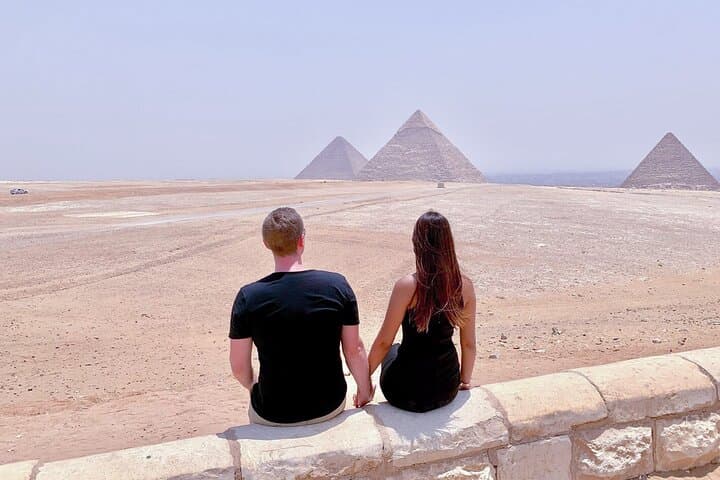
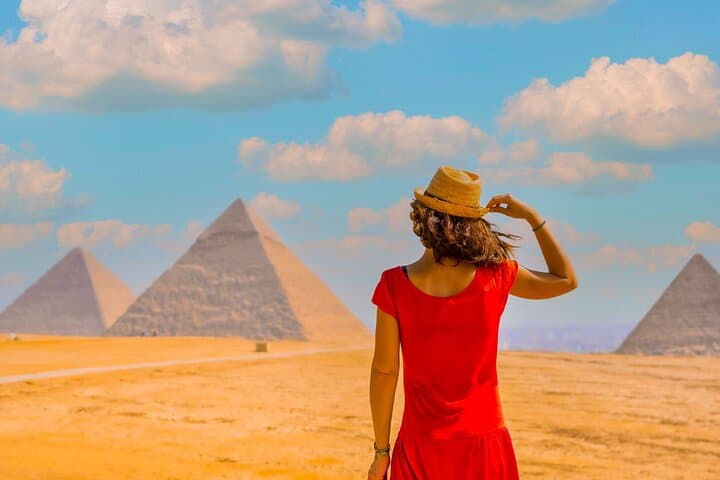
You step out of the car and the desert air pushes against you — warm, dry, filled with the scent of sun-baked limestone. The three great pyramids rise ahead, block by block, their angles catching light like the pages of a history book. A camel handler leads a patient dromedary; the animal’s slow, rolling gait contrasts with the sudden scale of the monuments.
You step out of the car and the desert air pushes against you — warm, dry, filled with the scent of sun-baked limestone. The three great pyramids rise ahead, block by block, their angles catching light like the pages of a history book. A camel handler leads a patient dromedary; the animal’s slow, rolling gait contrasts with the sudden scale of the monuments.
These monuments sit on the Giza Plateau, a raised shelf of Cenozoic limestone on the western edge of the Nile floodplain. The Great Pyramid of Khufu (today ~139 m tall), Khafre (~136 m) and Menkaure (~66 m) were built from massive limestone and granite blocks quarried nearby; the Valley Temple retains polished Aswan granite that hints at ancient ritual. Centuries of human activity have layered the site with stories — grave goods, funerary processions and the later gaze of archaeologists and travelers.
Expect mostly flat walking across compacted sand and uneven flagstones; distances between monuments are measured in hundreds of meters rather than kilometers, but sun and reflective stone make shade scarce. Your Egyptologist guide will unpack construction techniques, religious function and modern conservation efforts while you pause for photos from the panoramic plateau and a short camel ride with the pyramids as a backdrop.
Practical notes: schedule morning or late afternoon for cooler light, wear closed-toe shoes and sun protection, carry a refillable water bottle, and budget time for security checks and short walks between points. Tipping for handlers and guides is customary and supports local livelihoods.