THE ADVENTURE COLLECTIVE® · Independent discovery and booking for outdoor travel

See Buenos Aires’ best in a focused half-day: cobbled San Telmo, the painted houses of La Boca and modern Puerto Madero, led by a bilingual guide. Ideal for cruise passengers or anyone short on time.
See Buenos Aires’ best in a focused half-day: cobbled San Telmo, the painted houses of La Boca and modern Puerto Madero, led by a bilingual guide. Ideal for cruise passengers or anyone short on time.
The tour begins with the crunch of cobblestones underfoot in San Telmo, the air carrying the faint tang of the Río de la Plata and the distant rhythm of a bandoneón. Small groups fold into an air-conditioned vehicle and move through avenues that mark Buenos Aires’ layered past—colonial plazas, European-inspired boulevards and waterfront redevelopment.
Verified experiences and guided adventures in the surrounding area.
Operated by Baires Adventures · Buenos Aires, Buenos Aires
The tour begins with the crunch of cobblestones underfoot in San Telmo, the air carrying the faint tang of the Río de la Plata and the distant rhythm of a bandoneón. Small groups fold into an air-conditioned vehicle and move through avenues that mark Buenos Aires’ layered past—colonial plazas, European-inspired boulevards and waterfront redevelopment.
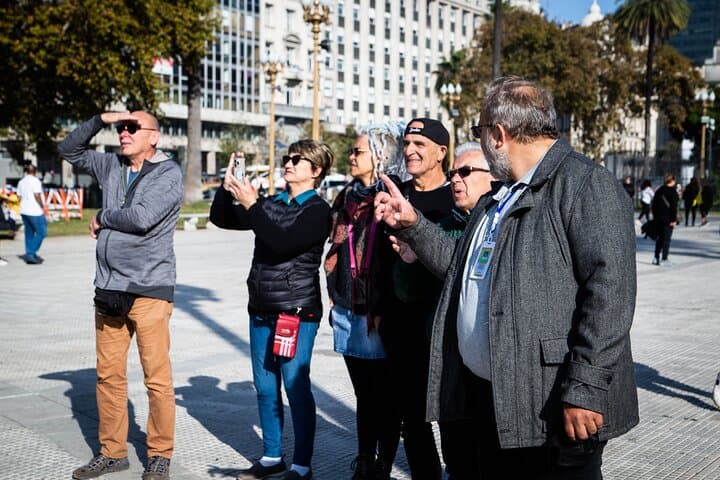
Colonial history is visible in Plaza de Mayo and the pink facade of the Casa Rosada; Avenida de Mayo maps the city’s turn-of-the-century ambitions, while La Boca’s Caminito preserves the working-class, immigrant art that shaped the port neighborhoods. Geologically the plain is part of the Río de la Plata estuary and Pampas lowlands—flat, wind-exposed terrain that shaped the city’s grid and port economy.
Culturally this is a city of tango and fútbol: photo stops at La Bombonera and the colorful promenade give context to both. The Ateneo Grand Splendid offers a contrast—a restored theater turned library where local life slows.
Practically, expect four hours with short on-foot segments (15–60 minutes) and guided commentary in English and Spanish. The small-group format keeps movement efficient for cruise passengers or short-stay visitors; guides manage photo stops and accessibility needs. Pack sun protection, a light jacket for river breezes, and comfortable shoes for uneven streets. Be mindful of pickpockets in crowded markets, and build time into your schedule for traffic returning to ports or hotels. This is a compact primer on Buenos Aires—social history, visual color and easy walking that readies visitors for deeper exploration.
easy.
3–4 hours.
Light fitness—suitable for most travelers; expect several short walks and some standing for photos.
The tour lasts about four hours with short on-foot stops ranging from 15 to 60 minutes; most of the route is covered by air-conditioned vehicle between photo stops.
Yes—this small-group, timed itinerary is designed to fit port schedules, but allow extra transit time for traffic when returning to terminals.
No—this tour focuses on guided photo stops and commentary; admissions (if desired) are typically paid on-site and optional.
The tour notes wheelchair-accessible transportation and routes, but accessibility during cobblestone sections and some stops may vary—notify the operator of needs when booking.
Buenos Aires grew from a 16th-century colonial fort into a cosmopolitan capital shaped by 19th-century European immigration and port-driven commerce.
Tourists are encouraged to respect public spaces and historic sites, avoid littering, and support local guides and small businesses to sustain community tourism.
Baires Adventures operates guided outdoor trips and adventures with an emphasis on safety, stewardship, and memorable experiences.
The tour begins with the crunch of cobblestones underfoot in San Telmo, the air carrying the faint tang of the Río de la Plata and the distant rhythm of a bandoneón. Small groups fold into an air-conditioned vehicle and move through avenues that mark Buenos Aires’ layered past—colonial plazas, European-inspired boulevards and waterfront redevelopment.
The tour begins with the crunch of cobblestones underfoot in San Telmo, the air carrying the faint tang of the Río de la Plata and the distant rhythm of a bandoneón. Small groups fold into an air-conditioned vehicle and move through avenues that mark Buenos Aires’ layered past—colonial plazas, European-inspired boulevards and waterfront redevelopment.
Colonial history is visible in Plaza de Mayo and the pink facade of the Casa Rosada; Avenida de Mayo maps the city’s turn-of-the-century ambitions, while La Boca’s Caminito preserves the working-class, immigrant art that shaped the port neighborhoods. Geologically the plain is part of the Río de la Plata estuary and Pampas lowlands—flat, wind-exposed terrain that shaped the city’s grid and port economy.
Culturally this is a city of tango and fútbol: photo stops at La Bombonera and the colorful promenade give context to both. The Ateneo Grand Splendid offers a contrast—a restored theater turned library where local life slows.
Practically, expect four hours with short on-foot segments (15–60 minutes) and guided commentary in English and Spanish. The small-group format keeps movement efficient for cruise passengers or short-stay visitors; guides manage photo stops and accessibility needs. Pack sun protection, a light jacket for river breezes, and comfortable shoes for uneven streets. Be mindful of pickpockets in crowded markets, and build time into your schedule for traffic returning to ports or hotels. This is a compact primer on Buenos Aires—social history, visual color and easy walking that readies visitors for deeper exploration.