THE ADVENTURE COLLECTIVE® · Independent discovery and booking for outdoor travel

Walk from the Haight to Ocean Beach and experience Golden Gate Park’s gardens, memorials, and dunes on a 3–4 hour guided route. This guide prepares you for the sights, history, terrain, and practicalities of the park’s lesser-traveled paths.
Walk from the Haight to Ocean Beach and experience Golden Gate Park’s gardens, memorials, and dunes on a 3–4 hour guided route. This guide prepares you for the sights, history, terrain, and practicalities of the park’s lesser-traveled paths.
Fog and gulls shape the edges of this walk before your soles even meet the path. The tour opens at Haight and Stanyan, where city hum gives way to the broad green spine of Golden Gate Park; a short climb to the de Young observation tower delivers a 360° wake-up call — skyline, park canopy, and the Bay laid out like a map.
Verified experiences and guided adventures in the surrounding area.
Fog and gulls shape the edges of this walk before your soles even meet the path. The tour opens at Haight and Stanyan, where city hum gives way to the broad green spine of Golden Gate Park; a short climb to the de Young observation tower delivers a 360° wake-up call — skyline, park canopy, and the Bay laid out like a map.
Golden Gate Park is an engineered landscape carved from dunes and marshland in the late 19th century. Here the Conservatory of Flowers and the Japanese Tea Garden reflect Victorian-era plant collecting and landscape design; the National AIDS Memorial offers a quieter, contemporary layer of civic history. Geologically the park sits on windblown sand over coastal plain deposits, which is why dunes and windmills still feel integral at the western edge.
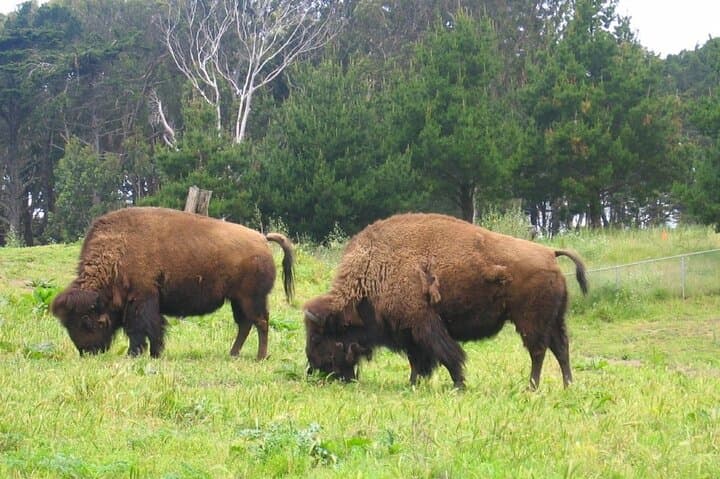
The route threads through shifting ecosystems — formal gardens, eucalyptus corridors, freshwater lakes, and the buffalo paddock where great American bison graze — giving walkers a compact survey of Bay Area biodiversity. Cultural notes are literal: murals in the Haight, memorial plaques, and the Park’s public art make history visible between benches.
Practical guidance: plan for 3–4 hours and 3–5 miles of walking on paved paths and packed dirt. Bring layered clothing for strong coastal wind and microclimates; wear supportive shoes for mixed surfaces. Expect restroom stops near major attractions, and short snack breaks at vendors. Tours end at the Dutch Windmill and Ocean Beach — a gusty, wide-open place to pause and watch the Pacific swallow the horizon.
moderate.
3–4 hours.
Comfortable walking fitness, able to cover several miles with short climbs and stairs
The tour meets at the corner of Haight Street and Stanyan Street by the park entrance across from Whole Foods.
Yes — public restrooms are at major attractions and vendors near music concourse and west-side lawns offer snacks; bring cash or card.
Only service animals are permitted on this tour and within many park facilities; check with the operator about pet policies.
Parts of the route use paved paths and plazas, but some sections include stairs or packed dirt; contact the operator for specific accessibility accommodations.
Golden Gate Park was constructed in the late 1800s on transformed sand dunes and marshes as San Francisco expanded; many plantings reflect Victorian-era botanical interests.
Park staff focus on invasive plant control and dune stabilization; visitors help by staying on trails, avoiding feeding wildlife, and packing out trash.
Fog and gulls shape the edges of this walk before your soles even meet the path. The tour opens at Haight and Stanyan, where city hum gives way to the broad green spine of Golden Gate Park; a short climb to the de Young observation tower delivers a 360° wake-up call — skyline, park canopy, and the Bay laid out like a map.
Fog and gulls shape the edges of this walk before your soles even meet the path. The tour opens at Haight and Stanyan, where city hum gives way to the broad green spine of Golden Gate Park; a short climb to the de Young observation tower delivers a 360° wake-up call — skyline, park canopy, and the Bay laid out like a map.
Golden Gate Park is an engineered landscape carved from dunes and marshland in the late 19th century. Here the Conservatory of Flowers and the Japanese Tea Garden reflect Victorian-era plant collecting and landscape design; the National AIDS Memorial offers a quieter, contemporary layer of civic history. Geologically the park sits on windblown sand over coastal plain deposits, which is why dunes and windmills still feel integral at the western edge.
The route threads through shifting ecosystems — formal gardens, eucalyptus corridors, freshwater lakes, and the buffalo paddock where great American bison graze — giving walkers a compact survey of Bay Area biodiversity. Cultural notes are literal: murals in the Haight, memorial plaques, and the Park’s public art make history visible between benches.
Practical guidance: plan for 3–4 hours and 3–5 miles of walking on paved paths and packed dirt. Bring layered clothing for strong coastal wind and microclimates; wear supportive shoes for mixed surfaces. Expect restroom stops near major attractions, and short snack breaks at vendors. Tours end at the Dutch Windmill and Ocean Beach — a gusty, wide-open place to pause and watch the Pacific swallow the horizon.