THE ADVENTURE COLLECTIVE® · Independent discovery and booking for outdoor travel

Walk The Hague at your own pace and trace the arc of Dutch power—from the Binnenhof’s chambers to the Peace Palace—using an offline app with 15 narrated stops. Ideal for first‑time visitors who want political history and city life combined.
Walk The Hague at your own pace and trace the arc of Dutch power—from the Binnenhof’s chambers to the Peace Palace—using an offline app with 15 narrated stops. Ideal for first‑time visitors who want political history and city life combined.
The spires of the Binnenhof cut a precise silhouette against The Hague’s cool sky as you begin a self-paced loop through centuries of Dutch power.
Verified experiences and guided adventures in the surrounding area.
Operated by Tourific · The Hague, South Holland
The spires of the Binnenhof cut a precise silhouette against The Hague’s cool sky as you begin a self-paced loop through centuries of Dutch power.
Start at the transport hub and let broad avenues and reflective ponds guide you past parliamentary chambers, the King’s working palace and the somber stone of the Peace Palace. Squares that once hosted public proclamations now host coffee tables and conversations; the city’s civic pulse is visible in placards and pavement alike.
The Hague’s story is political geography—medieval meetings at the Binnenhof, 17th‑century statesmen like Johan de Witt and the later arrival of international law institutions. The city’s layout reflects sand dunes and reclaimed land; canals and ponds mirror the layered changes in Dutch governance and trade. Cultural notes pop up in unexpected places: a 19th‑century covered arcade, embassy-lined avenues and cafés where political debates continue over local beer.
Practical navigation is straightforward: the route links 15 stops over roughly 1.5–2 hours of walking with an offline-enabled app so you can pause for museums, cafés or the occasional protest. Expect mostly paved city streets, short flights of steps and easy gradients—suitable for nearly every fitness level.
Bring weatherproof layers, a charged phone for maps and the patience to watch local life—bicycles and trams move fast and demand awareness. This self-guided walk is both a primer on Dutch statecraft and an urban stroll that lets history and the present-day city meet on the same pavement.
easy.
1.5–2 hours.
Suitable for all fitness levels; mostly flat walking on paved surfaces
The guided route covers 15 stops and takes about 1.5–2 hours at a steady pace; you can pause for museums, cafés or detours whenever you like.
No—once downloaded the tour works offline, though initial download requires internet and some museums may need online tickets.
Yes—routes are on paved streets and squares; some narrow alleys and steps may require folding a stroller or choosing alternate paths.
No—this self-guided experience provides audio and written commentary; admissions to museums or attractions are paid separately.
The Binnenhof has been a center of Dutch governance since the Middle Ages; The Hague later hosted international justice institutions, earning its reputation as a city of peace and law.
The city balances historic preservation with pedestrian-friendly design—stay on marked paths and respect museum rules to protect delicate sites.
Tourific operates guided outdoor trips and adventures with an emphasis on safety, stewardship, and memorable experiences.
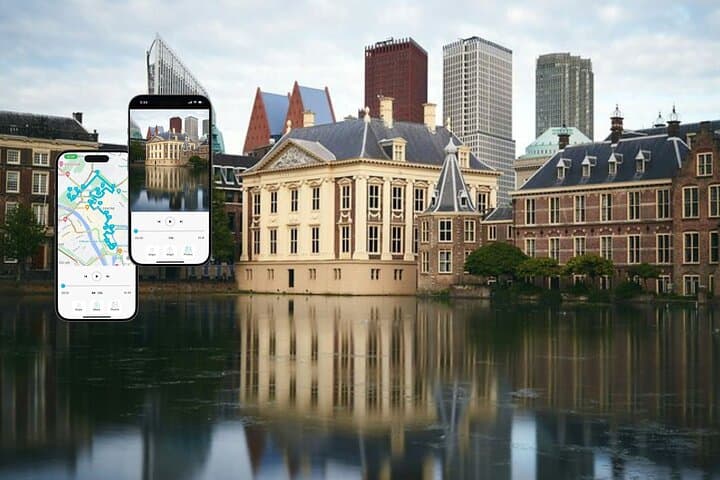


The spires of the Binnenhof cut a precise silhouette against The Hague’s cool sky as you begin a self-paced loop through centuries of Dutch power.
The spires of the Binnenhof cut a precise silhouette against The Hague’s cool sky as you begin a self-paced loop through centuries of Dutch power.
Start at the transport hub and let broad avenues and reflective ponds guide you past parliamentary chambers, the King’s working palace and the somber stone of the Peace Palace. Squares that once hosted public proclamations now host coffee tables and conversations; the city’s civic pulse is visible in placards and pavement alike.
The Hague’s story is political geography—medieval meetings at the Binnenhof, 17th‑century statesmen like Johan de Witt and the later arrival of international law institutions. The city’s layout reflects sand dunes and reclaimed land; canals and ponds mirror the layered changes in Dutch governance and trade. Cultural notes pop up in unexpected places: a 19th‑century covered arcade, embassy-lined avenues and cafés where political debates continue over local beer.
Practical navigation is straightforward: the route links 15 stops over roughly 1.5–2 hours of walking with an offline-enabled app so you can pause for museums, cafés or the occasional protest. Expect mostly paved city streets, short flights of steps and easy gradients—suitable for nearly every fitness level.
Bring weatherproof layers, a charged phone for maps and the patience to watch local life—bicycles and trams move fast and demand awareness. This self-guided walk is both a primer on Dutch statecraft and an urban stroll that lets history and the present-day city meet on the same pavement.