THE ADVENTURE COLLECTIVE® · Independent discovery and booking for outdoor travel

A private, car-based introduction to Hadrian’s Wall that stitches together Vindolanda, Housesteads, Sycamore Gap and lesser-known Roman relics. Ideal for travelers who want deep history with minimal hiking.
A private, car-based introduction to Hadrian’s Wall that stitches together Vindolanda, Housesteads, Sycamore Gap and lesser-known Roman relics. Ideal for travelers who want deep history with minimal hiking.
You ease into the passenger seat as the road climbs away from the Tyne; sheep-shorn fields slide past, dry-stone walls ticking off the miles. The guide points out a sun-bleached milestone half buried beside the road — a Roman marker that still keeps time — and you feel the frontier shifting under modern tyres.
Verified experiences and guided adventures in the surrounding area.
Operated by Curius Compass · Corbridge, Northumberland
You ease into the passenger seat as the road climbs away from the Tyne; sheep-shorn fields slide past, dry-stone walls ticking off the miles. The guide points out a sun-bleached milestone half buried beside the road — a Roman marker that still keeps time — and you feel the frontier shifting under modern tyres.
This short, private circuit threads key sites of the Roman northern march: Vindolanda’s fragile wooden tablets and Roman milestones, the exposed masonry at Housesteads, and the iconic Sycamore Gap viewpoint where a lone tree leans over the wall. Geology here is simple iron-rich sandstone heaved into crags and outcrops; the thin soils explain the wall’s stark silhouette across the moor. Culturally the laneways are layered — Roman logistics, medieval border raids by the Reivers, and 19th-century conservation by John Clayton all leave readable traces.
Expect mostly car travel with short, firm-surface walks and one permitted section of wall you can stride along. Stops are interpretive: quarries with ancient graffiti, a rare four-arch lime kiln, and a chance for brew and local banter at a Corbridge coffee van. Photography is excellent in low light; wind and changeable weather are the norm.
Practical: wear sturdy shoes for uneven stone, bring a waterproof layer and a refillable water bottle, and plan for 2–3 hours including brief stops. The tour doesn’t include entries to managed sites like Vindolanda Fort — check opening times if you want to go inside afterwards. Arrive with a sense of history and an appetite for short, revealing walks rather than long hikes.
easy.
2–3 hours.
Suitable for all fitness levels; requires short, easy walks and getting in/out of a vehicle
Yes — the tour includes a short stop at the officially permitted stretch where walking on the wall is allowed, with care and respect for the structure.
No. The tour stops at Vindolanda for interpretation and views of nearby finds but does not include admission to the museum or excavations.
No. The itinerary is car-based with short, easy walks at each stop, suitable for most mobility levels.
Yes—booking asks for special requirements; the operator can adjust stops or pace where feasible, but some sites have uneven paths.
Hadrian’s Wall marked Rome’s northern limit from AD 122; later antiquarians like John Clayton protected large sections, preventing agricultural clearance that would have erased them.
The area balances visitor access with fragile archaeology; stick to paths, avoid climbing unpermitted stretches of wall, and follow local guidance to reduce erosion and site damage.
Curius Compass operates guided outdoor trips and adventures with an emphasis on safety, stewardship, and memorable experiences.


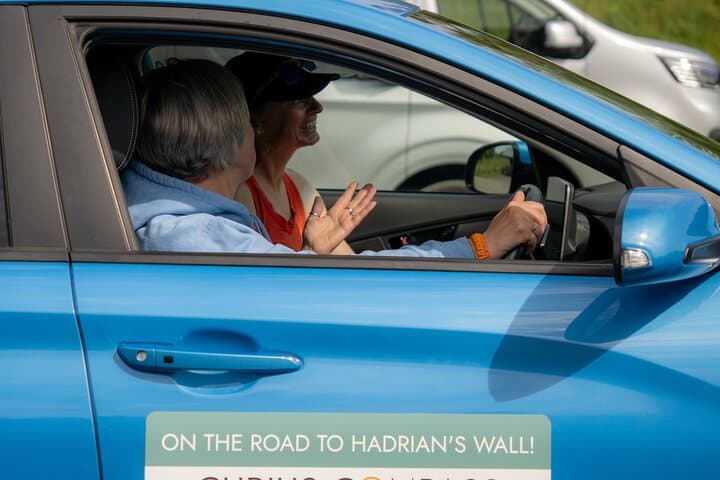

You ease into the passenger seat as the road climbs away from the Tyne; sheep-shorn fields slide past, dry-stone walls ticking off the miles. The guide points out a sun-bleached milestone half buried beside the road — a Roman marker that still keeps time — and you feel the frontier shifting under modern tyres.
You ease into the passenger seat as the road climbs away from the Tyne; sheep-shorn fields slide past, dry-stone walls ticking off the miles. The guide points out a sun-bleached milestone half buried beside the road — a Roman marker that still keeps time — and you feel the frontier shifting under modern tyres.
This short, private circuit threads key sites of the Roman northern march: Vindolanda’s fragile wooden tablets and Roman milestones, the exposed masonry at Housesteads, and the iconic Sycamore Gap viewpoint where a lone tree leans over the wall. Geology here is simple iron-rich sandstone heaved into crags and outcrops; the thin soils explain the wall’s stark silhouette across the moor. Culturally the laneways are layered — Roman logistics, medieval border raids by the Reivers, and 19th-century conservation by John Clayton all leave readable traces.
Expect mostly car travel with short, firm-surface walks and one permitted section of wall you can stride along. Stops are interpretive: quarries with ancient graffiti, a rare four-arch lime kiln, and a chance for brew and local banter at a Corbridge coffee van. Photography is excellent in low light; wind and changeable weather are the norm.
Practical: wear sturdy shoes for uneven stone, bring a waterproof layer and a refillable water bottle, and plan for 2–3 hours including brief stops. The tour doesn’t include entries to managed sites like Vindolanda Fort — check opening times if you want to go inside afterwards. Arrive with a sense of history and an appetite for short, revealing walks rather than long hikes.