THE ADVENTURE COLLECTIVE® · Independent discovery and booking for outdoor travel

Put on the goggles and join Japan’s AR sport in a brisk 15-minute session in Odaiba. Fast, accessible, and family-friendly — this AR dodgeball game is a short, tech-driven thrill perfect for travelers with tight schedules.
Put on the goggles and join Japan’s AR sport in a brisk 15-minute session in Odaiba. Fast, accessible, and family-friendly — this AR dodgeball game is a short, tech-driven thrill perfect for travelers with tight schedules.
Step into a compact arena on Odaiba’s entertainment strip and the city’s neon hum fades to the background. You strap on lightweight goggles, feel the headset settle, and the real world is overlaid with bright projectiles and virtual opponents — energy orbs that demand timing and quick feet. In three fast rounds you’ll shoot beams, dodge arcs of light, and move through a mapped playfield where every pivot matters.
Verified experiences and guided adventures in the surrounding area.
Operated by HADO 30分体験 · Tokyo, Tokyo
Step into a compact arena on Odaiba’s entertainment strip and the city’s neon hum fades to the background. You strap on lightweight goggles, feel the headset settle, and the real world is overlaid with bright projectiles and virtual opponents — energy orbs that demand timing and quick feet. In three fast rounds you’ll shoot beams, dodge arcs of light, and move through a mapped playfield where every pivot matters.
HADO launched in Japan as an accessible augmented-reality sport that blends motion play with social competition. The Odaiba venue keeps it compact: sessions are 15 minutes and coached by bilingual staff so first-timers and families can learn quickly. The technology layers inertial tracking and on-screen effects over a marked floor, producing a game that’s more about timing than raw athleticism — children as young as five and adults with limited mobility can participate.
Practicalities matter: the arena is fully indoors and wheelchair accessible, and groups of up to six play together. Expect three short rounds, a digital commemorative photo, and staff-led orientation. Peak times cluster on weekends and evenings near shopping complexes, so early bookings help avoid queues.
For travelers, Odaiba offers easy transit from central Tokyo and a compact itinerary: grab the session, then walk the bayfront after dusk when Rainbow Bridge lights up. Bring comfortable shoes and short, focused stamina — the game is sprinty but brief. Hydrate beforehand, arrive 10–15 minutes early for briefing, and treat the session as a lively tech-forward diversion rather than a workout.
easy.
15 minutes.
Suitable for most fitness levels; requires short bursts of movement and basic mobility.
The session is 15 minutes long and typically includes about three short rounds with a brief orientation.
Yes — participants aged 5 and up can join; staff provide guidance and the game emphasizes timing over physical contact.
Yes — the Odaiba facility is indoor and wheelchair accessible, but check with the operator in advance for specific assistance needs.
Staff can assist in Japanese, English, and Mandarin at many sessions, making it accessible to international visitors.
Odaiba was developed as a man-made island in the 19th and 20th centuries; today it’s a leisure and tech hub that hosts entertainment, shopping, and experimental attractions like HADO.
The venue is indoor with limited direct environmental impact, but Odaiba’s waterfront areas participate in local cleanup and coastal preservation initiatives — visitors are encouraged to respect public spaces and dispose of waste properly.
HADO 30分体験 operates guided outdoor trips and adventures with an emphasis on safety, stewardship, and memorable experiences.
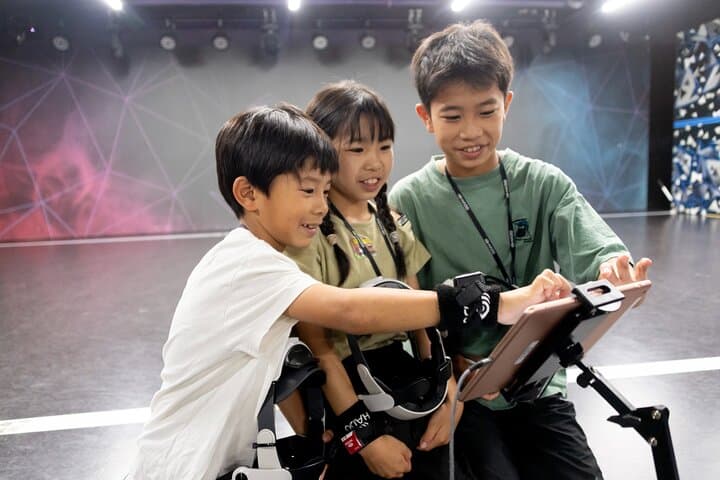


Step into a compact arena on Odaiba’s entertainment strip and the city’s neon hum fades to the background. You strap on lightweight goggles, feel the headset settle, and the real world is overlaid with bright projectiles and virtual opponents — energy orbs that demand timing and quick feet. In three fast rounds you’ll shoot beams, dodge arcs of light, and move through a mapped playfield where every pivot matters.
Step into a compact arena on Odaiba’s entertainment strip and the city’s neon hum fades to the background. You strap on lightweight goggles, feel the headset settle, and the real world is overlaid with bright projectiles and virtual opponents — energy orbs that demand timing and quick feet. In three fast rounds you’ll shoot beams, dodge arcs of light, and move through a mapped playfield where every pivot matters.
HADO launched in Japan as an accessible augmented-reality sport that blends motion play with social competition. The Odaiba venue keeps it compact: sessions are 15 minutes and coached by bilingual staff so first-timers and families can learn quickly. The technology layers inertial tracking and on-screen effects over a marked floor, producing a game that’s more about timing than raw athleticism — children as young as five and adults with limited mobility can participate.
Practicalities matter: the arena is fully indoors and wheelchair accessible, and groups of up to six play together. Expect three short rounds, a digital commemorative photo, and staff-led orientation. Peak times cluster on weekends and evenings near shopping complexes, so early bookings help avoid queues.
For travelers, Odaiba offers easy transit from central Tokyo and a compact itinerary: grab the session, then walk the bayfront after dusk when Rainbow Bridge lights up. Bring comfortable shoes and short, focused stamina — the game is sprinty but brief. Hydrate beforehand, arrive 10–15 minutes early for briefing, and treat the session as a lively tech-forward diversion rather than a workout.