THE ADVENTURE COLLECTIVE® · Independent discovery and booking for outdoor travel

Walk Trieste’s grand seafront and Habsburg-era boulevards with a local guide who connects imperial history to present-day cafés and canals. This private 2½-hour tour highlights neoclassical palaces, Borgo Teresiano, and the city’s maritime legacy.
Walk Trieste’s grand seafront and Habsburg-era boulevards with a local guide who connects imperial history to present-day cafés and canals. This private 2½-hour tour highlights neoclassical palaces, Borgo Teresiano, and the city’s maritime legacy.
The salt air of the Gulf of Trieste meets broad stone façades as you step off the cruise terminal and into Piazza Unità d'Italia — the square opens like a theatrical stage, the sea providing the final act.
Verified experiences and guided adventures in the surrounding area.
Operated by TUI Musement · Trieste, Friuli-Venezia Giulia
The salt air of the Gulf of Trieste meets broad stone façades as you step off the cruise terminal and into Piazza Unità d'Italia — the square opens like a theatrical stage, the sea providing the final act.
This private walking tour follows the traces of Habsburg ambition: imperial palaces, maritime exchanges, and the gridded Borgo Teresiano laid out in the 18th century to connect a bustling port with administrative power. Geologically, the city sits on karstified limestone that creates the abrupt cliffs and hidden springs behind the waterfront; buildings here were designed to stand against both wind and sea spray.
Along Via San Nicolò and across the Canal Grande, the guide points out neoclassical banks, the Verdi theater and merchant palaces that mark Trieste’s role as the Austro-Hungarian Empire’s fourth city. Cultural notes come through in café habits, the blend of Italian, Slovenian and Central European influences, and the city’s tradition of coffeehouses where diplomats and traders negotiated deals.
Practical guidance: the route is flat and paved but can be sheltered or windy depending on the bora; allow roughly 2½ hours, wear supportive shoes, and carry a light layer. The tour excludes paid-entry interiors, so expect exterior-focused commentary and time for photos and café stops. Ideal for travelers who want historical context delivered at a relaxed urban pace with the sea constantly at your side.
easy.
2–3 hours.
Suitable for most fitness levels; minimal inclines and steady walking pace.
The walking tour starts at the Trieste cruise port and loops through Piazza Unità d'Italia, Borgo Teresiano, Canal Grande and Via San Nicolò, finishing near Piazza Ponterosso.
No; the tour focuses on exterior architecture and public squares—entrance fees to museums or interiors are not included.
Yes; the route is mostly flat and wheelchair accessible, but let the operator know any mobility needs when booking.
This listing is for a private guided experience; group size is set per booking—confirm specifics with the operator at reservation.
Trieste grew under Habsburg rule as a free port and became the Austro-Hungarian Empire’s key Mediterranean outlet, shaping its architecture and multicultural identity.
Tourists are encouraged to stick to public paths, patronize local businesses, and avoid littering; marine efforts focus on reducing plastic in the Gulf and protecting coastal habitats.
TUI Musement operates guided outdoor trips and adventures with an emphasis on safety, stewardship, and memorable experiences.

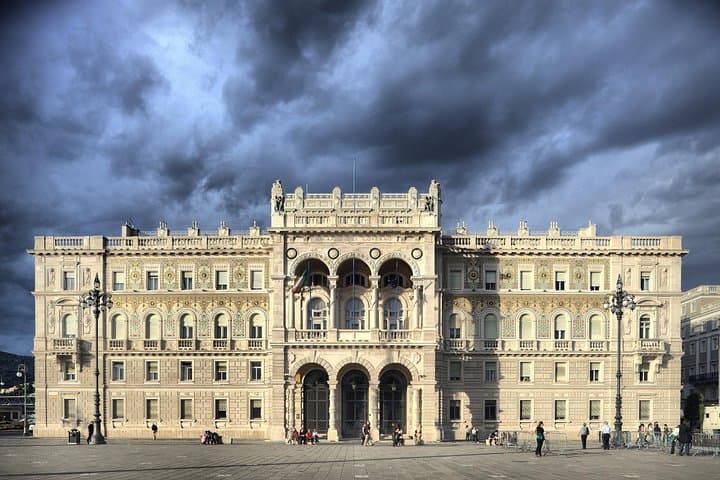


The salt air of the Gulf of Trieste meets broad stone façades as you step off the cruise terminal and into Piazza Unità d'Italia — the square opens like a theatrical stage, the sea providing the final act.
The salt air of the Gulf of Trieste meets broad stone façades as you step off the cruise terminal and into Piazza Unità d'Italia — the square opens like a theatrical stage, the sea providing the final act.
This private walking tour follows the traces of Habsburg ambition: imperial palaces, maritime exchanges, and the gridded Borgo Teresiano laid out in the 18th century to connect a bustling port with administrative power. Geologically, the city sits on karstified limestone that creates the abrupt cliffs and hidden springs behind the waterfront; buildings here were designed to stand against both wind and sea spray.
Along Via San Nicolò and across the Canal Grande, the guide points out neoclassical banks, the Verdi theater and merchant palaces that mark Trieste’s role as the Austro-Hungarian Empire’s fourth city. Cultural notes come through in café habits, the blend of Italian, Slovenian and Central European influences, and the city’s tradition of coffeehouses where diplomats and traders negotiated deals.
Practical guidance: the route is flat and paved but can be sheltered or windy depending on the bora; allow roughly 2½ hours, wear supportive shoes, and carry a light layer. The tour excludes paid-entry interiors, so expect exterior-focused commentary and time for photos and café stops. Ideal for travelers who want historical context delivered at a relaxed urban pace with the sea constantly at your side.