THE ADVENTURE COLLECTIVE® · Independent discovery and booking for outdoor travel

A five-day motorbike loop around Ha Giang delivers high mountain passes, twisting roads and close-up cultural encounters with hill-tribe villages. Expect long riding days, variable road surfaces, and remote fuel stops—rewarded by dramatic karst ridges and sweeping valley views.
A five-day motorbike loop around Ha Giang delivers high mountain passes, twisting roads and close-up cultural encounters with hill-tribe villages. Expect long riding days, variable road surfaces, and remote fuel stops—rewarded by dramatic karst ridges and sweeping valley views.
A low-slung Honda growls to life beneath a cool mountain sky as the first day of the Ha Giang loop opens. Riders leave Ha Giang city and follow ribboned roads that climb through terraced rice slopes, river-cut valleys and limestone ridges. The road bends like a question; the landscape answers with sheer passes and villages perched on puna-like benches.
Verified experiences and guided adventures in the surrounding area.
A low-slung Honda growls to life beneath a cool mountain sky as the first day of the Ha Giang loop opens. Riders leave Ha Giang city and follow ribboned roads that climb through terraced rice slopes, river-cut valleys and limestone ridges. The road bends like a question; the landscape answers with sheer passes and villages perched on puna-like benches.
This is the northern edge of Vietnam where Sino-Vietnamese history and Hmong, Tay and Dao cultures intersect. Geologically the region is carved from ancient limestone and folded bedrock—karst towers and steep river gorges that force the road to coil and drop. Small markets pulse with local trade, and hill-tribe homes sit above misty paddy fields, offering low-key cultural exchanges rather than staged performances.
Practical guidance: riders should expect 3–6 hours in the saddle per day on mixed pavement and rough sections, with steep ascents and frequent hairpins. Weather shifts quickly—mornings can be clear and afternoons rainy—so plan layers and waterproofs. Fuel stations are sparse outside major towns; carry a full tank and basic repair tools. Night stops are in guesthouses or dorm-style homestays—book or confirm space in advance during peak season.
Safety and etiquette matter: pass slowly through villages, ask before photographing people, and be conservative on blind corners. With conservative riding and basic mechanical preparedness, this five-day loop rewards persistence with wide summits, plunging river valleys and intimate cultural contact—an off-the-beaten-path ride that feels both rugged and imminently doable.
challenging.
5 days.
Moderate cardiovascular fitness and endurance for multiple daily hours of riding; ability to mount/dismount a motorcycle and handle long-seat days.
No—most operators provide quality semi-automatic or manual bikes tuned for the route; confirm model and condition before booking.
Yes—participants should have experience riding on varied surfaces and be comfortable with manual shifting, hill starts and tight switchbacks.
Fuel is available in Ha Giang and larger towns en route but scarce in remote stretches; ATMs are limited outside main towns—carry cash for fuel and homestays.
Yes—many guides speak basic English and the tour format is visual; bring a phrasebook or translation app for village interactions.
Ha Giang sits on historic borderlands with a mix of ethnic groups whose terrace farming and textiles reflect centuries of cross-border trade and localized governance.
The region faces erosion from road construction and expanding agriculture—ride responsibly, stick to paved paths where possible, and avoid single-use plastics in villages.
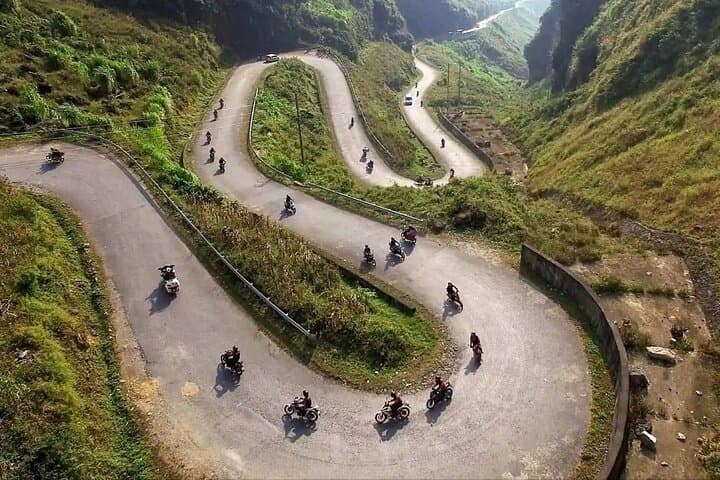
A low-slung Honda growls to life beneath a cool mountain sky as the first day of the Ha Giang loop opens. Riders leave Ha Giang city and follow ribboned roads that climb through terraced rice slopes, river-cut valleys and limestone ridges. The road bends like a question; the landscape answers with sheer passes and villages perched on puna-like benches.
A low-slung Honda growls to life beneath a cool mountain sky as the first day of the Ha Giang loop opens. Riders leave Ha Giang city and follow ribboned roads that climb through terraced rice slopes, river-cut valleys and limestone ridges. The road bends like a question; the landscape answers with sheer passes and villages perched on puna-like benches.
This is the northern edge of Vietnam where Sino-Vietnamese history and Hmong, Tay and Dao cultures intersect. Geologically the region is carved from ancient limestone and folded bedrock—karst towers and steep river gorges that force the road to coil and drop. Small markets pulse with local trade, and hill-tribe homes sit above misty paddy fields, offering low-key cultural exchanges rather than staged performances.
Practical guidance: riders should expect 3–6 hours in the saddle per day on mixed pavement and rough sections, with steep ascents and frequent hairpins. Weather shifts quickly—mornings can be clear and afternoons rainy—so plan layers and waterproofs. Fuel stations are sparse outside major towns; carry a full tank and basic repair tools. Night stops are in guesthouses or dorm-style homestays—book or confirm space in advance during peak season.
Safety and etiquette matter: pass slowly through villages, ask before photographing people, and be conservative on blind corners. With conservative riding and basic mechanical preparedness, this five-day loop rewards persistence with wide summits, plunging river valleys and intimate cultural contact—an off-the-beaten-path ride that feels both rugged and imminently doable.