THE ADVENTURE COLLECTIVE® · Independent discovery and booking for outdoor travel

Explore restored Moche temples and Trujillo’s colonial heart on a compact 4–5 hour guided tour. Visit the painted courtyards of Huaca de la Luna, then stroll Casa Urquiaga and the lively municipal market.
Explore restored Moche temples and Trujillo’s colonial heart on a compact 4–5 hour guided tour. Visit the painted courtyards of Huaca de la Luna, then stroll Casa Urquiaga and the lively municipal market.
You step out of an air-conditioned vehicle onto a sunbaked plain and the adobe walls of Huaca de la Luna rise like a painted memory — bands of red, white and ochre reliefs still telling stories of gods and ritual. The desert wind pushes across the Moche valley, stirring the fine sand and carrying the sharp smell of baked earth as your guide points to a ceremonial courtyard and explains the iconography carved into the clay.
Verified experiences and guided adventures in the surrounding area.
Operated by Viajes In Perú · Trujillo, La Libertad
You step out of an air-conditioned vehicle onto a sunbaked plain and the adobe walls of Huaca de la Luna rise like a painted memory — bands of red, white and ochre reliefs still telling stories of gods and ritual. The desert wind pushes across the Moche valley, stirring the fine sand and carrying the sharp smell of baked earth as your guide points to a ceremonial courtyard and explains the iconography carved into the clay.
The Moche built this complex between 100–800 AD from river silt and clay bricks; modern restoration began in the 1990s to stabilize polychrome friezes that record rites, warriors and human offerings. Geologically the site sits on the coastal plain just inland from the Pacific, where seasonal fog and scarce runoff shaped agricultural surpluses that funded monumental construction.
After the site visit the tour moves into Trujillo’s Plaza de Armas and colonial streets: Casa Urquiaga’s patios—where Simón Bolívar once stayed—lead to a bustling municipal market that showcases regional produce and Peruvian everyday life.
Practical guide: the itinerary runs about 4–5 hours and covers roughly a 20–25 minute drive each way from central Trujillo to the Huaca area. Expect some stairs and uneven adobe surfaces at the archaeological site; bottled water, entrance fees and a guide are included. Midday sun is strong — wear sun protection and comfortable walking shoes. The site has limited wheelchair access; follow signage, avoid touching restored reliefs and arrive early to beat crowds and heat.
easy.
4–5 hours.
Suitable for most travelers; requires short walks on uneven ground and several stair sections at the archaeological site.
The tour lasts about 4–5 hours, including transport between Trujillo and Huaca de la Luna.
Yes — entrance to Huaca de la Luna is included in the tour price.
Huaca de la Luna has limited (about 20%) wheelchair access; some areas require stairs and uneven ground.
Bottled water is provided; bring snacks if you prefer — there’s a market stop for food and drinks in Trujillo.
The Moche civilization (c.100–800 AD) built Huaca complexes as religious and administrative centers; Trujillo later became an important colonial city and a focal point in Peru’s independence movement.
Restoration work is ongoing—visitors should stay on marked paths and avoid touching painted adobe to protect pigments and fragile structures.
Viajes In Perú operates guided outdoor trips and adventures with an emphasis on safety, stewardship, and memorable experiences.


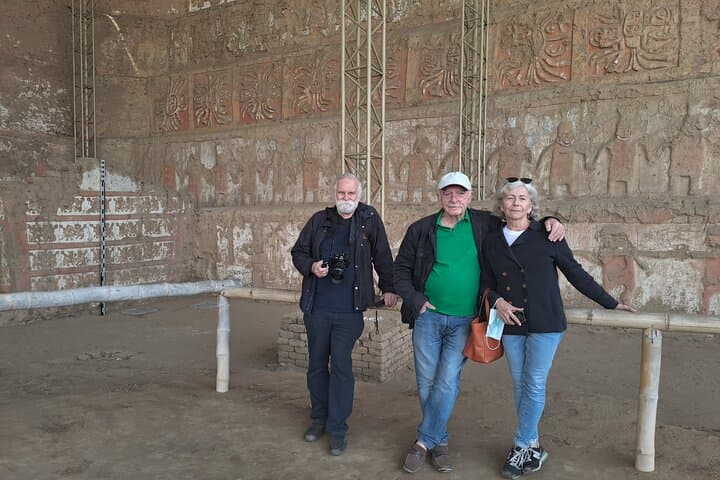

You step out of an air-conditioned vehicle onto a sunbaked plain and the adobe walls of Huaca de la Luna rise like a painted memory — bands of red, white and ochre reliefs still telling stories of gods and ritual. The desert wind pushes across the Moche valley, stirring the fine sand and carrying the sharp smell of baked earth as your guide points to a ceremonial courtyard and explains the iconography carved into the clay.
You step out of an air-conditioned vehicle onto a sunbaked plain and the adobe walls of Huaca de la Luna rise like a painted memory — bands of red, white and ochre reliefs still telling stories of gods and ritual. The desert wind pushes across the Moche valley, stirring the fine sand and carrying the sharp smell of baked earth as your guide points to a ceremonial courtyard and explains the iconography carved into the clay.
The Moche built this complex between 100–800 AD from river silt and clay bricks; modern restoration began in the 1990s to stabilize polychrome friezes that record rites, warriors and human offerings. Geologically the site sits on the coastal plain just inland from the Pacific, where seasonal fog and scarce runoff shaped agricultural surpluses that funded monumental construction.
After the site visit the tour moves into Trujillo’s Plaza de Armas and colonial streets: Casa Urquiaga’s patios—where Simón Bolívar once stayed—lead to a bustling municipal market that showcases regional produce and Peruvian everyday life.
Practical guide: the itinerary runs about 4–5 hours and covers roughly a 20–25 minute drive each way from central Trujillo to the Huaca area. Expect some stairs and uneven adobe surfaces at the archaeological site; bottled water, entrance fees and a guide are included. Midday sun is strong — wear sun protection and comfortable walking shoes. The site has limited wheelchair access; follow signage, avoid touching restored reliefs and arrive early to beat crowds and heat.