THE ADVENTURE COLLECTIVE® · Independent discovery and booking for outdoor travel

Drive out of Seattle for a full-day guided tour to Mt. Rainier’s Paradise: short guided hikes, glacier views, Narada and Christine Falls, and snowshoeing in winter when trails are white. A practical, scenic introduction to the park’s high-country highlights.
Drive out of Seattle for a full-day guided tour to Mt. Rainier’s Paradise: short guided hikes, glacier views, Narada and Christine Falls, and snowshoeing in winter when trails are white. A practical, scenic introduction to the park’s high-country highlights.
By midmorning the van grinds out of Seattle and the city’s glass and steel peel away to reveal fir-dark slopes and a sky that grows colder and clearer as Mount Rainier fills the windshield. Within two hours you’ve moved from freeway noise to a quieter world where trails push into old-growth forest, waterfalls drum the valley floor, and glaciers spill from the mountain’s upper flanks. The guide drops the doors and for a few hours the mountain does what mountains do best: it rearranges priorities.
Verified experiences and guided adventures in the surrounding area.
Operated by WOW Nature Tours - Susan Hill · Seattle, WA
By midmorning the van grinds out of Seattle and the city’s glass and steel peel away to reveal fir-dark slopes and a sky that grows colder and clearer as Mount Rainier fills the windshield. Within two hours you’ve moved from freeway noise to a quieter world where trails push into old-growth forest, waterfalls drum the valley floor, and glaciers spill from the mountain’s upper flanks. The guide drops the doors and for a few hours the mountain does what mountains do best: it rearranges priorities.
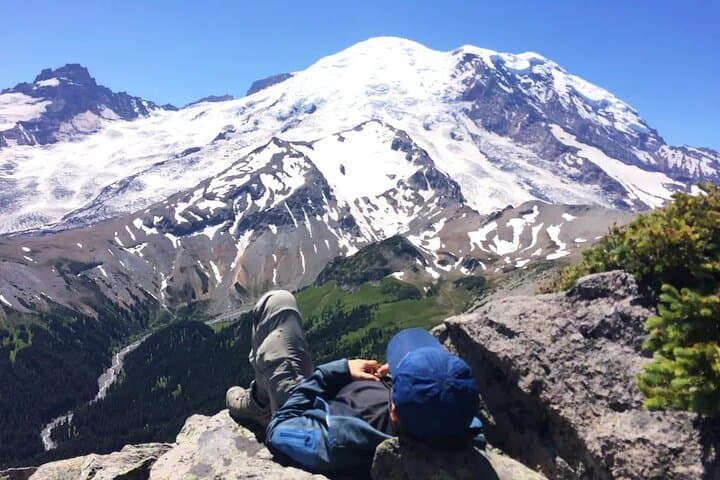
Mt. Rainier’s Paradise area sits at roughly 5,400–5,500 feet, carved by ice and volcanic fire. The mountain itself is an active stratovolcano—its glaciers and talus are geological pages that read like an atlas of Pleistocene movement and present-day melt. Indigenous Duwamish and Puyallup people have long-known routes here; later explorers and mountaineers used Paradise as a base for scientific study and alpine first ascents. Today the national park balances recreational access with fragile subalpine ecosystems, where lupine and avalanche lilies race the short summer growing season.
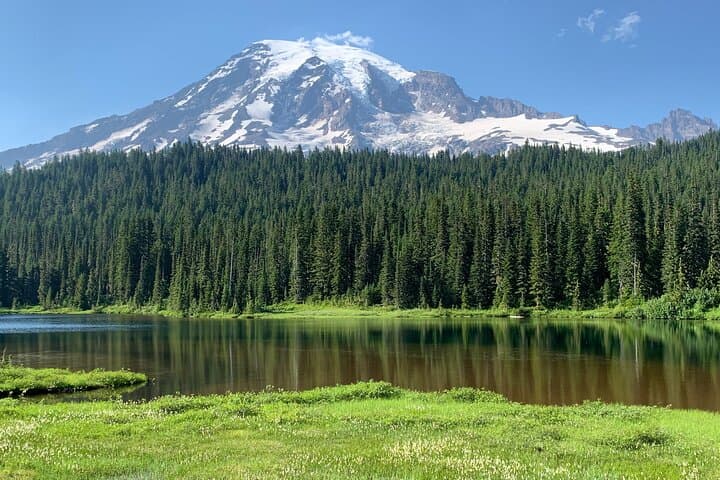
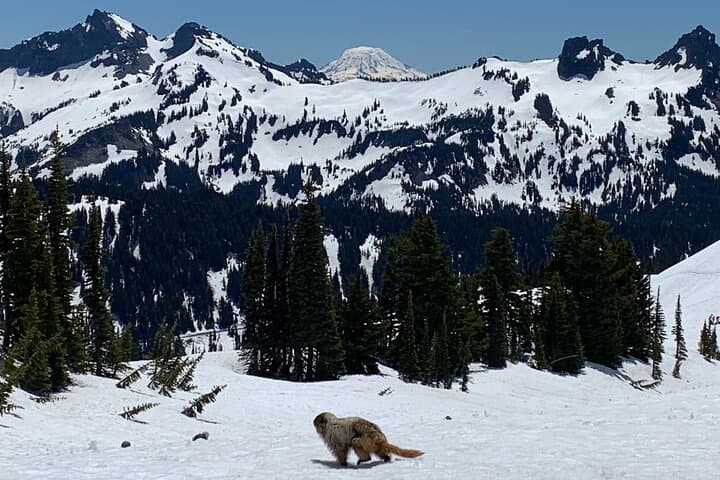
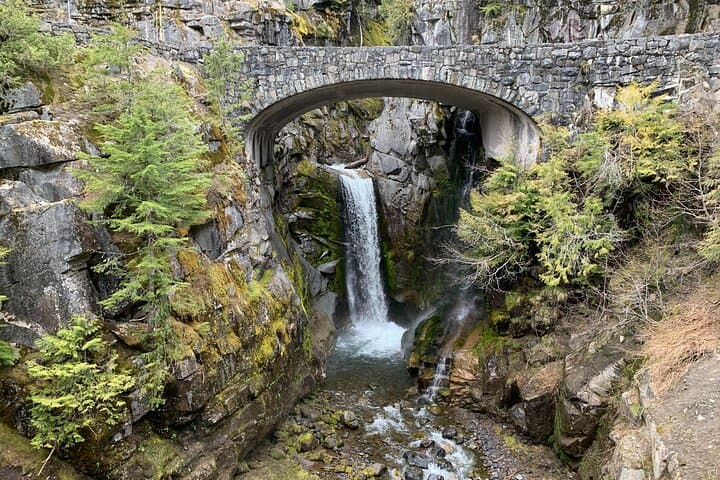
On this full-day tour you’ll hike short sections rather than linking long ridgelines: a mile on the Paradise trails near the visitor center (or snowshoeing in winter), a picnic with a glacier view, a walk to Narada Falls and a stop at Reflection Lakes and Christine Falls. The route threads between old-growth giants in Longmire and opens onto broad viewpoints where Rainier holds center stage. Guides supply crampons, snowshoes, trekking poles and bottled water when conditions call for them, so experience level is moderate rather than technical.
Practical edge: plan for big temperature swings. The Paradise zone can be sun-swept and icy in the same hour. Roads and viewpoints close seasonally—Reflection Lakes is most photogenic in summer reflections, while winter converts roads to snowfields best accessed with snowshoes. Bring layers, waterproof boots and a daypack; expect 10–11 hours including round-trip driving from Seattle.
Accessibility and safety notes are straightforward: this is a guided, moderate-level program that requires a reasonable fitness base and is not recommended for those with significant knee, hip, heart or spinal issues. Permits and park fees are part of the logistics the operator handles, but a park pass or payment method is useful to have on hand. The payoff is direct — short hikes that let you spend more time under the mountain’s gaze than on the road, with close-up waterfalls, glacier views and forest walks that show why Rainier remains the Pacific Northwest’s most magnetic peak.
moderate.
10–11 hours.
Should have a moderate fitness level: able to walk 2–3 miles on uneven terrain and handle short elevation changes at 5,400–5,500 ft.
Meet in downtown Seattle outside Sephora at 415 Pine St (near the big arch); pick-up and drop-off are in the same place, with Space Needle pickup available by request.
Yes—during November through June guides provide snowshoes or crampons as conditions require; no prior snowshoe experience is needed.
Hikes are short (about a mile near Paradise plus short walks to waterfalls and viewpoints), but the day includes driving and elevation—moderate fitness is recommended.
The operator covers fees as listed in the tour inclusions, but bringing a park pass or payment method is still a good fallback.
Child participation may be allowed but check with the operator; infant seats are available and the pace is family-friendly if children can handle short walks and a long day.
Tours may be modified or canceled for safety; the cancellation policy allows a full refund if you cancel at least 24 hours before departure or if the operator cancels due to weather.
Mount Rainier has been a sacred landmark and hunting ground for local Indigenous tribes for millennia; the national park was established in 1899 and shaped early national park policy in the Pacific Northwest.
Alpine meadows and glacier-fed systems are sensitive to trampling and climate change—stay on trails, pack out waste, and follow Leave No Trace practices to protect fragile subalpine flora.
WOW Nature Tours - Susan Hill operates guided outdoor trips and adventures with an emphasis on safety, stewardship, and memorable experiences.
By midmorning the van grinds out of Seattle and the city’s glass and steel peel away to reveal fir-dark slopes and a sky that grows colder and clearer as Mount Rainier fills the windshield. Within two hours you’ve moved from freeway noise to a quieter world where trails push into old-growth forest, waterfalls drum the valley floor, and glaciers spill from the mountain’s upper flanks. The guide drops the doors and for a few hours the mountain does what mountains do best: it rearranges priorities.
By midmorning the van grinds out of Seattle and the city’s glass and steel peel away to reveal fir-dark slopes and a sky that grows colder and clearer as Mount Rainier fills the windshield. Within two hours you’ve moved from freeway noise to a quieter world where trails push into old-growth forest, waterfalls drum the valley floor, and glaciers spill from the mountain’s upper flanks. The guide drops the doors and for a few hours the mountain does what mountains do best: it rearranges priorities.
Mt. Rainier’s Paradise area sits at roughly 5,400–5,500 feet, carved by ice and volcanic fire. The mountain itself is an active stratovolcano—its glaciers and talus are geological pages that read like an atlas of Pleistocene movement and present-day melt. Indigenous Duwamish and Puyallup people have long-known routes here; later explorers and mountaineers used Paradise as a base for scientific study and alpine first ascents. Today the national park balances recreational access with fragile subalpine ecosystems, where lupine and avalanche lilies race the short summer growing season.
On this full-day tour you’ll hike short sections rather than linking long ridgelines: a mile on the Paradise trails near the visitor center (or snowshoeing in winter), a picnic with a glacier view, a walk to Narada Falls and a stop at Reflection Lakes and Christine Falls. The route threads between old-growth giants in Longmire and opens onto broad viewpoints where Rainier holds center stage. Guides supply crampons, snowshoes, trekking poles and bottled water when conditions call for them, so experience level is moderate rather than technical.
Practical edge: plan for big temperature swings. The Paradise zone can be sun-swept and icy in the same hour. Roads and viewpoints close seasonally—Reflection Lakes is most photogenic in summer reflections, while winter converts roads to snowfields best accessed with snowshoes. Bring layers, waterproof boots and a daypack; expect 10–11 hours including round-trip driving from Seattle.
Accessibility and safety notes are straightforward: this is a guided, moderate-level program that requires a reasonable fitness base and is not recommended for those with significant knee, hip, heart or spinal issues. Permits and park fees are part of the logistics the operator handles, but a park pass or payment method is useful to have on hand. The payoff is direct — short hikes that let you spend more time under the mountain’s gaze than on the road, with close-up waterfalls, glacier views and forest walks that show why Rainier remains the Pacific Northwest’s most magnetic peak.