THE ADVENTURE COLLECTIVE® · Independent discovery and booking for outdoor travel

Spend a private day exploring Angkor’s major monuments with an English- or Spanish-speaking guide who combines archaeological research and local knowledge. This tour covers Angkor Wat, Bayon, Ta Prohm and the royal terraces with private transport and interpreter-led context.
Spend a private day exploring Angkor’s major monuments with an English- or Spanish-speaking guide who combines archaeological research and local knowledge. This tour covers Angkor Wat, Bayon, Ta Prohm and the royal terraces with private transport and interpreter-led context.
Morning light cuts across the moat like a slow blade as the visitor steps from the van and onto the wooden bridge toward Angkor Wat — stone rising from water, columns and bas-reliefs holding stories in shadow.
Verified experiences and guided adventures in the surrounding area.
Operated by Angkor wat guía en español · Siem Reap, Siem Reap Province
Morning light cuts across the moat like a slow blade as the visitor steps from the van and onto the wooden bridge toward Angkor Wat — stone rising from water, columns and bas-reliefs holding stories in shadow.
The private tour moves at a human pace: a three-level pyramid temple, towers grinning with carved faces, root-wrapped galleries where jungle and masonry argue over ownership. Guides on this route bring archaeology into the field — explaining reservoir and canal engineering that once supported a million people, the 12th-century ambitions of Suryavarman II, and the slow centuries that turned city to jungle.
Geology here is flat alluvium; sandstone, quarried and hauled, ages into warm ochre. Culture is present in small ways — saffron robes at sunrise, rice paddies reflecting sky — while conservation efforts by local authorities aim to balance access with preservation.
Practical guidance is direct: the full loop commonly takes 5–7 hours on private transport with long stretches on foot across uneven temple stones. Plan for sun, sticky humidity, and stepped platforms; terraces and narrow galleries require steady footing. Hydrate early, start at opening to avoid mid-day crowds, and bring local currency for temple passes and small purchases.
A private English- and Spanish-speaking guide will contextualize carvings, point out hydraulic works that defined Angkor’s rise, and advise respectful behavior around religious sites. For travelers seeking a concentrated, interpretive introduction to Angkor’s monuments, this private day tour delivers historical depth and on-the-ground logistics without the rush.
easy.
5–7 hours.
Suitable for travelers in average condition; expect multiple short walks on uneven stone and some steps
No; Angkor Park entry passes are typically purchased separately on arrival — your guide or driver can advise where to buy them.
Yes; this private tour provides guides fluent in English and Spanish as advertised.
Yes; the route is family-friendly, though many temple interiors have steps and uneven floors that complicate stroller use.
Expect several short to moderate walks at each temple (up to a few kilometers total across the day) with periods of driving between sites.
Angkor was the heart of the Khmer Empire from the 9th to 15th centuries; Angkor Wat was built in the early 12th century as a state temple and mausoleum for King Suryavarman II.
High visitor numbers stress fragile stone and bas-reliefs; follow your guide’s routes, avoid touching carvings, and support local conservation efforts through respectful tourism.
Angkor wat guía en español operates guided outdoor trips and adventures with an emphasis on safety, stewardship, and memorable experiences.
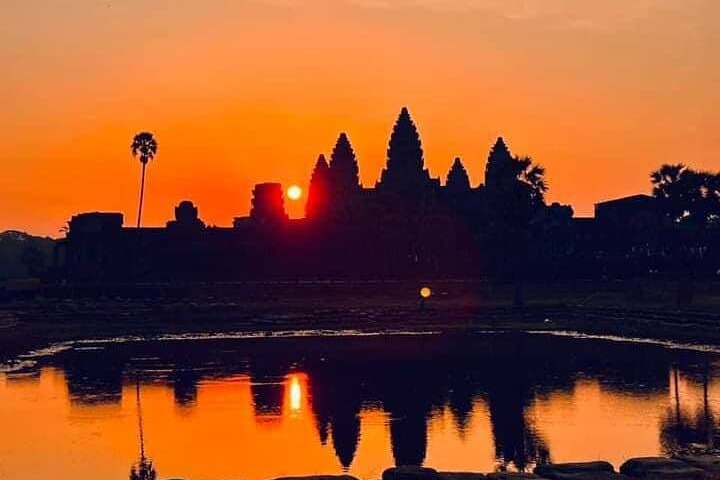
Morning light cuts across the moat like a slow blade as the visitor steps from the van and onto the wooden bridge toward Angkor Wat — stone rising from water, columns and bas-reliefs holding stories in shadow.
Morning light cuts across the moat like a slow blade as the visitor steps from the van and onto the wooden bridge toward Angkor Wat — stone rising from water, columns and bas-reliefs holding stories in shadow.
The private tour moves at a human pace: a three-level pyramid temple, towers grinning with carved faces, root-wrapped galleries where jungle and masonry argue over ownership. Guides on this route bring archaeology into the field — explaining reservoir and canal engineering that once supported a million people, the 12th-century ambitions of Suryavarman II, and the slow centuries that turned city to jungle.
Geology here is flat alluvium; sandstone, quarried and hauled, ages into warm ochre. Culture is present in small ways — saffron robes at sunrise, rice paddies reflecting sky — while conservation efforts by local authorities aim to balance access with preservation.
Practical guidance is direct: the full loop commonly takes 5–7 hours on private transport with long stretches on foot across uneven temple stones. Plan for sun, sticky humidity, and stepped platforms; terraces and narrow galleries require steady footing. Hydrate early, start at opening to avoid mid-day crowds, and bring local currency for temple passes and small purchases.
A private English- and Spanish-speaking guide will contextualize carvings, point out hydraulic works that defined Angkor’s rise, and advise respectful behavior around religious sites. For travelers seeking a concentrated, interpretive introduction to Angkor’s monuments, this private day tour delivers historical depth and on-the-ground logistics without the rush.