THE ADVENTURE COLLECTIVE® · Independent discovery and booking for outdoor travel

A private six‑day route from Guangzhou to Guilin that pairs Cantonese culture with karst landscapes, rice terraces and bamboo‑raft rivers. Expect moderate walking, short climbs, biking and guided village visits.
A private six‑day route from Guangzhou to Guilin that pairs Cantonese culture with karst landscapes, rice terraces and bamboo‑raft rivers. Expect moderate walking, short climbs, biking and guided village visits.
You step out of an air-conditioned car onto warm southern air — neon signage fading behind you, limestone peaks rising like slow-growing towers in the distance. The first day threads through Guangzhou’s tiled courtyards and market alleys; by mid-trip the Li River will be daring you to slow down.
Verified experiences and guided adventures in the surrounding area.
Operated by happychinatours · Guilin, Guangxi
You step out of an air-conditioned car onto warm southern air — neon signage fading behind you, limestone peaks rising like slow-growing towers in the distance. The first day threads through Guangzhou’s tiled courtyards and market alleys; by mid-trip the Li River will be daring you to slow down.
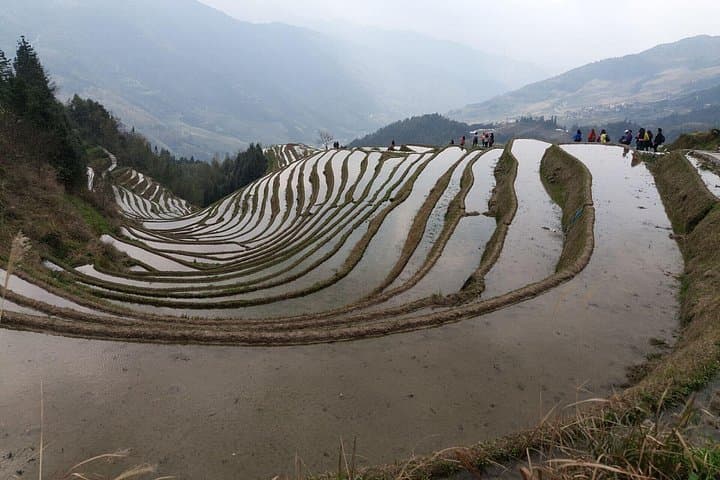
This six-day private tour pairs urban history with karst geography and village life. In Guangzhou expect Cantonese heritage: the Chen Clan Ancestral Hall’s carved beams and the 1,400‑year timeline of Hualin Temple. The landscape shifts by train to Guilin, where the Reed Flute Cave reveals classical karst stalactites and the Dragon’s Backbone terraces lay out stepped agriculture carved over 600 years. In Ping’an the rice platforms rise roughly 200–400 m above valley floors and require a 30–45 minute stair climb to reach top viewing platforms; Xianggong Hill near Yangshuo is a short 15‑minute ascent with a commanding 180° river bend view.
You’ll cycle 2–3 hours along the Yulong River, raft the Li River for about 60 minutes, and glide on a bamboo boat for 50 minutes — water here acts like a slow director, steering views and rhythms. Local Dong and Zhuang villages keep living traditions: wind‑and‑rain bridges and drum towers still mark social life.
Practical edge: travel involves several short hikes on stone steps, moderate bike riding on rural roads, and transfers by private car and high‑speed train (Guangzhou–Guilin ~3 hours). Bring layered clothing for river mists and sun, comfortable shoes for steps, and a day pack for water and your camera. Timing visits early or late in the day reduces crowds and gives the best light for the terraces and river bends.
moderate.
6 days.
Good general fitness—able to walk 40–60 minutes on uneven stone steps, cycle 2–3 hours on flat rural roads, and stand/sit on short raft trips.
The high‑speed D train takes around 3 hours between Guangzhou and Guilin; first‑class tickets are included on this itinerary.
Access involves stepped paths and moderate stair climbs—expect 30–45 minutes of uphill walking to main viewpoints with roughly 200–400 m of elevation change.
Operators commonly restrict children under 1 meter for safety; check with the operator for age and height rules before booking.
This tour is not recommended for travelers with significant spinal or cardiovascular issues due to stairs, transfers and occasional uneven terrain.
Guilin’s karst landscape formed over millions of years of limestone erosion; local Zhuang and Dong minorities have farmed the terraces for centuries using communal irrigation techniques.
Visitors should stick to marked paths in terraces and avoid stepping on bunds; support local businesses to help communities maintain traditional agriculture.
happychinatours operates guided outdoor trips and adventures with an emphasis on safety, stewardship, and memorable experiences.



You step out of an air-conditioned car onto warm southern air — neon signage fading behind you, limestone peaks rising like slow-growing towers in the distance. The first day threads through Guangzhou’s tiled courtyards and market alleys; by mid-trip the Li River will be daring you to slow down.
You step out of an air-conditioned car onto warm southern air — neon signage fading behind you, limestone peaks rising like slow-growing towers in the distance. The first day threads through Guangzhou’s tiled courtyards and market alleys; by mid-trip the Li River will be daring you to slow down.
This six-day private tour pairs urban history with karst geography and village life. In Guangzhou expect Cantonese heritage: the Chen Clan Ancestral Hall’s carved beams and the 1,400‑year timeline of Hualin Temple. The landscape shifts by train to Guilin, where the Reed Flute Cave reveals classical karst stalactites and the Dragon’s Backbone terraces lay out stepped agriculture carved over 600 years. In Ping’an the rice platforms rise roughly 200–400 m above valley floors and require a 30–45 minute stair climb to reach top viewing platforms; Xianggong Hill near Yangshuo is a short 15‑minute ascent with a commanding 180° river bend view.
You’ll cycle 2–3 hours along the Yulong River, raft the Li River for about 60 minutes, and glide on a bamboo boat for 50 minutes — water here acts like a slow director, steering views and rhythms. Local Dong and Zhuang villages keep living traditions: wind‑and‑rain bridges and drum towers still mark social life.
Practical edge: travel involves several short hikes on stone steps, moderate bike riding on rural roads, and transfers by private car and high‑speed train (Guangzhou–Guilin ~3 hours). Bring layered clothing for river mists and sun, comfortable shoes for steps, and a day pack for water and your camera. Timing visits early or late in the day reduces crowds and gives the best light for the terraces and river bends.