THE ADVENTURE COLLECTIVE® · Independent discovery and booking for outdoor travel

Explore the Green Grotto Caves on a full-day guided excursion from Negril. Walk limestone chambers etched with Taino markings, learn Spanish and runaway slave history, and move through cool underground pools and passageways with a local guide.
Explore the Green Grotto Caves on a full-day guided excursion from Negril. Walk limestone chambers etched with Taino markings, learn Spanish and runaway slave history, and move through cool underground pools and passageways with a local guide.
You step off the air-conditioned van and the tropical air tightens around the limestone mouth of the Green Grotto Caves—shadows slant inward and the echo of distant drops keeps time.
Verified experiences and guided adventures in the surrounding area.
Operated by El Sol Vida · Runaway Bay, Saint Ann Parish
You step off the air-conditioned van and the tropical air tightens around the limestone mouth of the Green Grotto Caves—shadows slant inward and the echo of distant drops keeps time.
The cave’s passages open into caverns where cool air presses against your skin. Stalactites hang like teeth; encaustic pools mirror the roof. A local guide points out faded Taino petroglyphs and pockets where Spanish fugitives once hid. The underground tunnel that links to Runaway Bay has the hush of escape routes and rum barrels stored here during World War II still live in story more than sight.
Geologically, the caves are classic karst: rainwater percolated through porous limestone over millennia, carving chambers, slick flowstones and freshwater pools. Culturally, this place has been shelter and refuge—from Indigenous peoples to runaway slaves—and that layered human history sits lightly alongside slow geological time.
Practical takeaways: allow roughly seven hours for round-trip transport from Negril, guided cave time, and short stops. Paths are mostly even but can be damp and uneven; protective headgear and a guide are standard. Bring a refillable water bottle, closed-toe shoes with grip, and a light layer against the cool interior. Expect brief photo stops and confined passages; mobility limitations may make some areas difficult.
Timing your visit for morning light reduces heat on the drive, and smaller groups let you hear the cave—drip by drip—while the guide traces the island’s hidden stories.
easy.
7 hours.
Suitable for most fitness levels; some walking on uneven, damp surfaces and short steps required
The full experience runs about seven hours including round-trip transport, the guided cave visit (about 90 minutes), and short stops.
Yes—it's listed as suitable for all fitness levels, though some narrow or damp passages may be uncomfortable for very young children or those with limited mobility.
Yes, protective headgear is typically provided as part of the tour inclusions.
Swimming is generally not part of the standard guided visit; pools are primarily interpretive and for conservation—follow your guide's instructions.
The caves show layered human use—from Taino occupation to Spanish refuges in the 17th century and later use by runaway slaves; WWII rum storage is part of the site's recent lore.
The cave’s formations are fragile—avoid touching flowstones, stay with the group, and use provided paths to minimize disturbance; limit flash photography where requested.
El Sol Vida operates guided outdoor trips and adventures with an emphasis on safety, stewardship, and memorable experiences.


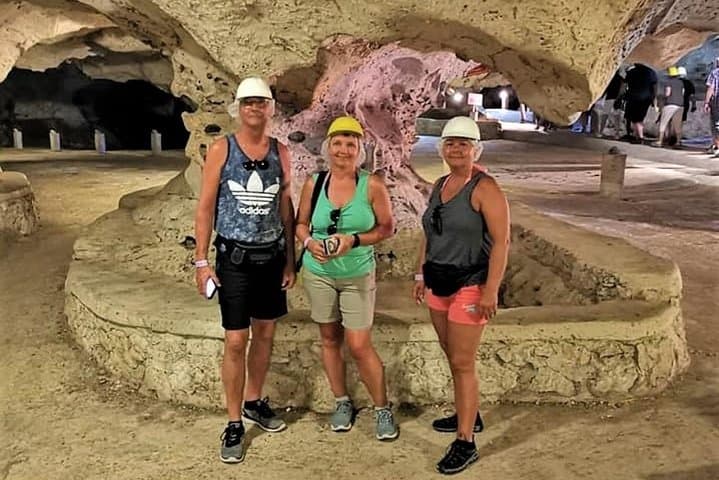
You step off the air-conditioned van and the tropical air tightens around the limestone mouth of the Green Grotto Caves—shadows slant inward and the echo of distant drops keeps time.
You step off the air-conditioned van and the tropical air tightens around the limestone mouth of the Green Grotto Caves—shadows slant inward and the echo of distant drops keeps time.
The cave’s passages open into caverns where cool air presses against your skin. Stalactites hang like teeth; encaustic pools mirror the roof. A local guide points out faded Taino petroglyphs and pockets where Spanish fugitives once hid. The underground tunnel that links to Runaway Bay has the hush of escape routes and rum barrels stored here during World War II still live in story more than sight.
Geologically, the caves are classic karst: rainwater percolated through porous limestone over millennia, carving chambers, slick flowstones and freshwater pools. Culturally, this place has been shelter and refuge—from Indigenous peoples to runaway slaves—and that layered human history sits lightly alongside slow geological time.
Practical takeaways: allow roughly seven hours for round-trip transport from Negril, guided cave time, and short stops. Paths are mostly even but can be damp and uneven; protective headgear and a guide are standard. Bring a refillable water bottle, closed-toe shoes with grip, and a light layer against the cool interior. Expect brief photo stops and confined passages; mobility limitations may make some areas difficult.
Timing your visit for morning light reduces heat on the drive, and smaller groups let you hear the cave—drip by drip—while the guide traces the island’s hidden stories.