THE ADVENTURE COLLECTIVE® · Independent discovery and booking for outdoor travel

Spend a focused day on the Giza Plateau and inside the National Museum of Egyptian Civilization. This private or shared guided tour pairs the Great Pyramids’ monumental presence with curated museum context, plus practical tips for timing, tickets, and what to wear.
Spend a focused day on the Giza Plateau and inside the National Museum of Egyptian Civilization. This private or shared guided tour pairs the Great Pyramids’ monumental presence with curated museum context, plus practical tips for timing, tickets, and what to wear.
Morning light slices across the Giza Plateau and the pyramids stand like deliberate machines of stone—silent, geometric, and patient. Visitors step from an air‑conditioned vehicle onto a spread of packed sand and limestone, where the Great Pyramid of Khufu, Khafre’s crest, and Menkaure’s smaller form command a low horizon. The plateau’s wind carries fine grit that dares you to linger with your camera; vendors and camel handlers move like a human tide around the monuments.
Verified experiences and guided adventures in the surrounding area.
Operated by Egypt Excursions Online · Giza, Giza Governorate
Morning light slices across the Giza Plateau and the pyramids stand like deliberate machines of stone—silent, geometric, and patient. Visitors step from an air‑conditioned vehicle onto a spread of packed sand and limestone, where the Great Pyramid of Khufu, Khafre’s crest, and Menkaure’s smaller form command a low horizon. The plateau’s wind carries fine grit that dares you to linger with your camera; vendors and camel handlers move like a human tide around the monuments.
Geology and history are close companions here: the pyramids rise from a natural limestone plateau quarried and shaped by successive pharaonic dynasties. Built in the fourth millennium BCE, these funerary complexes were engineered with remarkable precision; nearby, the National Museum of Egyptian Civilization threads millennia into curated exhibits, including the Royal Mummies Hall—recently centralized after the high‑profile “Golden Parade.” The area’s living culture—Cairo’s vibrant streets, local guides trained in Egyptology, and neighborhood eateries—gives modern context to ancient practice.
Practical guidance is straightforward. Expect 5–6 hours for a combined pyramids and museum itinerary, with roughly 2–3 kilometers of walking on uneven surfaces and steps. Arrive early to beat heat and crowds; mid‑day temperatures can be extreme, especially summer. Wear closed‑toe walking shoes, sun protection, and modest clothing respectful of local customs. If entry is included in your option, carry ID and printed or mobile tickets; otherwise plan for onsite ticket lines. Bring cash for tips and small purchases, and keep water accessible—hydration is non‑negotiable in the desert sun. With a good guide, this day blends clear logistics with a direct encounter with Egypt’s most enduring monuments.
easy.
5–6 hours.
Suitable for most fitness levels; involves 2–3 km of walking on uneven ground and some short stair sections.
There are multiple booking options; confirm whether your selected option includes pyramid and museum admission—if not, you’ll purchase tickets onsite.
Access varies: interior pyramid chambers have separate tickets and capacity limits; the Royal Mummies Hall inside the National Museum of Egyptian Civilization usually requires an admission ticket—choose an option that includes them if desired.
This tour lists hotel pickup and drop‑off included in the itinerary—verify your pickup point when booking and supply full names and pickup details.
Children can enjoy the visuals but heat, crowds, and uneven ground make midday challenging—plan for early starts, frequent water breaks, and shaded rests.
The Giza pyramids were constructed during Egypt’s Old Kingdom as monumental tombs; the National Museum of Egyptian Civilization centralizes artifacts spanning prehistoric eras to modern times, including the relocated royal mummies.
Visitor management and ticketing aim to reduce crowding inside sensitive spaces; avoid touching monuments and follow guide instructions to help preserve stone and organic artifacts.
Egypt Excursions Online operates guided outdoor trips and adventures with an emphasis on safety, stewardship, and memorable experiences.
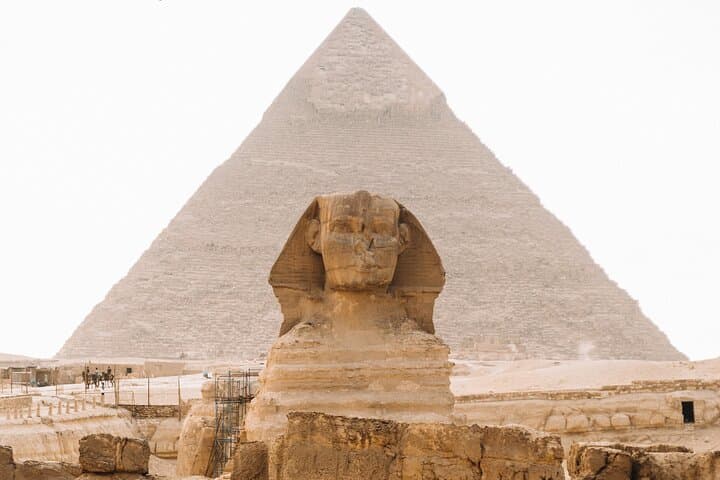


Morning light slices across the Giza Plateau and the pyramids stand like deliberate machines of stone—silent, geometric, and patient. Visitors step from an air‑conditioned vehicle onto a spread of packed sand and limestone, where the Great Pyramid of Khufu, Khafre’s crest, and Menkaure’s smaller form command a low horizon. The plateau’s wind carries fine grit that dares you to linger with your camera; vendors and camel handlers move like a human tide around the monuments.
Morning light slices across the Giza Plateau and the pyramids stand like deliberate machines of stone—silent, geometric, and patient. Visitors step from an air‑conditioned vehicle onto a spread of packed sand and limestone, where the Great Pyramid of Khufu, Khafre’s crest, and Menkaure’s smaller form command a low horizon. The plateau’s wind carries fine grit that dares you to linger with your camera; vendors and camel handlers move like a human tide around the monuments.
Geology and history are close companions here: the pyramids rise from a natural limestone plateau quarried and shaped by successive pharaonic dynasties. Built in the fourth millennium BCE, these funerary complexes were engineered with remarkable precision; nearby, the National Museum of Egyptian Civilization threads millennia into curated exhibits, including the Royal Mummies Hall—recently centralized after the high‑profile “Golden Parade.” The area’s living culture—Cairo’s vibrant streets, local guides trained in Egyptology, and neighborhood eateries—gives modern context to ancient practice.
Practical guidance is straightforward. Expect 5–6 hours for a combined pyramids and museum itinerary, with roughly 2–3 kilometers of walking on uneven surfaces and steps. Arrive early to beat heat and crowds; mid‑day temperatures can be extreme, especially summer. Wear closed‑toe walking shoes, sun protection, and modest clothing respectful of local customs. If entry is included in your option, carry ID and printed or mobile tickets; otherwise plan for onsite ticket lines. Bring cash for tips and small purchases, and keep water accessible—hydration is non‑negotiable in the desert sun. With a good guide, this day blends clear logistics with a direct encounter with Egypt’s most enduring monuments.