THE ADVENTURE COLLECTIVE® · Independent discovery and booking for outdoor travel

Explore Grand Central beyond the concourse on a guided two-hour walk that reveals hidden rooms, historic passages, and architectural details not usually open to the public. Ideal for history buffs and urban explorers who want layered context and practical tips for navigating Midtown crowds.
Explore Grand Central beyond the concourse on a guided two-hour walk that reveals hidden rooms, historic passages, and architectural details not usually open to the public. Ideal for history buffs and urban explorers who want layered context and practical tips for navigating Midtown crowds.
Step into Grand Central's main concourse and the room swells with motion: commuters stream like a river, under the painted ceiling that seems to keep time of its own. Light pools on the terrazzo floor; marble pillars hold conversations and the whispering niche dares you to put it to the test.
Verified experiences and guided adventures in the surrounding area.
Operated by CityShuffles · New York, NY
Step into Grand Central's main concourse and the room swells with motion: commuters stream like a river, under the painted ceiling that seems to keep time of its own. Light pools on the terrazzo floor; marble pillars hold conversations and the whispering niche dares you to put it to the test.
This two-hour guided walk moves beyond postcards. Opened in 1913 by the New York Central Railroad and shaped by Beaux‑Arts designers, the terminal sits on Manhattan schist and grew with the city's rise. The tour threads public rooms and off-limits levels—Pershing Square, the Jacqueline Kennedy Onassis Foyer, the Biltmore Room, the Graybar passage and even traces of old projection and tennis court spaces—each space telling part of the city's transportation and preservation story.
Culturally, Grand Central has been a meeting place, a film set, and a frontline in the 20th-century battle to preserve civic architecture; the late-20th-century restoration restored its marble and celestial ceiling to public view. Geology plays a quiet role here — heavy engineering anchors the structure to bedrock beneath Midtown.
Practical points: the tour is walking-paced and largely indoors, accessible to wheelchairs, and suitable for most people who can manage around 5,000 steps. Expect crowded moments during morning and evening commutes, quieter mid-mornings, and strong photo opportunities in the concourse and on hidden galleries. Bring comfortable shoes, a charged phone for your mobile ticket and to capture details, and allow extra time before or after the tour to explore the dining concourse and look up—some of the best details live above eye level.
easy.
2 hours.
Suitable for most adults who can walk and stand for up to two hours; able to handle ~5,000 steps.
This tour is conducted in English.
Yes, the tour is wheelchair accessible and notes indicate surfaces and transportation options accommodate mobility devices.
Grand Central is served by multiple subway lines and commuter trains; follow signage to the main concourse and confirm the exact meeting location on your booking confirmation.
Photography for personal use is generally allowed throughout public areas; follow the guide's instructions in smaller or sensitive rooms.
Grand Central opened in 1913, financed by the Vanderbilt-backed New York Central; its Beaux‑Arts design and later restorations made it a landmark of civic architecture.
The terminal is a designated landmark with ongoing preservation efforts; visitors help by staying on paths, carrying out litter, and respecting restricted areas to protect historic finishes.
CityShuffles operates guided outdoor trips and adventures with an emphasis on safety, stewardship, and memorable experiences.


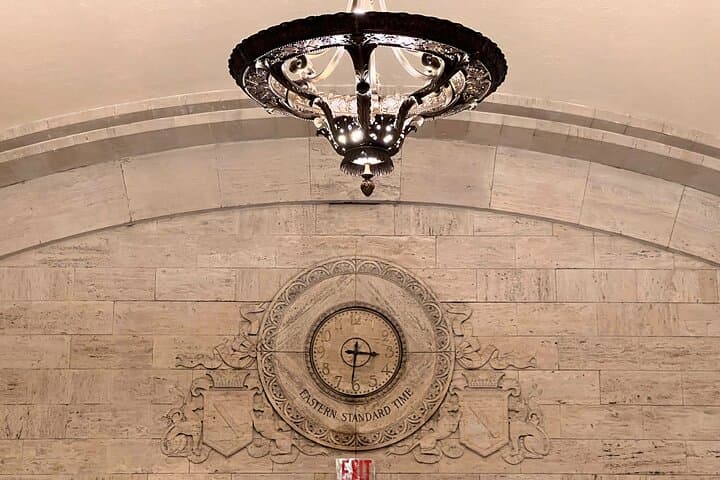

Step into Grand Central's main concourse and the room swells with motion: commuters stream like a river, under the painted ceiling that seems to keep time of its own. Light pools on the terrazzo floor; marble pillars hold conversations and the whispering niche dares you to put it to the test.
Step into Grand Central's main concourse and the room swells with motion: commuters stream like a river, under the painted ceiling that seems to keep time of its own. Light pools on the terrazzo floor; marble pillars hold conversations and the whispering niche dares you to put it to the test.
This two-hour guided walk moves beyond postcards. Opened in 1913 by the New York Central Railroad and shaped by Beaux‑Arts designers, the terminal sits on Manhattan schist and grew with the city's rise. The tour threads public rooms and off-limits levels—Pershing Square, the Jacqueline Kennedy Onassis Foyer, the Biltmore Room, the Graybar passage and even traces of old projection and tennis court spaces—each space telling part of the city's transportation and preservation story.
Culturally, Grand Central has been a meeting place, a film set, and a frontline in the 20th-century battle to preserve civic architecture; the late-20th-century restoration restored its marble and celestial ceiling to public view. Geology plays a quiet role here — heavy engineering anchors the structure to bedrock beneath Midtown.
Practical points: the tour is walking-paced and largely indoors, accessible to wheelchairs, and suitable for most people who can manage around 5,000 steps. Expect crowded moments during morning and evening commutes, quieter mid-mornings, and strong photo opportunities in the concourse and on hidden galleries. Bring comfortable shoes, a charged phone for your mobile ticket and to capture details, and allow extra time before or after the tour to explore the dining concourse and look up—some of the best details live above eye level.