THE ADVENTURE COLLECTIVE® · Independent discovery and booking for outdoor travel

A full-day tour from Las Vegas that pairs Hoover Dam photo stops with direct access to Grand Canyon West’s Eagle and Guano Points. Optional Skywalk, helicopter and pontoon upgrades let you tailor the views—expect a long, sun-exposed day with short rimside walks.
A full-day tour from Las Vegas that pairs Hoover Dam photo stops with direct access to Grand Canyon West’s Eagle and Guano Points. Optional Skywalk, helicopter and pontoon upgrades let you tailor the views—expect a long, sun-exposed day with short rimside walks.
You step out of the early-morning glare of Las Vegas and the bus hums toward a horizon that grows raw and mineral-rich with every mile. Red-brown cliffs peel away from the road, the Colorado River hidden until you crest the rim; at Eagle and Guano Points the canyon opens like a challenge—sheer walls daring you to come closer and look down.
Verified experiences and guided adventures in the surrounding area.
You step out of the early-morning glare of Las Vegas and the bus hums toward a horizon that grows raw and mineral-rich with every mile. Red-brown cliffs peel away from the road, the Colorado River hidden until you crest the rim; at Eagle and Guano Points the canyon opens like a challenge—sheer walls daring you to come closer and look down.
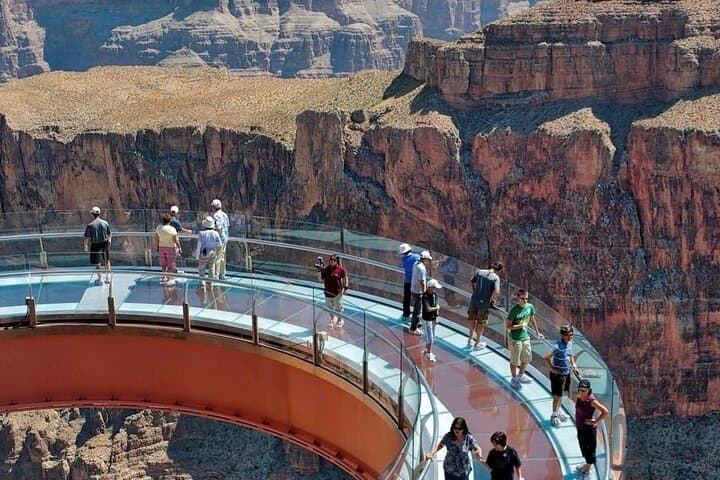
The West Rim sits on the Hualapai Reservation and offers a different feel from the South Rim: shorter drives between viewpoints, direct rim access, and the glass Skywalk that cantilevers visitors over empty air. Geologically, this rim displays the same layered rock story—Paleozoic and Mesozoic strata etched by the Colorado River over millions of years—while Hoover Dam, en route, marks 20th-century engineering harnessing Lake Mead’s waters.
Culturally, the Hualapai steward much of the visitor experience here; expect interpretive material and opportunities to learn about tribal history. Practicalities matter: the West Rim is roughly 2–2.5 hours from the Las Vegas Strip each way, with short paved or packed-gravel walks (generally under a mile round-trip at each viewpoint) and modest elevation around 4,000 ft.
Bring sun protection and plenty of water—desert heat is the dominant variable. If you opt for the Skywalk, note it often requires separate admission and has photo/locker rules; helicopter and pontoon options add spectacular aerial or river perspectives but also additional time and cost. Plan for a full-day outing: early start to beat crowds and heat, comfortable shoes for rimside walking, and an awareness that services are limited out on the reservation. The payoff is expansive canyon vistas, dramatic geology up close, and the chance to pair a Hoover Dam photo with a walk on glass over one of North America’s great chasms.
moderate.
6–7 hours.
Suitable for people who can manage short walks on paved or gravel surfaces and tolerate a long day of sitting in transit; moderate stamina recommended
Expect roughly 2–2.5 hours one-way depending on traffic and the tour route, with a Hoover Dam stop en route.
The Skywalk is commonly an optional add-on with separate admission and specific rules about cameras and lockers—confirm availability and fees when booking.
Some tours include an optional lunch; otherwise limited concession options exist at visitor areas—bring snacks and water if you prefer.
The bus trip and many viewpoints have accessible elements, but specific access to the Skywalk and some rim areas can be restricted; check tour operator accessibility details before booking.
Grand Canyon West is on Hualapai land and developed as an accessible rim experience distinct from the National Park’s South Rim; Hoover Dam nearby represents major 20th-century water and power infrastructure.
High visitor use and desert fragility mean pack-it-in/pack-it-out practices matter; support tribal stewardship by following signage and staying on designated paths.
You step out of the early-morning glare of Las Vegas and the bus hums toward a horizon that grows raw and mineral-rich with every mile. Red-brown cliffs peel away from the road, the Colorado River hidden until you crest the rim; at Eagle and Guano Points the canyon opens like a challenge—sheer walls daring you to come closer and look down.
You step out of the early-morning glare of Las Vegas and the bus hums toward a horizon that grows raw and mineral-rich with every mile. Red-brown cliffs peel away from the road, the Colorado River hidden until you crest the rim; at Eagle and Guano Points the canyon opens like a challenge—sheer walls daring you to come closer and look down.
The West Rim sits on the Hualapai Reservation and offers a different feel from the South Rim: shorter drives between viewpoints, direct rim access, and the glass Skywalk that cantilevers visitors over empty air. Geologically, this rim displays the same layered rock story—Paleozoic and Mesozoic strata etched by the Colorado River over millions of years—while Hoover Dam, en route, marks 20th-century engineering harnessing Lake Mead’s waters.
Culturally, the Hualapai steward much of the visitor experience here; expect interpretive material and opportunities to learn about tribal history. Practicalities matter: the West Rim is roughly 2–2.5 hours from the Las Vegas Strip each way, with short paved or packed-gravel walks (generally under a mile round-trip at each viewpoint) and modest elevation around 4,000 ft.
Bring sun protection and plenty of water—desert heat is the dominant variable. If you opt for the Skywalk, note it often requires separate admission and has photo/locker rules; helicopter and pontoon options add spectacular aerial or river perspectives but also additional time and cost. Plan for a full-day outing: early start to beat crowds and heat, comfortable shoes for rimside walking, and an awareness that services are limited out on the reservation. The payoff is expansive canyon vistas, dramatic geology up close, and the chance to pair a Hoover Dam photo with a walk on glass over one of North America’s great chasms.