THE ADVENTURE COLLECTIVE® · Independent discovery and booking for outdoor travel

Explore Grace Cathedral’s soaring vaults, Ghiberti door replicas and a contemplative labyrinth on this 60-minute guided highlights tour. Learn about the building’s post‑1906 history, social justice role and the artworks that make it a distinct San Francisco stop.
Explore Grace Cathedral’s soaring vaults, Ghiberti door replicas and a contemplative labyrinth on this 60-minute guided highlights tour. Learn about the building’s post‑1906 history, social justice role and the artworks that make it a distinct San Francisco stop.
You arrive at the top of Nob Hill and the cathedral's stone steps frame a cityscape — cable cars clicking below, the Pacific light flattening rooftops. Inside, vaulted ceilings open like pages of history; sunlight slants through tall stained glass and lands on marble floors where a Chartres-style labyrinth waits for quiet feet.
Verified experiences and guided adventures in the surrounding area.
Operated by Grace Cathedral · San Francisco, California
You arrive at the top of Nob Hill and the cathedral's stone steps frame a cityscape — cable cars clicking below, the Pacific light flattening rooftops. Inside, vaulted ceilings open like pages of history; sunlight slants through tall stained glass and lands on marble floors where a Chartres-style labyrinth waits for quiet feet.
Grace Cathedral stands where San Francisco rebuilt itself after the 1906 earthquake, a Gothic revival presence shaped by both civic ambition and spiritual practice. The interior houses a replica of Ghiberti’s Gates of Paradise and a striking modern altarpiece by Keith Haring, pairing Renaissance reference with contemporary voice. The hill beneath the building is part of the city's raised moraine and urban bedrock, which helped determine early construction choices and the cathedral’s resilient foundations.
Guides steer you through architectural details — ribbed vaults, carved capitals and the mosaicked labyrinth — while also telling stories of the cathedral’s social justice work and role in community recovery after disaster. The experience balances visual wonder with reflective space: the labyrinth invites intentional walking; galleries and stained glass reward patient observation.
Practicalities: tours run about 60 minutes and start at the Welcome Desk on Taylor Street; arrive 10 minutes early. The building is wheelchair accessible and stroller friendly, but wear quiet, non-marking shoes for the mosaic floor. Photography is allowed without flash in many areas; respect service times and private events. Public transit and nearby parking make a midday or late-afternoon visit easy; if you want fewer people, aim for weekday mornings. A visit here is equal parts art walk and moment of city history — compact, thoughtfully paced and uniquely San Francisco.
easy.
1 hour.
Suitable for most visitors; minimal walking and no technical exertion required
The guided highlights tour runs approximately 60 minutes and focuses on the main floor, artworks and a labyrinth visit.
Yes — entrances, main floor areas and most surfaces are wheelchair accessible; check in at the Welcome Desk for assistance.
Photography without flash is generally allowed, though visitors should avoid disruption during services and follow staff guidance near artworks.
Yes — the cathedral is family friendly and accommodates strollers; quiet behavior is requested to preserve the contemplative atmosphere.
Built as part of San Francisco’s post-1906 rebuilding, Grace Cathedral became a mid‑20th century civic and spiritual landmark that blends Gothic revival architecture with modern commissions.
The cathedral balances public access with preservation — visitors are asked to avoid flash photography, respect restricted areas and support upkeep through donations.
Grace Cathedral operates guided outdoor trips and adventures with an emphasis on safety, stewardship, and memorable experiences.


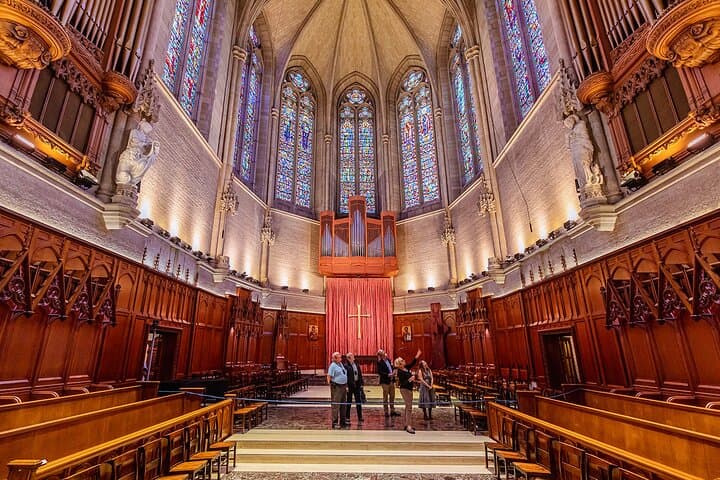
You arrive at the top of Nob Hill and the cathedral's stone steps frame a cityscape — cable cars clicking below, the Pacific light flattening rooftops. Inside, vaulted ceilings open like pages of history; sunlight slants through tall stained glass and lands on marble floors where a Chartres-style labyrinth waits for quiet feet.
You arrive at the top of Nob Hill and the cathedral's stone steps frame a cityscape — cable cars clicking below, the Pacific light flattening rooftops. Inside, vaulted ceilings open like pages of history; sunlight slants through tall stained glass and lands on marble floors where a Chartres-style labyrinth waits for quiet feet.
Grace Cathedral stands where San Francisco rebuilt itself after the 1906 earthquake, a Gothic revival presence shaped by both civic ambition and spiritual practice. The interior houses a replica of Ghiberti’s Gates of Paradise and a striking modern altarpiece by Keith Haring, pairing Renaissance reference with contemporary voice. The hill beneath the building is part of the city's raised moraine and urban bedrock, which helped determine early construction choices and the cathedral’s resilient foundations.
Guides steer you through architectural details — ribbed vaults, carved capitals and the mosaicked labyrinth — while also telling stories of the cathedral’s social justice work and role in community recovery after disaster. The experience balances visual wonder with reflective space: the labyrinth invites intentional walking; galleries and stained glass reward patient observation.
Practicalities: tours run about 60 minutes and start at the Welcome Desk on Taylor Street; arrive 10 minutes early. The building is wheelchair accessible and stroller friendly, but wear quiet, non-marking shoes for the mosaic floor. Photography is allowed without flash in many areas; respect service times and private events. Public transit and nearby parking make a midday or late-afternoon visit easy; if you want fewer people, aim for weekday mornings. A visit here is equal parts art walk and moment of city history — compact, thoughtfully paced and uniquely San Francisco.