THE ADVENTURE COLLECTIVE® · Independent discovery and booking for outdoor travel

Spend a full day exploring Angkor’s major temples with an expert guide, ending at Pre Rup for sunset. This small-group tour covers Angkor Wat, Angkor Thom, Bayon, Ta Prohm and more with hotel pickup and bottled water.
Spend a full day exploring Angkor’s major temples with an expert guide, ending at Pre Rup for sunset. This small-group tour covers Angkor Wat, Angkor Thom, Bayon, Ta Prohm and more with hotel pickup and bottled water.
Early light slants across a broad moat and the first stone faces catch the day: by mid-morning the group moves from the towering causeway of Angkor Wat into long galleries worn smooth by centuries of feet. The guide’s voice cuts through the heat, pointing out bas-reliefs of epic battles while tourists drift through shadowed corridors and open courtyards.
Verified experiences and guided adventures in the surrounding area.
Operated by Tourme ANGKOR · Siem Reap, Siem Reap Province
Early light slants across a broad moat and the first stone faces catch the day: by mid-morning the group moves from the towering causeway of Angkor Wat into long galleries worn smooth by centuries of feet. The guide’s voice cuts through the heat, pointing out bas-reliefs of epic battles while tourists drift through shadowed corridors and open courtyards.
This full-day loop traces the arc of the 12th‑century Khmer Empire—Angkor Wat’s 402 acres (163 ha) of concentric galleries, the gate-lined approach to Angkor Thom, and Bayon’s enigmatic towers carved with more than 200 smiling faces. Ta Prohm shows nature’s slow reclaiming: strangler figs and silk-cotton roots threading walls and doorways. Pre Rup’s laterite summit rewards the day with a broad western sky at sunset, when the stones glow copper.
Geology here is primarily sandstone and laterite; expect uneven, worn steps and compacted dirt paths rather than sustained elevation gain—this is a walking tour across a largely flat archaeological park. Culturally, the complex is still a living heritage site; modest dress and discrete behavior inside sanctuaries are required. Practicalities: the tour runs about 11 hours, includes air‑conditioned transfers, an English-speaking licensed guide, and bottled water; lunch and Angkor Park admission are not included.
Plan for heat, sun, and dusty paths—hat, sun protection, sturdy footwear, and cash for your Angkor pass. Move deliberately through the temples: slow pacing reveals carvings and quiet corners that a hurried visit misses.
moderate.
11 hours.
Suitable for travelers who can manage several hours of walking on uneven surfaces in heat; basic stamina for an all-day outing is recommended.
No—Angkor Archaeological Park admission (the Angkor pass) is not included; purchase your pass at the park ticket center before visiting.
The tour is approximately 11 hours and runs as a small-group experience with a maximum of around 10 participants.
Lunch is not included; the itinerary stops at a local Khmer restaurant for those who wish to eat (pay on-site).
Children under 5 are not permitted on this small-group tour; check with the operator for policies on older children.
These monuments were constructed during the Khmer Empire (9th–15th centuries), with Angkor Wat built in the early 12th century as a Hindu then Buddhist sanctuary.
Visitor pressure and tropical weather accelerate stone erosion; follow rope lines, avoid climbing restricted structures, and support local conservation fees via official park passes.
Tourme ANGKOR operates guided outdoor trips and adventures with an emphasis on safety, stewardship, and memorable experiences.
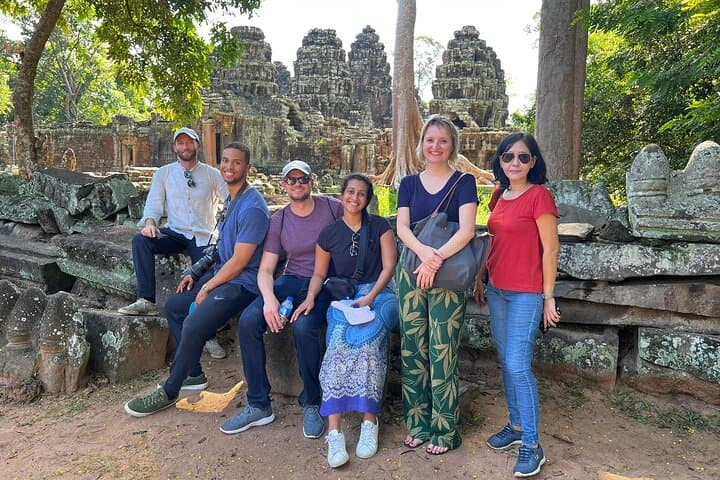
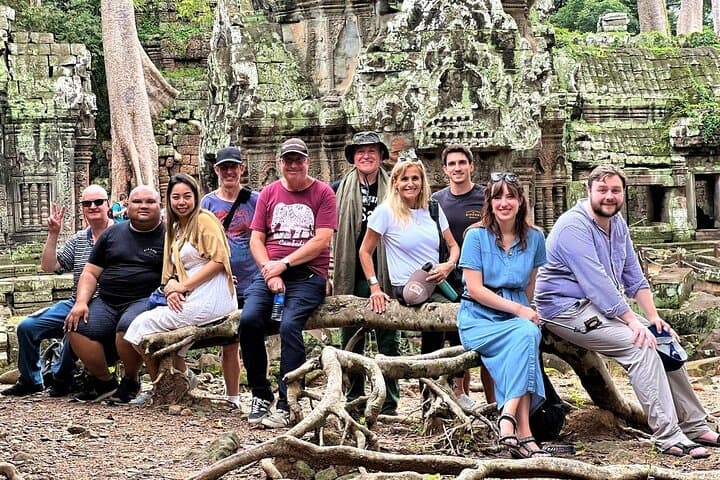
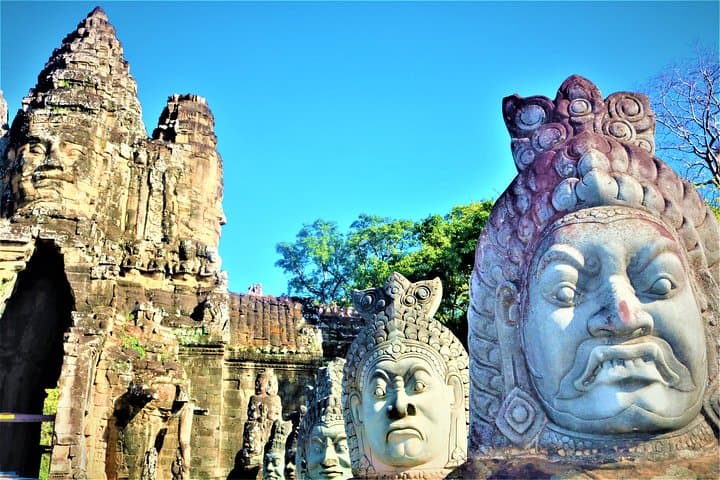
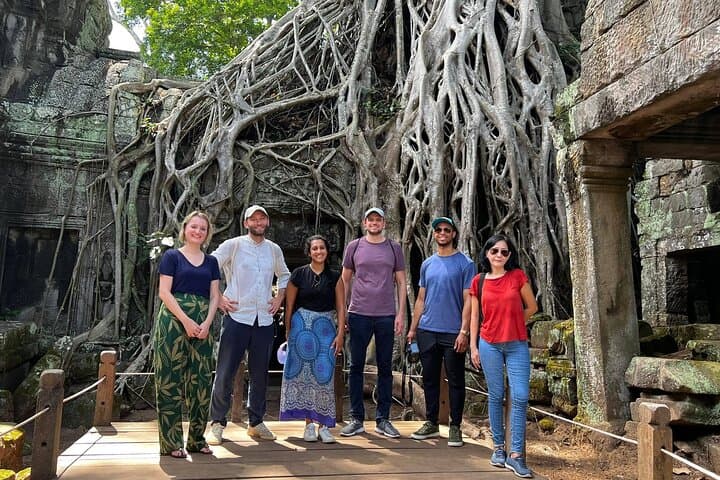
Early light slants across a broad moat and the first stone faces catch the day: by mid-morning the group moves from the towering causeway of Angkor Wat into long galleries worn smooth by centuries of feet. The guide’s voice cuts through the heat, pointing out bas-reliefs of epic battles while tourists drift through shadowed corridors and open courtyards.
Early light slants across a broad moat and the first stone faces catch the day: by mid-morning the group moves from the towering causeway of Angkor Wat into long galleries worn smooth by centuries of feet. The guide’s voice cuts through the heat, pointing out bas-reliefs of epic battles while tourists drift through shadowed corridors and open courtyards.
This full-day loop traces the arc of the 12th‑century Khmer Empire—Angkor Wat’s 402 acres (163 ha) of concentric galleries, the gate-lined approach to Angkor Thom, and Bayon’s enigmatic towers carved with more than 200 smiling faces. Ta Prohm shows nature’s slow reclaiming: strangler figs and silk-cotton roots threading walls and doorways. Pre Rup’s laterite summit rewards the day with a broad western sky at sunset, when the stones glow copper.
Geology here is primarily sandstone and laterite; expect uneven, worn steps and compacted dirt paths rather than sustained elevation gain—this is a walking tour across a largely flat archaeological park. Culturally, the complex is still a living heritage site; modest dress and discrete behavior inside sanctuaries are required. Practicalities: the tour runs about 11 hours, includes air‑conditioned transfers, an English-speaking licensed guide, and bottled water; lunch and Angkor Park admission are not included.
Plan for heat, sun, and dusty paths—hat, sun protection, sturdy footwear, and cash for your Angkor pass. Move deliberately through the temples: slow pacing reveals carvings and quiet corners that a hurried visit misses.