THE ADVENTURE COLLECTIVE® · Independent discovery and booking for outdoor travel

See the Golden Circle’s tectonic rifts, geysers and Gullfoss in one long day, soak in the Secret Lagoon, then head out after dark in search of the Northern Lights. This full-day combo pairs classic Icelandic scenery with a patient aurora hunt.
See the Golden Circle’s tectonic rifts, geysers and Gullfoss in one long day, soak in the Secret Lagoon, then head out after dark in search of the Northern Lights. This full-day combo pairs classic Icelandic scenery with a patient aurora hunt.
You step onto the bus in Reykjavík as the city’s orange streetlights still cling to the low winter sky. By midmorning the asphalt gives way to lava fields that look newly formed, black and jagged, and the guide’s voice cuts through the hum—pointing out a valley where glaciers once chewed the earth. The day is organized like a compact syllabus on Icelandic geology: Thingvellir’s fissured rift, the geysers’ punctual eruptions, the raw thunder of Gullfoss, and the green-steamed refuge of the Secret Lagoon — all before the night hunt for aurorae.
Verified experiences and guided adventures in the surrounding area.
Operated by BusTravel Iceland · Reykjavík, Capital Region
You step onto the bus in Reykjavík as the city’s orange streetlights still cling to the low winter sky. By midmorning the asphalt gives way to lava fields that look newly formed, black and jagged, and the guide’s voice cuts through the hum—pointing out a valley where glaciers once chewed the earth. The day is organized like a compact syllabus on Icelandic geology: Thingvellir’s fissured rift, the geysers’ punctual eruptions, the raw thunder of Gullfoss, and the green-steamed refuge of the Secret Lagoon — all before the night hunt for aurorae.
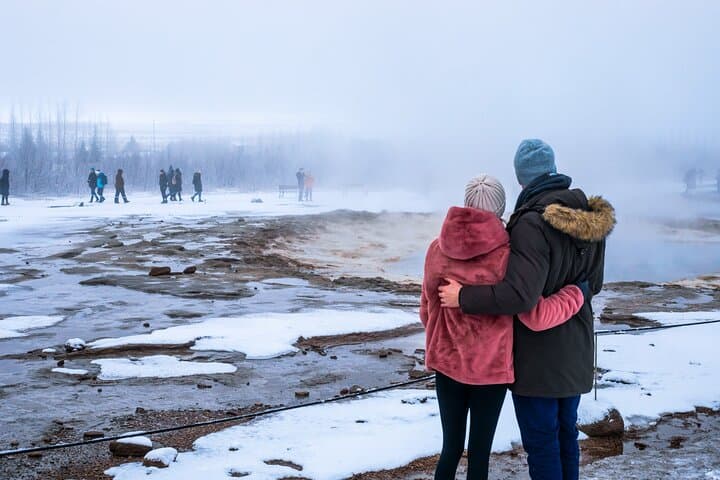
Thingvellir National Park is where history and plate tectonics meet. Walk the rift between the North American and Eurasian plates — a shallow trail with only a few dozen meters of elevation gain — and imagine the Alþingi assemblies that began here in the 10th century. From there the bus threads toward Geysir and Strokkur: a geothermal theatre where mineral-rich pools hiss and Strokkur reliably spouts water up to 30–40 meters every few minutes. It’s easy to line up a clean shot from the viewing path; expect a 1–2 km loop of boardwalks and packed-earth trails.
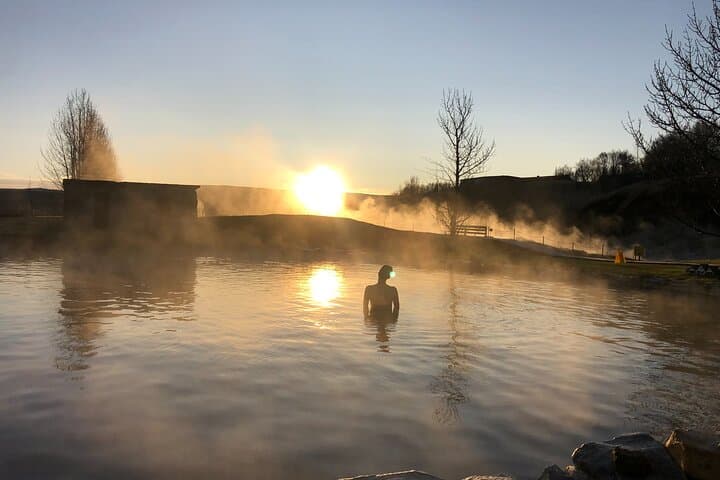
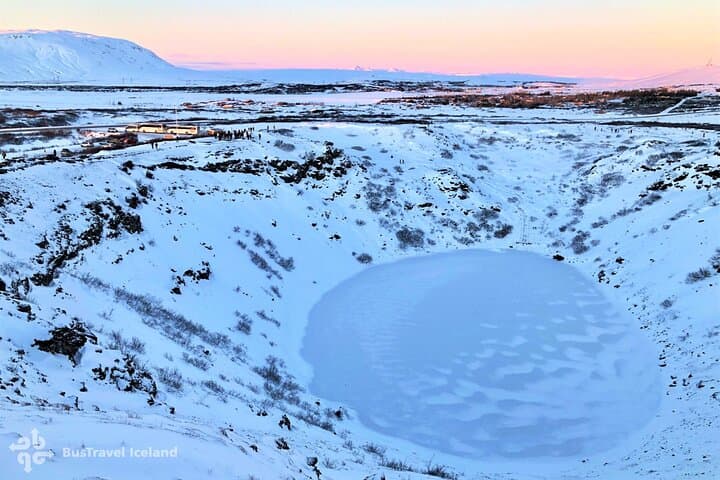
Gullfoss is the day’s crescendo: a double-drop waterfall powered by Langjökull’s meltwater. Viewing platforms put you within spray distance — the paths are short but can be icy in winter, and wind will push at you like a blunt hand. Kerið volcanic crater provides a quieter counterpoint; the rim-walk is just over a kilometre with a short descent into the bowl if you choose. Later, the Secret Lagoon (Gamla Laugin) rewards stamina with naturally heated water and steam that lifts off the surface like a private cloud. Bring a swimsuit; the lagoon’s facilities are simple but comfortable.
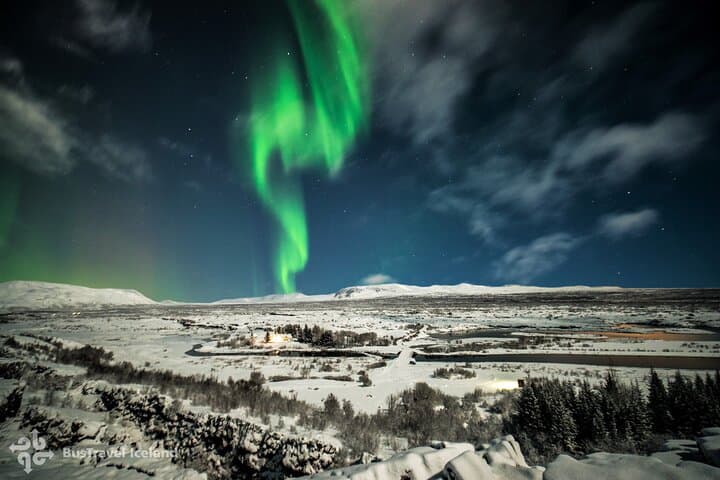
After an evening back in Reykjavík to refuel, the second bus takes you away from light pollution into the countryside. Northern Lights hunting is patient work: guides chase clear skies, reading clouds and KP indices, and often drive kilometers between vantage points to find a dark, open horizon.
Practical edge: expect a long, full day—roughly 13–14 hours total—with multiple short walks rather than sustained hikes. Weather changes quickly; layers and waterproofs matter more than heavy footwear, though decent hiking shoes help on uneven ground. Charging your camera and downloading an aurora app will increase your odds of capturing the show. The route is ideal for travelers who want concentrated exposure to Iceland's defining landscapes without the need for advanced fitness or technical skills.
easy.
13–14 hours.
Suitable for most fitness levels; you'll do short walks (0.5–2 km) and stand for viewpoints but no sustained uphill hiking.
The full combo runs approximately 13–14 hours from morning departure in Reykjavík through the evening Northern Lights hunt.
Yes, entrance to the Secret Lagoon is included; swimsuits and towels can be rented on site for an extra fee.
No advanced fitness or technical skills are required—most stops involve short, easy walks suitable for a wide range of travelers.
Aurora visibility depends on solar activity and clear skies. Guides increase odds by driving to darker skies, but sightings can’t be guaranteed.
The tour collects and returns to bus stop 12 outside Storm Hotel in central Reykjavík; many hotels offer pickup—allow up to 30 minutes for collection.
Bring insulating layers, a windproof/waterproof outer layer, warm hat and gloves, and footwear with good traction; crampons may be recommended in icy conditions.
Thingvellir hosted the Alþingi, Iceland’s early parliament founded in the 10th century, making the area a cornerstone of Icelandic national identity.
This corridor receives heavy visitation—stay on marked paths to protect fragile moss and geothermal features; use local facilities to reduce ecological impact.
BusTravel Iceland operates guided outdoor trips and adventures with an emphasis on safety, stewardship, and memorable experiences.
You step onto the bus in Reykjavík as the city’s orange streetlights still cling to the low winter sky. By midmorning the asphalt gives way to lava fields that look newly formed, black and jagged, and the guide’s voice cuts through the hum—pointing out a valley where glaciers once chewed the earth. The day is organized like a compact syllabus on Icelandic geology: Thingvellir’s fissured rift, the geysers’ punctual eruptions, the raw thunder of Gullfoss, and the green-steamed refuge of the Secret Lagoon — all before the night hunt for aurorae.
You step onto the bus in Reykjavík as the city’s orange streetlights still cling to the low winter sky. By midmorning the asphalt gives way to lava fields that look newly formed, black and jagged, and the guide’s voice cuts through the hum—pointing out a valley where glaciers once chewed the earth. The day is organized like a compact syllabus on Icelandic geology: Thingvellir’s fissured rift, the geysers’ punctual eruptions, the raw thunder of Gullfoss, and the green-steamed refuge of the Secret Lagoon — all before the night hunt for aurorae.
Thingvellir National Park is where history and plate tectonics meet. Walk the rift between the North American and Eurasian plates — a shallow trail with only a few dozen meters of elevation gain — and imagine the Alþingi assemblies that began here in the 10th century. From there the bus threads toward Geysir and Strokkur: a geothermal theatre where mineral-rich pools hiss and Strokkur reliably spouts water up to 30–40 meters every few minutes. It’s easy to line up a clean shot from the viewing path; expect a 1–2 km loop of boardwalks and packed-earth trails.
Gullfoss is the day’s crescendo: a double-drop waterfall powered by Langjökull’s meltwater. Viewing platforms put you within spray distance — the paths are short but can be icy in winter, and wind will push at you like a blunt hand. Kerið volcanic crater provides a quieter counterpoint; the rim-walk is just over a kilometre with a short descent into the bowl if you choose. Later, the Secret Lagoon (Gamla Laugin) rewards stamina with naturally heated water and steam that lifts off the surface like a private cloud. Bring a swimsuit; the lagoon’s facilities are simple but comfortable.
After an evening back in Reykjavík to refuel, the second bus takes you away from light pollution into the countryside. Northern Lights hunting is patient work: guides chase clear skies, reading clouds and KP indices, and often drive kilometers between vantage points to find a dark, open horizon.
Practical edge: expect a long, full day—roughly 13–14 hours total—with multiple short walks rather than sustained hikes. Weather changes quickly; layers and waterproofs matter more than heavy footwear, though decent hiking shoes help on uneven ground. Charging your camera and downloading an aurora app will increase your odds of capturing the show. The route is ideal for travelers who want concentrated exposure to Iceland's defining landscapes without the need for advanced fitness or technical skills.