THE ADVENTURE COLLECTIVE® · Independent discovery and booking for outdoor travel

A seven‑hour small‑group loop from Reykjavik that pairs Þingvellir’s rifted cliffs, the geysers’ boiling theatrics and Gullfoss’s thunder with a greenhouse lunch at Friðheimar. Limited to six passengers and includes professional photos uploaded after the tour.
A seven‑hour small‑group loop from Reykjavik that pairs Þingvellir’s rifted cliffs, the geysers’ boiling theatrics and Gullfoss’s thunder with a greenhouse lunch at Friðheimar. Limited to six passengers and includes professional photos uploaded after the tour.
You step out of a low-slung Mercedes‑Benz V‑Class into air that smells faintly of sulphur and damp stone. The Highlands feel like a living map: a field of black lava flows carving lines across a pale sky, steam vents puffing rhythmically as if the ground breathes. This is the Golden Circle—Iceland’s compact primer on tectonics, waterfalls, and geothermal theatre—and by noon you’ll be trading basalt and geysers for the warm, tomato-scented glasshouse of Friðheimar, where lunch is served amid hanging vines.
Verified experiences and guided adventures in the surrounding area.
You step out of a low-slung Mercedes‑Benz V‑Class into air that smells faintly of sulphur and damp stone. The Highlands feel like a living map: a field of black lava flows carving lines across a pale sky, steam vents puffing rhythmically as if the ground breathes. This is the Golden Circle—Iceland’s compact primer on tectonics, waterfalls, and geothermal theatre—and by noon you’ll be trading basalt and geysers for the warm, tomato-scented glasshouse of Friðheimar, where lunch is served amid hanging vines.
Geology writes itself here. The country sits astride the Mid‑Atlantic Ridge and the trail between Þingvellir, Geysir, and Gullfoss reads like a field guide to volcanic processes: rift valleys where the Eurasian and North American plates pull apart, silica‑lined hot springs that boil then idle, and river cataracts that have chewed through layers of basalt for millennia. Þingvellir doubles the lesson with history—this is where Icelanders convened the Alþingi in 930 AD to make law in a landscape that still holds the fissures people argued across.
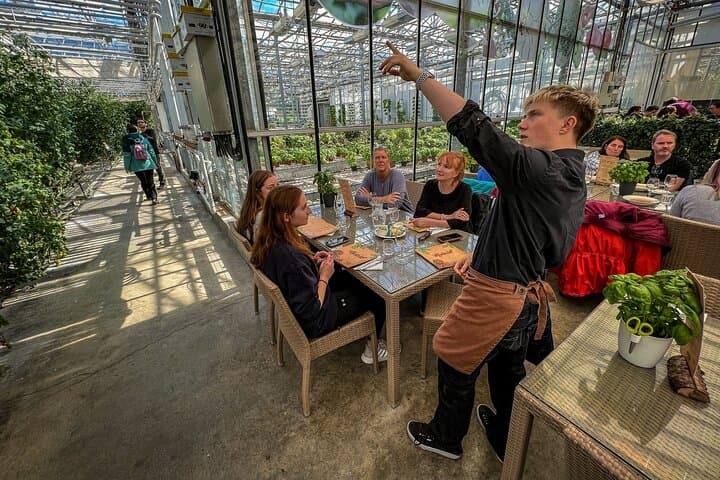
The cultural shift at Friðheimar feels intentional. Here, geothermal water heats greenhouses year round; tomato plants climb winter and summer alike, and a simple bowl of tomato soup tastes like climate ingenuity. The farm’s staff will seat you under glass, pour fresh soups and warm bread, and the guide will keep an eye on light and composition so you’ll get photos uploaded after the tour.
Practicalities are crisp: the full loop is about 7 hours with hotel pick‑up in Reykjavik, the tour capped at six passengers for a quieter experience, and short walks at each stop—generally 10–30 minutes on mostly even paths, with some stairs and muddy patches near waterfalls. Bring waterproof layers and sturdy footwear; weather changes on the hour and the spray at Gullfoss will find you. In summer expect long daylight and crowds; in winter expect icy approaches and limited sun.
Timing matters: aim for shoulder seasons if you want shorter queues at Geysir and Gullfoss, and reserve the Friðheimar lunch in advance—tables inside the greenhouse fill quickly. Cameras with a wide lens will capture the scale of Gullfoss and the steam columns at Geysir; a fast shutter helps freeze erupting bursts. Finally, treat the land with care: stick to marked paths, respect fragile moss and rift edges, and know that much of Iceland’s charm depends on small acts of restraint.
This Golden Circle loop is compact but varied—tectonic drama, thunderous water, and a horticultural surprise that proves the country’s heat is not just raw power but a tool for crafting memorable meals.
moderate.
7 hours.
Comfortable walking fitness for short, sometimes uneven trails and stairs; minimal elevation.
The tour lasts about seven hours and includes hotel pick‑up in Reykjavik, visits to Þingvellir, Geysir, Gullfoss, and lunch at Friðheimar, plus photos from the guide uploaded after the trip.
Yes—pick‑up from central Reykjavik accommodations is included; confirm your address when booking.
Yes: Þingvellir, Geysir, Gullfoss and Friðheimar all have visitor facilities; stops are spaced so you won’t go long without a break.
Friðheimar typically offers vegetarian options like their signature tomato soup and gluten‑free bread on request—notify the operator when booking.
Yes—the short walks are family‑friendly; travelers using mobility aids should note there are stairs and uneven ground at some viewpoints.
Guides will adjust the itinerary for safety—if a site is closed due to conditions you’ll be offered alternatives or extended time at other stops.
Þingvellir was the site of Iceland’s Alþingi from 930 AD, one of the world’s oldest parliamentary sites, and sits astride the tectonic rift between two continents.
Stick to marked paths and boardwalks—moss and lichen take decades to recover from trampling; operators limit group sizes to reduce impact.
You step out of a low-slung Mercedes‑Benz V‑Class into air that smells faintly of sulphur and damp stone. The Highlands feel like a living map: a field of black lava flows carving lines across a pale sky, steam vents puffing rhythmically as if the ground breathes. This is the Golden Circle—Iceland’s compact primer on tectonics, waterfalls, and geothermal theatre—and by noon you’ll be trading basalt and geysers for the warm, tomato-scented glasshouse of Friðheimar, where lunch is served amid hanging vines.
You step out of a low-slung Mercedes‑Benz V‑Class into air that smells faintly of sulphur and damp stone. The Highlands feel like a living map: a field of black lava flows carving lines across a pale sky, steam vents puffing rhythmically as if the ground breathes. This is the Golden Circle—Iceland’s compact primer on tectonics, waterfalls, and geothermal theatre—and by noon you’ll be trading basalt and geysers for the warm, tomato-scented glasshouse of Friðheimar, where lunch is served amid hanging vines.
Geology writes itself here. The country sits astride the Mid‑Atlantic Ridge and the trail between Þingvellir, Geysir, and Gullfoss reads like a field guide to volcanic processes: rift valleys where the Eurasian and North American plates pull apart, silica‑lined hot springs that boil then idle, and river cataracts that have chewed through layers of basalt for millennia. Þingvellir doubles the lesson with history—this is where Icelanders convened the Alþingi in 930 AD to make law in a landscape that still holds the fissures people argued across.
The cultural shift at Friðheimar feels intentional. Here, geothermal water heats greenhouses year round; tomato plants climb winter and summer alike, and a simple bowl of tomato soup tastes like climate ingenuity. The farm’s staff will seat you under glass, pour fresh soups and warm bread, and the guide will keep an eye on light and composition so you’ll get photos uploaded after the tour.
Practicalities are crisp: the full loop is about 7 hours with hotel pick‑up in Reykjavik, the tour capped at six passengers for a quieter experience, and short walks at each stop—generally 10–30 minutes on mostly even paths, with some stairs and muddy patches near waterfalls. Bring waterproof layers and sturdy footwear; weather changes on the hour and the spray at Gullfoss will find you. In summer expect long daylight and crowds; in winter expect icy approaches and limited sun.
Timing matters: aim for shoulder seasons if you want shorter queues at Geysir and Gullfoss, and reserve the Friðheimar lunch in advance—tables inside the greenhouse fill quickly. Cameras with a wide lens will capture the scale of Gullfoss and the steam columns at Geysir; a fast shutter helps freeze erupting bursts. Finally, treat the land with care: stick to marked paths, respect fragile moss and rift edges, and know that much of Iceland’s charm depends on small acts of restraint.
This Golden Circle loop is compact but varied—tectonic drama, thunderous water, and a horticultural surprise that proves the country’s heat is not just raw power but a tool for crafting memorable meals.