THE ADVENTURE COLLECTIVE® · Independent discovery and booking for outdoor travel

Leave Baku for a single-day loop that lays out Azerbaijan’s wild geology and long human story: bubbling mud volcanoes, millennia-old petroglyphs at Gobustan, the Ateshgah fire temple, and Yanardagh’s eternal flames. Expect easy walks, dramatic photo ops, and a solid dose of local history.
Leave Baku for a single-day loop that lays out Azerbaijan’s wild geology and long human story: bubbling mud volcanoes, millennia-old petroglyphs at Gobustan, the Ateshgah fire temple, and Yanardagh’s eternal flames. Expect easy walks, dramatic photo ops, and a solid dose of local history.
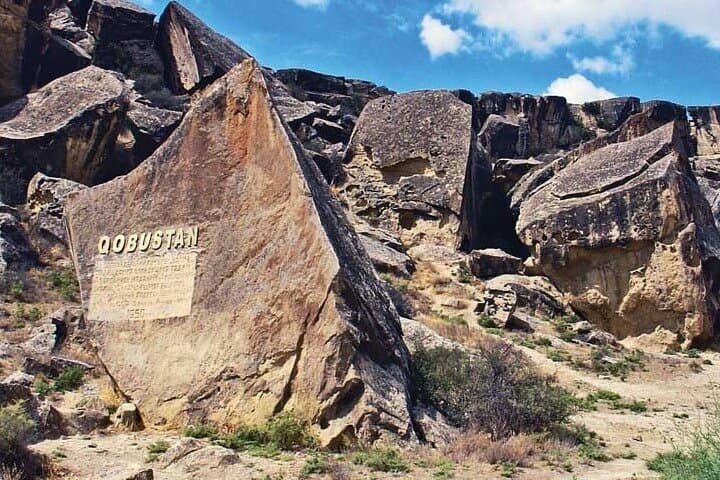
A morning bus slips out of Baku and the city’s glass facades and cranes fall away, replaced by a low, wind-sheared plain where the earth seems to be thinking aloud. By the time the diesel hush of the coach eases and you step onto the cracked ground at Gobustan, the air smells faintly of salt and old fire; a silent gallery of rocks rises like pages turned back to reveal human marks from ten thousand years ago.
Verified experiences and guided adventures in the surrounding area.
Operated by ATI · Baku, Absheron
A morning bus slips out of Baku and the city’s glass facades and cranes fall away, replaced by a low, wind-sheared plain where the earth seems to be thinking aloud. By the time the diesel hush of the coach eases and you step onto the cracked ground at Gobustan, the air smells faintly of salt and old fire; a silent gallery of rocks rises like pages turned back to reveal human marks from ten thousand years ago.
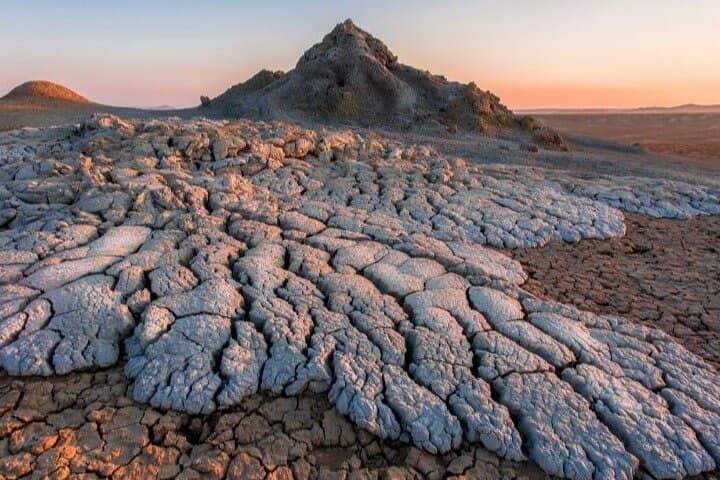
Walk the carved trails and the petroglyphs begin to talk: hunters, boats, strange ritual scenes scratched into volcanic stone. The museum lays out the chronology—Paleolithic camps, the slow expansion of herding cultures, the strategic pulse of the Caspian coast—and then the real work of the day is geological. A dirt road takes you closer to mud volcanoes where blue-gray slurries bubble and cough; steam and sulfur punctuate the landscape, and legends of djinn feel less like myth than explanations locals still whisper. The guide threads history and geology together—how subterranean gases and oil fields feed these eruptions, and why the Absheron peninsula has been a crossroads since antiquity.
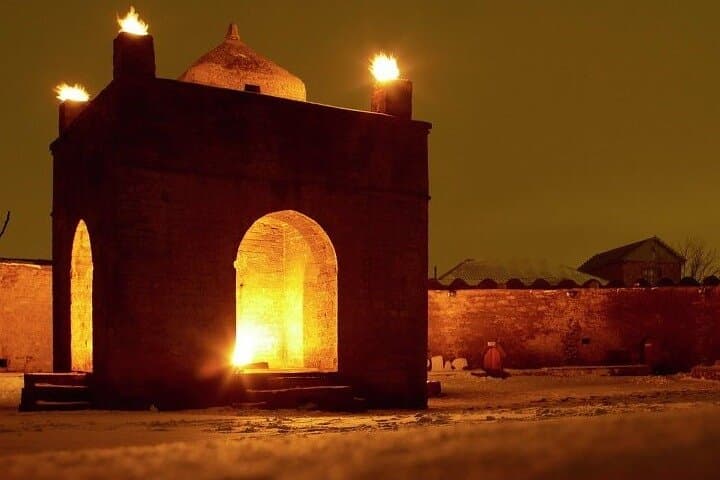
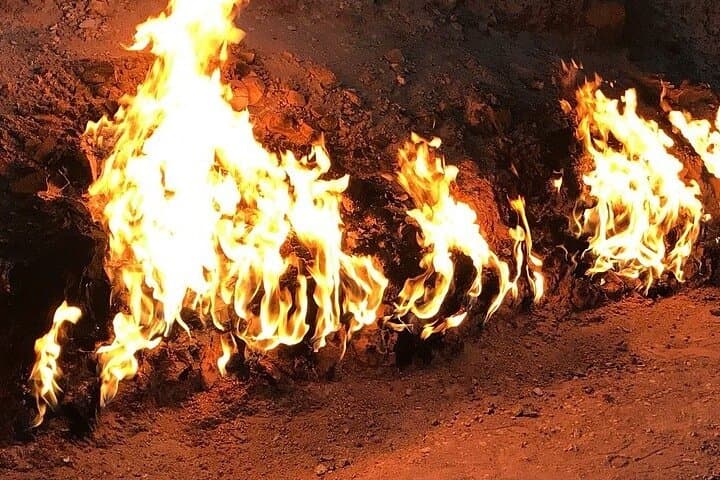
In the afternoon the route turns toward Absheron’s strange human-made reliquaries: the Ateshgah fire temple where traders on the Silk Road paused before the caravanserai, and Yanardagh, the Burning Mountain, which has spit natural gas flames into the air for centuries. From the Yanardagh observation deck you can see oil rigs on the horizon and the bow of the Caspian—industrial and primordial side by side.
This tour is equal parts archaeology and raw earth science, and the practical side matters. Expect several short walks on uneven rock and a stretch of road to the mud volcanoes that can be bumpy. Comfortable shoes, sun protection, and a daypack for water and a camera will make the day move from interesting to effortless.
Local etiquette is simple: petroglyphs are fragile—do not touch or climb on marked sites—and inside the Ateshgah speak quietly and remove headwear where appropriate. Photography is excellent nearly everywhere but brings contrast challenges; compose for low angles to include the Caspian’s light.
Timing helps: an early start avoids midday heat at the open-air sites and lets the low light make the petroglyphs read on camera. The tour runs about eight to nine hours and returns to central Baku in the evening—enough time for lunch at a local restaurant where lamb and pilaf ground the day in present-day Azerbaijan.
Whether you arrive seeking geology, history, or a concise primer on the region’s culture, the Gobustan–Absheron loop compresses a lot of Azerbaijan into a single, well-paced day: rock art that predates nations, mud that remembers the sea, and a flame that refuses to go out.
easy.
8–9 hours.
Light fitness; able to stand and walk short uneven trails several times during the day.
The full-day tour lasts about 8–9 hours, departing from central Baku in the morning and returning in the evening.
Yes—operators list the tour as physically easy with short walks; however, uneven terrain may be challenging for some mobility-limited travelers.
Admission to Gobustan National Reserve and sites like Ateshgah and Yanardagh is included as noted in the itinerary.
Guides are provided in English and Russian; check ahead for other language needs when booking.
A three-course lunch is included at a central Baku restaurant during the tour, so bring snacks only if you have dietary restrictions.
Yes, photography is allowed at most outdoor sites; avoid flash or touching rock art, and follow any onsite restrictions inside museum areas.
Gobustan preserves rock art spanning millennia and shows continuous human presence tied to the Caspian’s shifting coastline; Absheron’s natural gas seeps shaped both ritual (fire temples) and industry (oil fields).
Petroglyphs are vulnerable to erosion and vandalism; visitors should stay on trails and follow guide instructions to protect fragile surfaces.
ATI operates guided outdoor trips and adventures with an emphasis on safety, stewardship, and memorable experiences.
A morning bus slips out of Baku and the city’s glass facades and cranes fall away, replaced by a low, wind-sheared plain where the earth seems to be thinking aloud. By the time the diesel hush of the coach eases and you step onto the cracked ground at Gobustan, the air smells faintly of salt and old fire; a silent gallery of rocks rises like pages turned back to reveal human marks from ten thousand years ago.
A morning bus slips out of Baku and the city’s glass facades and cranes fall away, replaced by a low, wind-sheared plain where the earth seems to be thinking aloud. By the time the diesel hush of the coach eases and you step onto the cracked ground at Gobustan, the air smells faintly of salt and old fire; a silent gallery of rocks rises like pages turned back to reveal human marks from ten thousand years ago.
Walk the carved trails and the petroglyphs begin to talk: hunters, boats, strange ritual scenes scratched into volcanic stone. The museum lays out the chronology—Paleolithic camps, the slow expansion of herding cultures, the strategic pulse of the Caspian coast—and then the real work of the day is geological. A dirt road takes you closer to mud volcanoes where blue-gray slurries bubble and cough; steam and sulfur punctuate the landscape, and legends of djinn feel less like myth than explanations locals still whisper. The guide threads history and geology together—how subterranean gases and oil fields feed these eruptions, and why the Absheron peninsula has been a crossroads since antiquity.
In the afternoon the route turns toward Absheron’s strange human-made reliquaries: the Ateshgah fire temple where traders on the Silk Road paused before the caravanserai, and Yanardagh, the Burning Mountain, which has spit natural gas flames into the air for centuries. From the Yanardagh observation deck you can see oil rigs on the horizon and the bow of the Caspian—industrial and primordial side by side.
This tour is equal parts archaeology and raw earth science, and the practical side matters. Expect several short walks on uneven rock and a stretch of road to the mud volcanoes that can be bumpy. Comfortable shoes, sun protection, and a daypack for water and a camera will make the day move from interesting to effortless.
Local etiquette is simple: petroglyphs are fragile—do not touch or climb on marked sites—and inside the Ateshgah speak quietly and remove headwear where appropriate. Photography is excellent nearly everywhere but brings contrast challenges; compose for low angles to include the Caspian’s light.
Timing helps: an early start avoids midday heat at the open-air sites and lets the low light make the petroglyphs read on camera. The tour runs about eight to nine hours and returns to central Baku in the evening—enough time for lunch at a local restaurant where lamb and pilaf ground the day in present-day Azerbaijan.
Whether you arrive seeking geology, history, or a concise primer on the region’s culture, the Gobustan–Absheron loop compresses a lot of Azerbaijan into a single, well-paced day: rock art that predates nations, mud that remembers the sea, and a flame that refuses to go out.