THE ADVENTURE COLLECTIVE® · Independent discovery and booking for outdoor travel

Move through Sonoma’s oldest vineyards on a guided Segway tour that combines hands-on training, country-road cruising, and winery stops. It’s an easy, scenic way to cover more ground while tasting the region’s history and wines.
Move through Sonoma’s oldest vineyards on a guided Segway tour that combines hands-on training, country-road cruising, and winery stops. It’s an easy, scenic way to cover more ground while tasting the region’s history and wines.
The hum of wheels and the scent of fermenting grape must meet you at the edge of a vineyard road. Riders line up for short, focused Segway training on a grassy lot until balance feels routine, then the guide leads the group onto quiet country lanes where century-old head-trained vines march in rows and oak-studded ridgelines frame the valley.
Verified experiences and guided adventures in the surrounding area.
The hum of wheels and the scent of fermenting grape must meet you at the edge of a vineyard road. Riders line up for short, focused Segway training on a grassy lot until balance feels routine, then the guide leads the group onto quiet country lanes where century-old head-trained vines march in rows and oak-studded ridgelines frame the valley.
Sonoma County is one of California’s earliest wine regions; vineyards here sit on uplifted marine terraces and volcanic soils that feed grapes with minerality and depth. The tour moves through properties that helped define American winemaking—tasting rooms often occupy former barns or historic estate houses—so each stop is equal parts landscape and local story. Guides mix notes on varietals with on-the-ground history: how Mission grapes gave way to Cabernet, and how Prohibition-era closures reshaped small estates.
Expect flat to rolling paved and dirt lanes, brief trail crossings, and slow-speed cruising between tasting rooms. The pace keeps the scenery immediate: wind pushing through vine leaves, the river valley below nudging cool air up the slope. Practicalities matter—rides last about 3.5 hours, include training, and require standing balance rather than hiking fitness. Bring a refillable water bottle, sun protection, and comfortable shoes; plan for tastings by arranging transport afterward.
This experience is as much about flow as flavor: the Segway extends your range without masking the terrain. It’s an efficient, playful way to sample Sonoma’s wine country while staying close to the land.
easy.
3–4 hours.
Able to stand and balance for several hours; basic mobility and no serious back or balance issues.
No—tours begin with one-on-one training in an open area and only require basic balance and comfort standing for the tour duration.
Tasting policies vary by stop; some include a tasting while others charge a fee—confirm details with the operator when booking.
Operators typically set minimum age (often 10–12) and weight/height limits for safety—check the specific tour policy before reserving.
Tours may proceed in light rain with waterproof layers, but heavy storms can trigger rescheduling or cancellation for safety; confirm the operator’s weather policy.
Sonoma played a key role in California’s wine history; many estates date to the 19th century when winemaking shifted from Mission-era plantings to commercial vineyards.
Many Sonoma wineries practice sustainable and organic viticulture—stay on designated paths, respect private property, and pack out waste to minimize impact.
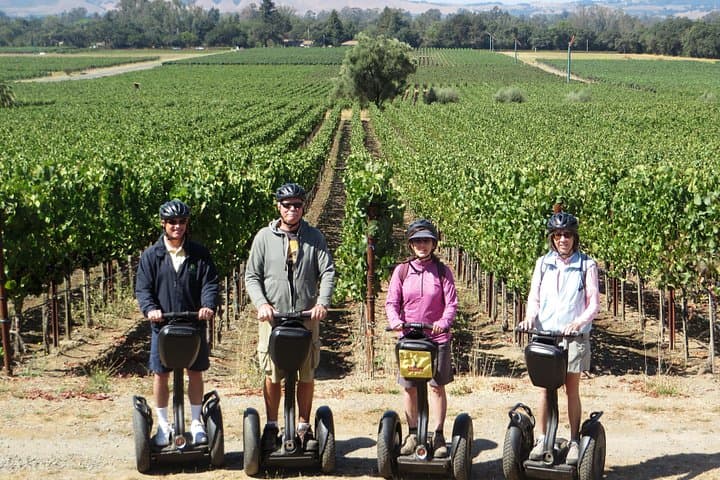
The hum of wheels and the scent of fermenting grape must meet you at the edge of a vineyard road. Riders line up for short, focused Segway training on a grassy lot until balance feels routine, then the guide leads the group onto quiet country lanes where century-old head-trained vines march in rows and oak-studded ridgelines frame the valley.
The hum of wheels and the scent of fermenting grape must meet you at the edge of a vineyard road. Riders line up for short, focused Segway training on a grassy lot until balance feels routine, then the guide leads the group onto quiet country lanes where century-old head-trained vines march in rows and oak-studded ridgelines frame the valley.
Sonoma County is one of California’s earliest wine regions; vineyards here sit on uplifted marine terraces and volcanic soils that feed grapes with minerality and depth. The tour moves through properties that helped define American winemaking—tasting rooms often occupy former barns or historic estate houses—so each stop is equal parts landscape and local story. Guides mix notes on varietals with on-the-ground history: how Mission grapes gave way to Cabernet, and how Prohibition-era closures reshaped small estates.
Expect flat to rolling paved and dirt lanes, brief trail crossings, and slow-speed cruising between tasting rooms. The pace keeps the scenery immediate: wind pushing through vine leaves, the river valley below nudging cool air up the slope. Practicalities matter—rides last about 3.5 hours, include training, and require standing balance rather than hiking fitness. Bring a refillable water bottle, sun protection, and comfortable shoes; plan for tastings by arranging transport afterward.
This experience is as much about flow as flavor: the Segway extends your range without masking the terrain. It’s an efficient, playful way to sample Sonoma’s wine country while staying close to the land.