THE ADVENTURE COLLECTIVE® · Independent discovery and booking for outdoor travel

Walk inside a 300-meter-deep gorge carved by ancient ice. Glacier Canyon in Grindelwald delivers close-up geology, rushing water, and an accessible wooden walkway into one of the Bernese Oberland’s most tactile attractions.
Walk inside a 300-meter-deep gorge carved by ancient ice. Glacier Canyon in Grindelwald delivers close-up geology, rushing water, and an accessible wooden walkway into one of the Bernese Oberland’s most tactile attractions.
You enter the canyon the way explorers have for a century: through a narrow mouth where light thins and the air cools. The wooden walkway hugs sheer walls of dark rock, and every step echoes against a river that has been impatiently scouring its bed for millions of years. Water hurls itself through throat-like channels, throwing spray that briefly fogs your lenses and makes the stone smell of mineral and cold.
Verified experiences and guided adventures in the surrounding area.
Operated by Outdoor · Grindelwald, Bern
You enter the canyon the way explorers have for a century: through a narrow mouth where light thins and the air cools. The wooden walkway hugs sheer walls of dark rock, and every step echoes against a river that has been impatiently scouring its bed for millions of years. Water hurls itself through throat-like channels, throwing spray that briefly fogs your lenses and makes the stone smell of mineral and cold.
This is the Gletscherschlucht, the Glacier Canyon that once lay beneath an ice sheet so vast it ground 300 meters of rock away. Today the lower glacier has retreated, but the gorge remains — a geological cross-section of time, riddled with smooth funnels, fluted walls, and tunnels carved by relentless meltwater. Information panels punctuate the walk, translating deep time into immediate facts: this rock was written by pressure, melted by climate, and revealed by retreat.
Grindelwald itself is a high-alpine village in Canton Bern where tourism and shepherding have overlapped for centuries. The gorge became a popular local attraction in the 19th century when visitors followed paved trails and wooden galleries into the cleft, marveling at the temperature shift as sunlight gives way to shade. The Crystal Museum next door adds a cultural layer — local minerals, alpine folklore, and the story of how tourism shaped the valley.
The experience is sensory and compact: the roar of the Lütschine River, a graffiti of lichen on damp stone, and wind that funnels through the narrows and surprises you with a cold pulse. The walk is accessible, family-friendly, and readable for most visitors, but the canyon has personality — it demands attention and rewards slower steps with details you miss at a run.
Practical guidance: plan 60 minutes if you only want the canyon, 2–3 hours if you add the Crystal Museum and a village stroll. Wear grippy footwear; the wooden walkway and occasional spray make surfaces slick. Mornings tend to be quieter for photography and to avoid tour groups. The site is wheelchair and stroller accessible on the main path, though some vantage points use stairs.
Bring a lightweight waterproof layer and a small towel for lenses. If you want dramatic light, catch the gorge at low sun when raking beams highlight striations in the rock. Respect barriers: the walkways protect both visitors and fragile geology. Entrance fees support maintenance and local conservation efforts — a direct way to keep the canyon open for the next generation of observers.
easy.
1–5 hours.
Suitable for most visitors including families and older adults; basic mobility required for walking ramps and short stairs.
The wooden walkway through the canyon covers roughly 1 km and most visitors spend 45–90 minutes including viewpoints and information panels.
Yes; the main path is stroller and wheelchair accessible, though some lookout points may have steps—check on-site signage.
Service animals are allowed; pets policies can vary so keep dogs on a short leash and avoid letting them off the path.
The canyon is generally open year-round but may close for maintenance or extreme weather; check local listings before traveling.
Yes; the Crystal Museum is adjacent and the village, Pfingstegg, and nearby trails make good half-day or full-day itineraries.
No — the site is well-signed and accessible independently, though guides add geological or historical context if you prefer deeper interpretation.
The gorge was sculpted over hundreds of millions of years by ice and meltwater; 19th-century tourist infrastructure established the wooden galleries visitors use today.
Stay on designated walkways to protect fragile rock faces and stream habitats; entrance fees contribute to maintenance and local conservation programs.
Outdoor operates guided outdoor trips and adventures with an emphasis on safety, stewardship, and memorable experiences.
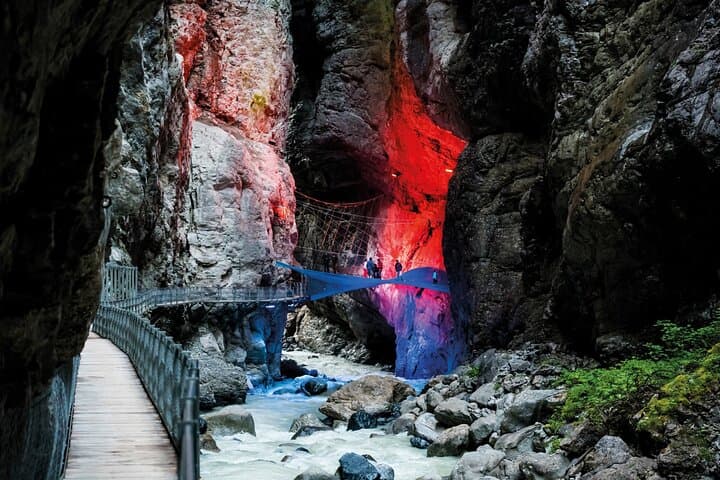
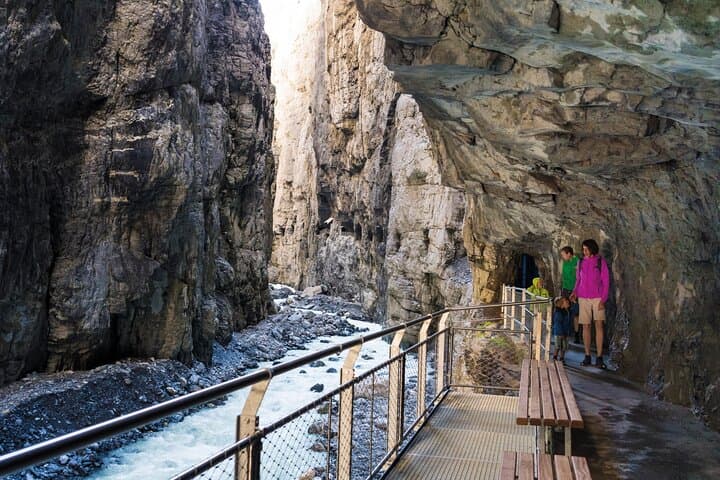
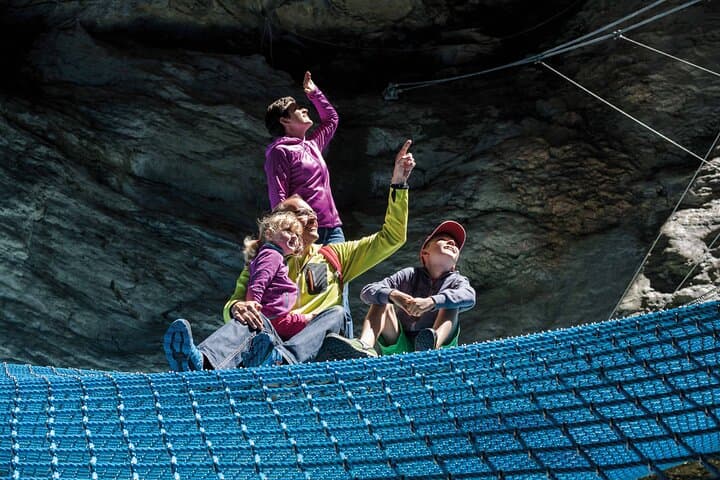
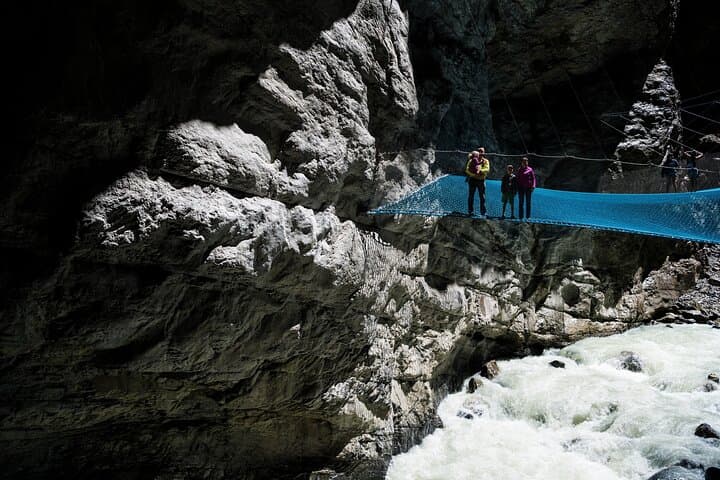
You enter the canyon the way explorers have for a century: through a narrow mouth where light thins and the air cools. The wooden walkway hugs sheer walls of dark rock, and every step echoes against a river that has been impatiently scouring its bed for millions of years. Water hurls itself through throat-like channels, throwing spray that briefly fogs your lenses and makes the stone smell of mineral and cold.
You enter the canyon the way explorers have for a century: through a narrow mouth where light thins and the air cools. The wooden walkway hugs sheer walls of dark rock, and every step echoes against a river that has been impatiently scouring its bed for millions of years. Water hurls itself through throat-like channels, throwing spray that briefly fogs your lenses and makes the stone smell of mineral and cold.
This is the Gletscherschlucht, the Glacier Canyon that once lay beneath an ice sheet so vast it ground 300 meters of rock away. Today the lower glacier has retreated, but the gorge remains — a geological cross-section of time, riddled with smooth funnels, fluted walls, and tunnels carved by relentless meltwater. Information panels punctuate the walk, translating deep time into immediate facts: this rock was written by pressure, melted by climate, and revealed by retreat.
Grindelwald itself is a high-alpine village in Canton Bern where tourism and shepherding have overlapped for centuries. The gorge became a popular local attraction in the 19th century when visitors followed paved trails and wooden galleries into the cleft, marveling at the temperature shift as sunlight gives way to shade. The Crystal Museum next door adds a cultural layer — local minerals, alpine folklore, and the story of how tourism shaped the valley.
The experience is sensory and compact: the roar of the Lütschine River, a graffiti of lichen on damp stone, and wind that funnels through the narrows and surprises you with a cold pulse. The walk is accessible, family-friendly, and readable for most visitors, but the canyon has personality — it demands attention and rewards slower steps with details you miss at a run.
Practical guidance: plan 60 minutes if you only want the canyon, 2–3 hours if you add the Crystal Museum and a village stroll. Wear grippy footwear; the wooden walkway and occasional spray make surfaces slick. Mornings tend to be quieter for photography and to avoid tour groups. The site is wheelchair and stroller accessible on the main path, though some vantage points use stairs.
Bring a lightweight waterproof layer and a small towel for lenses. If you want dramatic light, catch the gorge at low sun when raking beams highlight striations in the rock. Respect barriers: the walkways protect both visitors and fragile geology. Entrance fees support maintenance and local conservation efforts — a direct way to keep the canyon open for the next generation of observers.