THE ADVENTURE COLLECTIVE® · Independent discovery and booking for outdoor travel

Spend a full day moving between ancient stones and lively bazaars on a private Cairo tour. Ride a camel at Giza, explore the Egyptian Museum’s royal treasures, and lose yourself in Khan el-Khalili with a local guide.
Spend a full day moving between ancient stones and lively bazaars on a private Cairo tour. Ride a camel at Giza, explore the Egyptian Museum’s royal treasures, and lose yourself in Khan el-Khalili with a local guide.
You step onto sun-baked stone where the desert insists on moving—sand scuffs the soles of your shoes and the Great Pyramid looms, patient and precise, measuring time in shadows.
Verified experiences and guided adventures in the surrounding area.
You step onto sun-baked stone where the desert insists on moving—sand scuffs the soles of your shoes and the Great Pyramid looms, patient and precise, measuring time in shadows.
This full-day private tour threads three eras of Cairo: the Bronze Age engineering of Giza, the pharaonic treasures housed in the Egyptian Museum, and the living marketplace culture of Khan el-Khalili. At Giza you’ll circle the funerary complex and the Valley Temple, stand near the Sphinx and, if you choose, take a camel ride along the plateau’s edge where wind and sand push at your balance like an inquisitive companion.
Geology here is simple and stark: limestone bedrock raised and worked into monuments that have shed millennia of wind. The museum’s galleries collect funerary riches—gold, cartonnage and mummies—offering a direct line to rulers and rituals that shaped the Nile valley.
Khan el-Khalili trades in scent and story: copper work, spices and narrow alleys where bargaining is part of the architecture.
Practically: expect about eight hours on foot with uneven stone, short climbs and crowded museum rooms. Wear sturdy shoes, sun protection and carry water. Aim for early morning at Giza to avoid heat and the biggest crowds, then reserve time for a paced museum tour and a relaxed lunch near the bazaar. Respect signage at archaeological sites—climbing or touching fragile stones accelerates decay. With a guide, you get context and logistics handled, leaving you to watch the desert keep its secrets while you collect a day of tangible history.
moderate.
8 hours.
Moderate—able to walk several miles over uneven terrain and stand through museum exhibits.
Expect moderate walking across uneven ground at Giza, short climbs, and museum galleries—plan for several miles over the day.
Camel rides are typically included or optional; animals are used to riders but follow the handler’s safety instructions and mount/dismount carefully.
Photography rules change—non-flash photos are often allowed in some rooms but restricted in others; follow on-site signage and guide advice.
Policies vary by operator; confirm whether museum entry, lunch and camel ride fees are covered when booking the private tour.
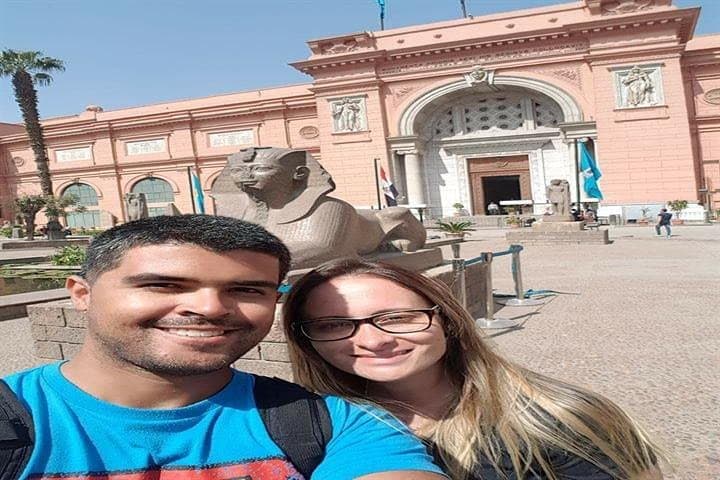
The Great Pyramid of Khufu dates to around 2560 BCE; the Egyptian Museum in Tahrir holds many finds from the Pharaonic era, including Tutankhamun’s treasures.
Archaeological sites are vulnerable—avoid touching stonework or leaving litter. Support licensed guides and local conservation fees where offered.
You step onto sun-baked stone where the desert insists on moving—sand scuffs the soles of your shoes and the Great Pyramid looms, patient and precise, measuring time in shadows.
You step onto sun-baked stone where the desert insists on moving—sand scuffs the soles of your shoes and the Great Pyramid looms, patient and precise, measuring time in shadows.
This full-day private tour threads three eras of Cairo: the Bronze Age engineering of Giza, the pharaonic treasures housed in the Egyptian Museum, and the living marketplace culture of Khan el-Khalili. At Giza you’ll circle the funerary complex and the Valley Temple, stand near the Sphinx and, if you choose, take a camel ride along the plateau’s edge where wind and sand push at your balance like an inquisitive companion.
Geology here is simple and stark: limestone bedrock raised and worked into monuments that have shed millennia of wind. The museum’s galleries collect funerary riches—gold, cartonnage and mummies—offering a direct line to rulers and rituals that shaped the Nile valley.
Khan el-Khalili trades in scent and story: copper work, spices and narrow alleys where bargaining is part of the architecture.
Practically: expect about eight hours on foot with uneven stone, short climbs and crowded museum rooms. Wear sturdy shoes, sun protection and carry water. Aim for early morning at Giza to avoid heat and the biggest crowds, then reserve time for a paced museum tour and a relaxed lunch near the bazaar. Respect signage at archaeological sites—climbing or touching fragile stones accelerates decay. With a guide, you get context and logistics handled, leaving you to watch the desert keep its secrets while you collect a day of tangible history.