THE ADVENTURE COLLECTIVE® · Independent discovery and booking for outdoor travel

Walk up to the only surviving ancient Wonder of the world on a private half-day tour of the Giza Plateau. Includes a one-hour camel ride, a certified Egyptology guide, and lunch at a local restaurant.
Walk up to the only surviving ancient Wonder of the world on a private half-day tour of the Giza Plateau. Includes a one-hour camel ride, a certified Egyptology guide, and lunch at a local restaurant.
The wind on the Giza Plateau pushes fine sand across ancient stone; you step from a cool, air-conditioned vehicle into a wide, sunlit sweep where the Great Pyramid looms like a deliberate geometry of time. Your Egyptologist guide guides the rhythm — stop, listen, photograph — while camels wait with patient, swaying grace for a one-hour loop around the monuments.
Verified experiences and guided adventures in the surrounding area.
Operated by Egypt Gift Tours · Giza, Cairo Governorate
The wind on the Giza Plateau pushes fine sand across ancient stone; you step from a cool, air-conditioned vehicle into a wide, sunlit sweep where the Great Pyramid looms like a deliberate geometry of time. Your Egyptologist guide guides the rhythm — stop, listen, photograph — while camels wait with patient, swaying grace for a one-hour loop around the monuments.
These monuments date to the Fourth Dynasty (c. 2600–2500 BCE): the Great Pyramid (Khufu) is the only surviving Wonder of the ancient world, Chephren’s pyramid still shows casing stone near its peak, and the Sphinx, carved from the native bedrock, watches the plateau as both guardian and riddle. The plateau’s geology is limestone bedrock weathered into stepped platforms; archaeologists later reused nearby desert stone for temples and boats, examples of which appear in the Solar Boat Museum.
Culturally, the site sits at the intersection of modern Cairo life and deep antiquity — vendors, conservation crews, and museum curators all share the same horizon. Practicalities matter: expect uneven ground, strong sun, and brisk bargaining if you visit the shops. Entrance fees and optional interior-pyramid tickets are extra; the tour includes private pickup, an English-speaking Egyptology guide, a camel ride, and lunch at a local restaurant.
Bring sun protection, a refillable water bottle, and sturdy shoes. If you want better photos, plan early morning or late afternoon light. Respect ropes and signage — these ruins are fragile and travel here has real impact.
easy.
4 hours.
Suitable for most fitness levels; involves moderate walking on uneven terrain and short climbs over rocks
No — standard tour price covers guide, transport, camel ride and lunch; site entrance fees and optional pyramid interior tickets are paid separately and can usually be paid by card.
Yes — a one-hour camel ride around the plateau is included as part of this private half-day tour.
The tour operator lists wheelchair accessibility, but the plateau itself has uneven ground and limited paved paths; contact the operator in advance to arrange specifics.
Yes — the tour includes a professional English-speaking Egyptology guide who will provide historical context throughout the visit.
The largest pyramids at Giza were built during Egypt’s Fourth Dynasty (about 2600–2500 BCE) as funerary monuments for pharaohs like Khufu and Khafre; the Sphinx likely represents Khafre’s visage carved from the existing limestone outcrop.
Heavy visitor traffic and nearby urban growth stress the site; stick to marked paths, avoid touching monuments, and follow guide instructions to support ongoing conservation efforts.
Egypt Gift Tours operates guided outdoor trips and adventures with an emphasis on safety, stewardship, and memorable experiences.


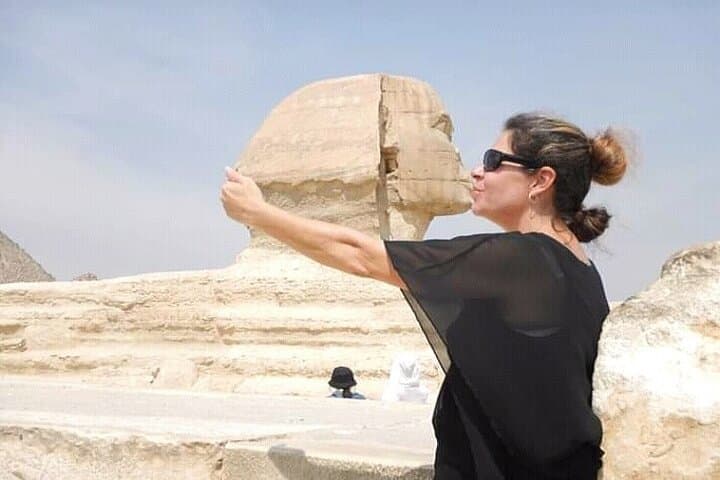

The wind on the Giza Plateau pushes fine sand across ancient stone; you step from a cool, air-conditioned vehicle into a wide, sunlit sweep where the Great Pyramid looms like a deliberate geometry of time. Your Egyptologist guide guides the rhythm — stop, listen, photograph — while camels wait with patient, swaying grace for a one-hour loop around the monuments.
The wind on the Giza Plateau pushes fine sand across ancient stone; you step from a cool, air-conditioned vehicle into a wide, sunlit sweep where the Great Pyramid looms like a deliberate geometry of time. Your Egyptologist guide guides the rhythm — stop, listen, photograph — while camels wait with patient, swaying grace for a one-hour loop around the monuments.
These monuments date to the Fourth Dynasty (c. 2600–2500 BCE): the Great Pyramid (Khufu) is the only surviving Wonder of the ancient world, Chephren’s pyramid still shows casing stone near its peak, and the Sphinx, carved from the native bedrock, watches the plateau as both guardian and riddle. The plateau’s geology is limestone bedrock weathered into stepped platforms; archaeologists later reused nearby desert stone for temples and boats, examples of which appear in the Solar Boat Museum.
Culturally, the site sits at the intersection of modern Cairo life and deep antiquity — vendors, conservation crews, and museum curators all share the same horizon. Practicalities matter: expect uneven ground, strong sun, and brisk bargaining if you visit the shops. Entrance fees and optional interior-pyramid tickets are extra; the tour includes private pickup, an English-speaking Egyptology guide, a camel ride, and lunch at a local restaurant.
Bring sun protection, a refillable water bottle, and sturdy shoes. If you want better photos, plan early morning or late afternoon light. Respect ropes and signage — these ruins are fragile and travel here has real impact.