THE ADVENTURE COLLECTIVE® · Independent discovery and booking for outdoor travel

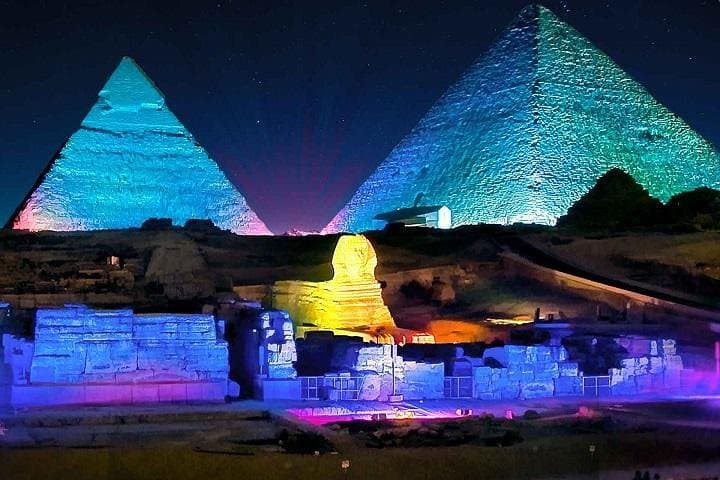
Experience the Giza Plateau after dark as lights, lasers and narration animate the Great Pyramids and Sphinx. This evening production blends history, projection mapping, and music to retell ancient Egypt’s story on the stones themselves.
Experience the Giza Plateau after dark as lights, lasers and narration animate the Great Pyramids and Sphinx. This evening production blends history, projection mapping, and music to retell ancient Egypt’s story on the stones themselves.
When night descends on the Giza Plateau, the stones take on a new voice: beams of light trace angles carved millennia ago and the Sphinx’s face reclaims the spotlight as a recorded narration begins. Sitting on a low wall or in a theater seat a short walk from the Great Pyramid, you feel the desert breathe around the monuments as lasers and projections redraw pharaonic history across limestone facades.
Verified experiences and guided adventures in the surrounding area.
Operated by Oman Day Tours · Giza, Giza
When night descends on the Giza Plateau, the stones take on a new voice: beams of light trace angles carved millennia ago and the Sphinx’s face reclaims the spotlight as a recorded narration begins. Sitting on a low wall or in a theater seat a short walk from the Great Pyramid, you feel the desert breathe around the monuments as lasers and projections redraw pharaonic history across limestone facades.
The show is a modern layer over an ancient site—Khufu’s pyramid (c. 2560 BCE) and its neighbors were built during Egypt’s Old Kingdom to serve as monumental tombs and ritual nodes. The plateau’s geology is hard, wind-polished limestone and sand that has shifted around pathways and temples over thousands of years; the performance highlights the mummification temple, pyramid faces and the Sphinx while narrating builders’ stories against a score designed to amplify drama.
Culturally, the production is meant to educate and entertain: the Sphinx “speaks” in a sonorous voice, and light designers use the plateau’s contours to stage scenes of funerary rites and royal power. Local guides often add context before the show—ask about solar boats and the nearby museum for a fuller picture.
Practical guidance: the event runs roughly 60–90 minutes, and bookings commonly include hotel transfers. Expect dim walking surfaces—bring a headlamp for the walk to and from parking, layer up for desert nights, and keep to designated paths to help protect the site. Photography is allowed but avoid flash and follow staff directions. The experience is low-impact physically but rich in historical spectacle—best timed either just after sunset or later to avoid crowds and heat.
easy.
2–4 hours (including transfers).
Minimal physical exertion; suitable for all fitness levels though walking over uneven sand/limestone is required
The on-site presentation runs about 60–90 minutes; transfers and hotel pickup/drop-off typically extend the booking to 2–4 hours.
Yes; content is educational and family-friendly, but families should supervise children around low walls, steps, and open desert areas.
Many bookings include air-conditioned transfers and meet-and-assist services—check the specific tour details for pickup times and pickup points.
Tickets are usually sold in advance; availability can vary so pre-booking is recommended, especially during peak tourist seasons.
The Giza Plateau served as a necropolis for Egypt’s Old Kingdom; the Great Pyramid was constructed for Pharaoh Khufu around 2560 BCE, while nearby temples and tombs supported funerary cults.
Visitors should stay on marked paths and avoid touching stone surfaces; local authorities control lighting and access to reduce wear on the monuments.
Oman Day Tours operates guided outdoor trips and adventures with an emphasis on safety, stewardship, and memorable experiences.
When night descends on the Giza Plateau, the stones take on a new voice: beams of light trace angles carved millennia ago and the Sphinx’s face reclaims the spotlight as a recorded narration begins. Sitting on a low wall or in a theater seat a short walk from the Great Pyramid, you feel the desert breathe around the monuments as lasers and projections redraw pharaonic history across limestone facades.
When night descends on the Giza Plateau, the stones take on a new voice: beams of light trace angles carved millennia ago and the Sphinx’s face reclaims the spotlight as a recorded narration begins. Sitting on a low wall or in a theater seat a short walk from the Great Pyramid, you feel the desert breathe around the monuments as lasers and projections redraw pharaonic history across limestone facades.
The show is a modern layer over an ancient site—Khufu’s pyramid (c. 2560 BCE) and its neighbors were built during Egypt’s Old Kingdom to serve as monumental tombs and ritual nodes. The plateau’s geology is hard, wind-polished limestone and sand that has shifted around pathways and temples over thousands of years; the performance highlights the mummification temple, pyramid faces and the Sphinx while narrating builders’ stories against a score designed to amplify drama.
Culturally, the production is meant to educate and entertain: the Sphinx “speaks” in a sonorous voice, and light designers use the plateau’s contours to stage scenes of funerary rites and royal power. Local guides often add context before the show—ask about solar boats and the nearby museum for a fuller picture.
Practical guidance: the event runs roughly 60–90 minutes, and bookings commonly include hotel transfers. Expect dim walking surfaces—bring a headlamp for the walk to and from parking, layer up for desert nights, and keep to designated paths to help protect the site. Photography is allowed but avoid flash and follow staff directions. The experience is low-impact physically but rich in historical spectacle—best timed either just after sunset or later to avoid crowds and heat.