THE ADVENTURE COLLECTIVE® · Independent discovery and booking for outdoor travel

Watch the Giza pyramids and the Sphinx come alive after dark with an audio-visual narration of pharaohs, builders and legends. This two-hour evening production pairs dramatic lighting with translation headsets and hotel pickup for a one-night primer on Ancient Egypt.
Watch the Giza pyramids and the Sphinx come alive after dark with an audio-visual narration of pharaohs, builders and legends. This two-hour evening production pairs dramatic lighting with translation headsets and hotel pickup for a one-night primer on Ancient Egypt.
Night falls and the Giza Plateau shifts from sun-baked geometry to a stage of shadow and light. Spotlights trace the angles of Cheops, Chefren and Mykerinos while a measured narration rides across the dry air—the Sphinx’s profile catching light like a slow-breathing guardian. Visitors gather on low terraces as recorded voices and music guide the story of builders, kings and landscapes older than city walls.
Verified experiences and guided adventures in the surrounding area.
Operated by Tamer Safari · Giza, Giza Governorate
Night falls and the Giza Plateau shifts from sun-baked geometry to a stage of shadow and light. Spotlights trace the angles of Cheops, Chefren and Mykerinos while a measured narration rides across the dry air—the Sphinx’s profile catching light like a slow-breathing guardian. Visitors gather on low terraces as recorded voices and music guide the story of builders, kings and landscapes older than city walls.
The script of the show is a compact history lesson: the Sphinx as guardian, the labor and logistics behind pyramid construction, and the lives of figures such as Thutmose IV and Tutankhamun. Geologically the plateau is bedrock limestone carved and quarried into architectural forms; that hard, wind-polished stone gives the nighttime projections crisp edges. Culturally the experience is theatrical rather than archaeological—translation headsets are provided in multiple languages and the narration blends mythic accounts with archaeological highlights.
Practical details matter: the production lasts about two hours and most operators include hotel pickup in Cairo or Giza and return transfers by air‑conditioned vehicle. Bring a light layer for desert nights, avoid flash photography to preserve the show and nearby monuments, and plan for security checks and short walks over uneven, sandy ground. Translation headsets are usually provided free; if you want close-up photos, eye-level vantage points are limited and tripods are often restricted.
Expect an accessible, evening theatrical introduction to ancient Egypt—less a deep-dive archaeological tour and more a dramatic primer under the open sky. Time your arrival with hotel pickup windows, carry ID for checkpoint entry, and let the plateau’s stones tell their story under the lights.
easy.
2 hours.
Suitable for most fitness levels; involves short walks over sandy, uneven ground and standing during the show.
Yes—multilingual translation headsets (English, French, German, Spanish, Italian, Russian, Japanese, Polish, Arabic and others) are typically provided free of charge.
Most tours include private hotel pickup and return by air‑conditioned vehicle; confirm pickup time and location at booking.
Flash photography is discouraged and tripods are often restricted—check with your provider and use a fast lens or high‑ISO settings for low-light photos.
The production runs about two hours; this typical package includes entrance fees and admission as listed by the operator.
The Sphinx and pyramids date to the Old Kingdom; the Great Pyramid (Khufu/Cheops) remains one of the oldest monumental structures still standing.
Light shows use focused projection to limit impact, but visitors should avoid litter and follow barriers to protect fragile stone and archaeological contexts.
Tamer Safari operates guided outdoor trips and adventures with an emphasis on safety, stewardship, and memorable experiences.
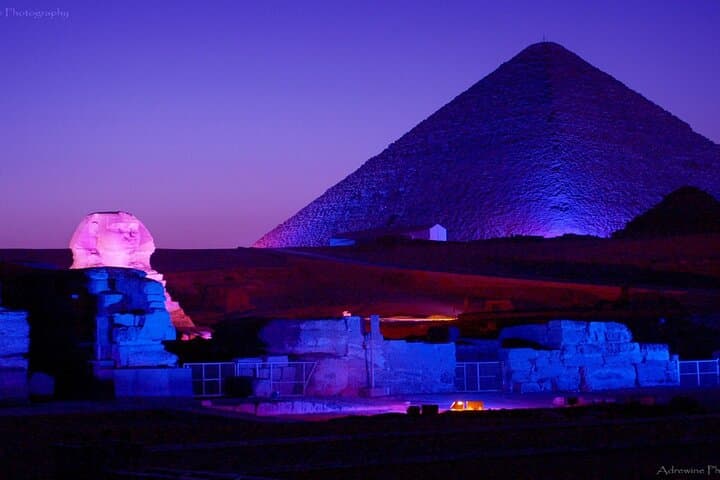
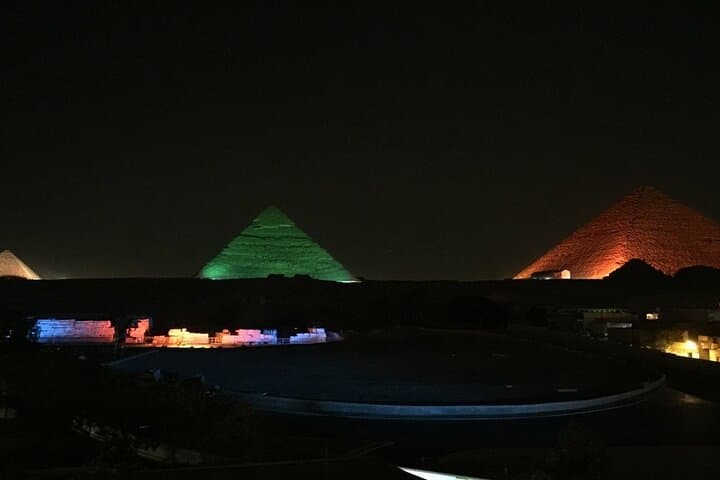
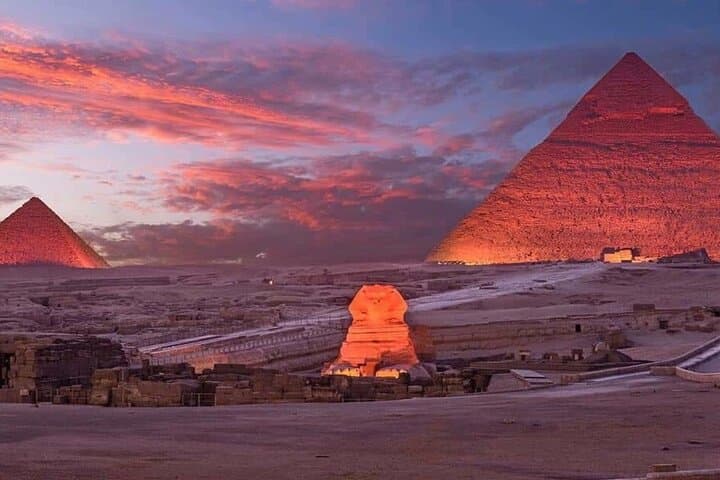
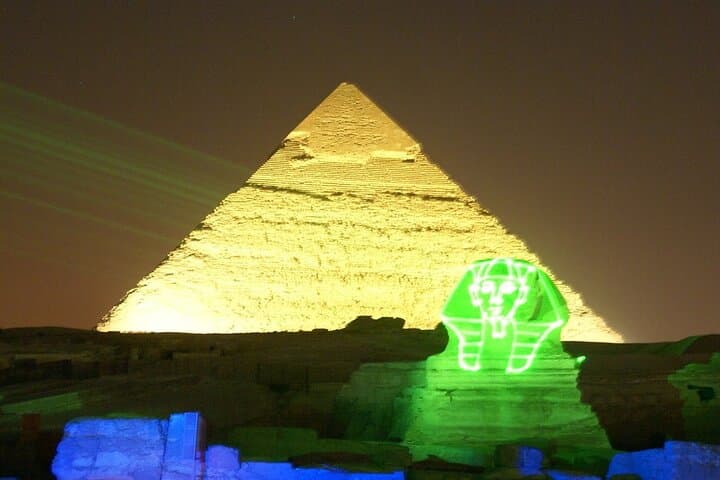
Night falls and the Giza Plateau shifts from sun-baked geometry to a stage of shadow and light. Spotlights trace the angles of Cheops, Chefren and Mykerinos while a measured narration rides across the dry air—the Sphinx’s profile catching light like a slow-breathing guardian. Visitors gather on low terraces as recorded voices and music guide the story of builders, kings and landscapes older than city walls.
Night falls and the Giza Plateau shifts from sun-baked geometry to a stage of shadow and light. Spotlights trace the angles of Cheops, Chefren and Mykerinos while a measured narration rides across the dry air—the Sphinx’s profile catching light like a slow-breathing guardian. Visitors gather on low terraces as recorded voices and music guide the story of builders, kings and landscapes older than city walls.
The script of the show is a compact history lesson: the Sphinx as guardian, the labor and logistics behind pyramid construction, and the lives of figures such as Thutmose IV and Tutankhamun. Geologically the plateau is bedrock limestone carved and quarried into architectural forms; that hard, wind-polished stone gives the nighttime projections crisp edges. Culturally the experience is theatrical rather than archaeological—translation headsets are provided in multiple languages and the narration blends mythic accounts with archaeological highlights.
Practical details matter: the production lasts about two hours and most operators include hotel pickup in Cairo or Giza and return transfers by air‑conditioned vehicle. Bring a light layer for desert nights, avoid flash photography to preserve the show and nearby monuments, and plan for security checks and short walks over uneven, sandy ground. Translation headsets are usually provided free; if you want close-up photos, eye-level vantage points are limited and tripods are often restricted.
Expect an accessible, evening theatrical introduction to ancient Egypt—less a deep-dive archaeological tour and more a dramatic primer under the open sky. Time your arrival with hotel pickup windows, carry ID for checkpoint entry, and let the plateau’s stones tell their story under the lights.