THE ADVENTURE COLLECTIVE® · Independent discovery and booking for outdoor travel

Spend a full day moving from the open dunes of Giza to the packed alleys of Khan el-Khalili. This private tour pairs a camel ride beside the pyramids with curated time inside the Egyptian Museum and a lively bazaar visit.
Spend a full day moving from the open dunes of Giza to the packed alleys of Khan el-Khalili. This private tour pairs a camel ride beside the pyramids with curated time inside the Egyptian Museum and a lively bazaar visit.
You arrive on the Giza Plateau with warm wind at your back and the Great Pyramid rising like a deliberate plan against the sky. Sand crunches underfoot as camels shift and the Sphinx watches with an unblinking stillness; the desert seems to test your pace, not your courage.
Verified experiences and guided adventures in the surrounding area.
You arrive on the Giza Plateau with warm wind at your back and the Great Pyramid rising like a deliberate plan against the sky. Sand crunches underfoot as camels shift and the Sphinx watches with an unblinking stillness; the desert seems to test your pace, not your courage.
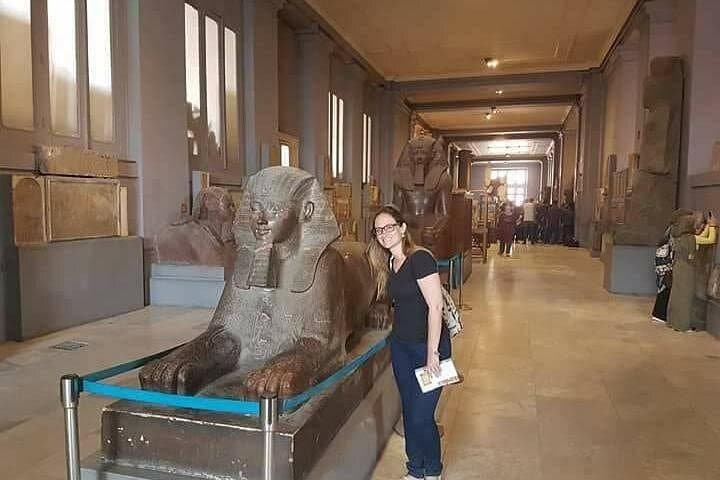
The plateau’s monuments date to the Fourth Dynasty (around 2560 BCE) and sit on a bed of limestone and ancient Nile silt—geology that both allowed their construction and now shapes how they erode. The Egyptian Museum in downtown Cairo houses millennia of material culture, from pharaonic funerary furniture to Tutankhamun’s treasures, giving context to what you’ve seen on the stones.
Khan el-Khalili’s narrow lanes contrast with the open plateau: merchants call, brass glints and coffee aromas pull you into Cairo’s living marketplace. This tour stitches three distinct layers—prehistoric engineering, curated museum collections, and contemporary street life—into a single day.
Practical guidance: start early to avoid midday heat and crowds, bring at least 2 liters of water, and wear sturdy closed-toe shoes for uneven sand and paved areas. Photography is generally permitted but can be restricted inside museum galleries; check with your guide before using tripods or flash. Expect short walks between highlights and brief time at each stop—plan for an 8-hour day with historic stands and active navigation of crowded market streets. Respect signage: climbing on monuments is prohibited and accelerates wear. With straightforward preparation, this full-day private tour delivers a compact, sensory primer on Egypt’s ancient and modern life.
moderate.
8 hours.
Moderate fitness; able to walk on sand and over uneven pavement for several hours, with occasional climbs and descents.
Yes—the advertised itinerary includes a short camel ride on the Giza Plateau as part of the full-day private tour.
Policies vary by operator—confirm whether site entrance fees and any supplemental pyramid interior tickets are included when you book.
Access inside pyramids is often limited, requires a special ticket, and may be subject to closures; check availability with your guide in advance.
Photography is generally allowed in the bazaar; inside the museum certain rooms restrict flash or tripods—ask your guide to avoid penalties.
The Giza pyramids were constructed as royal tombs during Egypt’s Old Kingdom (c. 2600–2500 BCE); the Egyptian Museum (established 1902) gathers artifacts spanning millennia of pharaonic rule.
High visitor numbers and urban pollution threaten fragile limestone and internal chambers; follow site rules, avoid touching stone surfaces, and support licensed guides to minimize impact.
You arrive on the Giza Plateau with warm wind at your back and the Great Pyramid rising like a deliberate plan against the sky. Sand crunches underfoot as camels shift and the Sphinx watches with an unblinking stillness; the desert seems to test your pace, not your courage.
You arrive on the Giza Plateau with warm wind at your back and the Great Pyramid rising like a deliberate plan against the sky. Sand crunches underfoot as camels shift and the Sphinx watches with an unblinking stillness; the desert seems to test your pace, not your courage.
The plateau’s monuments date to the Fourth Dynasty (around 2560 BCE) and sit on a bed of limestone and ancient Nile silt—geology that both allowed their construction and now shapes how they erode. The Egyptian Museum in downtown Cairo houses millennia of material culture, from pharaonic funerary furniture to Tutankhamun’s treasures, giving context to what you’ve seen on the stones.
Khan el-Khalili’s narrow lanes contrast with the open plateau: merchants call, brass glints and coffee aromas pull you into Cairo’s living marketplace. This tour stitches three distinct layers—prehistoric engineering, curated museum collections, and contemporary street life—into a single day.
Practical guidance: start early to avoid midday heat and crowds, bring at least 2 liters of water, and wear sturdy closed-toe shoes for uneven sand and paved areas. Photography is generally permitted but can be restricted inside museum galleries; check with your guide before using tripods or flash. Expect short walks between highlights and brief time at each stop—plan for an 8-hour day with historic stands and active navigation of crowded market streets. Respect signage: climbing on monuments is prohibited and accelerates wear. With straightforward preparation, this full-day private tour delivers a compact, sensory primer on Egypt’s ancient and modern life.