THE ADVENTURE COLLECTIVE® · Independent discovery and booking for outdoor travel

Walk the Giza Plateau from a panoramic ridge into the narrow corridors of the Great Pyramid. This private tour pairs priority access with measured historical context—ideal for travelers who want both scale and detail.
Walk the Giza Plateau from a panoramic ridge into the narrow corridors of the Great Pyramid. This private tour pairs priority access with measured historical context—ideal for travelers who want both scale and detail.
Sunlight slices across wind-scoured limestone as you approach the Giza Plateau: three sharp silhouettes—Khufu, Khafre and Menkaure—rise from ochre sands while the Sphinx watches with an expression carved across millennia.
Verified experiences and guided adventures in the surrounding area.
Operated by Misk Tours · Giza, Giza Governorate
Sunlight slices across wind-scoured limestone as you approach the Giza Plateau: three sharp silhouettes—Khufu, Khafre and Menkaure—rise from ochre sands while the Sphinx watches with an expression carved across millennia.
This private, guided excursion moves from panoramic overlooks into the engineered heart of Egypt’s Old Kingdom. The Great Pyramid of Khufu, built around 2560 BCE from millions of blocks, stands as both archaeological puzzle and architectural achievement; its interior passageways lead to the narrow King’s Chamber, where cramped corbelled walls and granite sarcophagus recall funerary practice and cosmology. Nearby, the Valley Temple and the Sphinx reveal ritual and royal portraiture; Khafre’s complex preserves traces of mummification rites and granite work that tell the social story of pharaonic power.
Geologically the plateau is a band of sedimentary limestone, cut by desert wind and human hands; culturally the site remains active, surrounded by Cairo’s urban sprawl and Bedouin vendors who still read the land differently than tourists do.
Practically: expect 4–5 hours on a mostly flat but open site with sun exposure and short uphill approaches to viewpoints. Interior access to Khufu requires stooping through a narrow, dim corridor; comfortable, stable footwear, sun protection, and a soft flashlight are sensible. Travel early in the day to avoid heat and crowds; bring water and patience for security checks. Guides will frame measured historical detail amid the drama of the stones—this is an encounter that balances visceral scale with careful contextual interpretation.
moderate.
4–5 hours.
Moderate fitness: mostly walking on level ground with short uphill approaches and a stooped interior crawl for the Great Pyramid.
Interior access is included with this tour but subject to site regulations and capacity limits; occasional temporary closures can occur for conservation or security reasons.
Children may enter but guardians should note the narrow, steep passages; infants and small children are often better kept out of interior sections for safety.
Much of the open plateau and panoramic viewpoints are reachable, but the interior of the Great Pyramid requires climbing stairs and crawling; full interior access is not wheelchair accessible.
Allocate 4–5 hours for pickup, transport, guided visits to the pyramids, the Valley Temple, Panoramic View, Sphinx and interior access; morning slots are preferable to avoid heat.
The Giza complex dates to Egypt’s Fourth Dynasty (c. 2600 BCE); Khufu’s pyramid is the only surviving structure of the ancient Seven Wonders and reflects complex logistical organization and ritual practice.
Ongoing preservation balances tourism with vulnerability to erosion, pollution and structural stress—staying on marked paths and following guide instructions helps minimize impact.
Misk Tours operates guided outdoor trips and adventures with an emphasis on safety, stewardship, and memorable experiences.

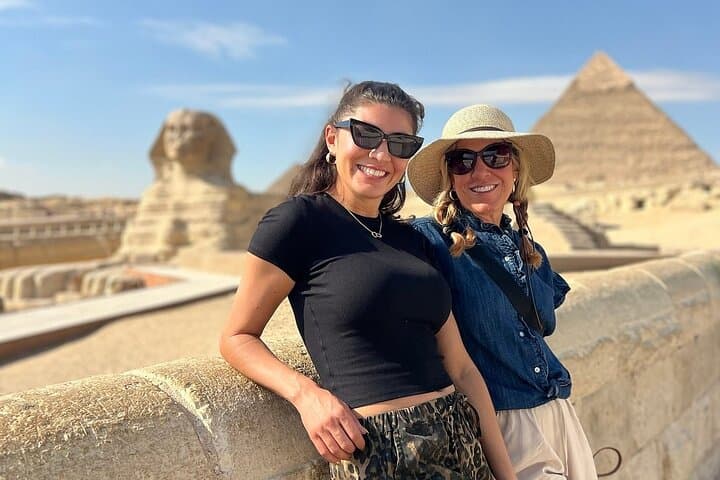

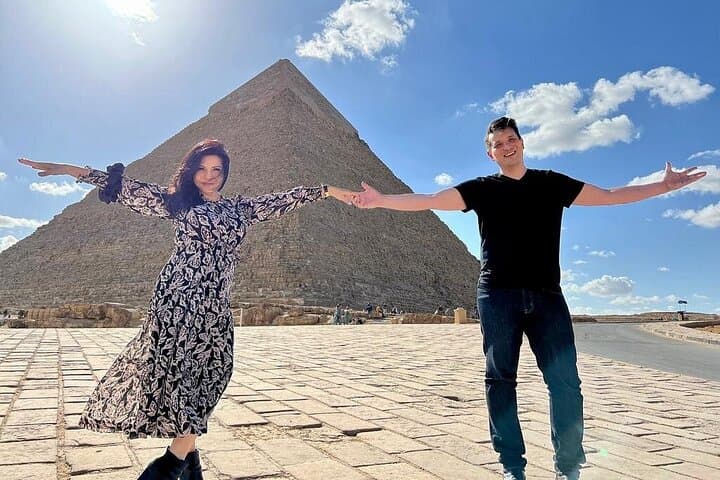
Sunlight slices across wind-scoured limestone as you approach the Giza Plateau: three sharp silhouettes—Khufu, Khafre and Menkaure—rise from ochre sands while the Sphinx watches with an expression carved across millennia.
Sunlight slices across wind-scoured limestone as you approach the Giza Plateau: three sharp silhouettes—Khufu, Khafre and Menkaure—rise from ochre sands while the Sphinx watches with an expression carved across millennia.
This private, guided excursion moves from panoramic overlooks into the engineered heart of Egypt’s Old Kingdom. The Great Pyramid of Khufu, built around 2560 BCE from millions of blocks, stands as both archaeological puzzle and architectural achievement; its interior passageways lead to the narrow King’s Chamber, where cramped corbelled walls and granite sarcophagus recall funerary practice and cosmology. Nearby, the Valley Temple and the Sphinx reveal ritual and royal portraiture; Khafre’s complex preserves traces of mummification rites and granite work that tell the social story of pharaonic power.
Geologically the plateau is a band of sedimentary limestone, cut by desert wind and human hands; culturally the site remains active, surrounded by Cairo’s urban sprawl and Bedouin vendors who still read the land differently than tourists do.
Practically: expect 4–5 hours on a mostly flat but open site with sun exposure and short uphill approaches to viewpoints. Interior access to Khufu requires stooping through a narrow, dim corridor; comfortable, stable footwear, sun protection, and a soft flashlight are sensible. Travel early in the day to avoid heat and crowds; bring water and patience for security checks. Guides will frame measured historical detail amid the drama of the stones—this is an encounter that balances visceral scale with careful contextual interpretation.