THE ADVENTURE COLLECTIVE® · Independent discovery and booking for outdoor travel

Explore Egypt’s Old Kingdom on a full-day circuit from Cairo to Giza, Memphis, and Saqqara. See the Great Pyramid and Sphinx, colossal statues at Memphis, and the Step Pyramid at Saqqara with practical tips for making the most of a long, mostly outdoor day.
Explore Egypt’s Old Kingdom on a full-day circuit from Cairo to Giza, Memphis, and Saqqara. See the Great Pyramid and Sphinx, colossal statues at Memphis, and the Step Pyramid at Saqqara with practical tips for making the most of a long, mostly outdoor day.
The morning sun cuts across the Giza Plateau like a broad hand, warming limestone faces that have watched the Nile flood and cities rise. Visitors step from an air-conditioned vehicle into a sweep of open desert where the Great Pyramid of Khufu dominates the skyline, the Sphinx stares into an endless horizon, and a trace wind dares you to walk its terraces.
Verified experiences and guided adventures in the surrounding area.
Operated by Egypt Wonderful Tours · Giza, Giza Governorate
The morning sun cuts across the Giza Plateau like a broad hand, warming limestone faces that have watched the Nile flood and cities rise. Visitors step from an air-conditioned vehicle into a sweep of open desert where the Great Pyramid of Khufu dominates the skyline, the Sphinx stares into an endless horizon, and a trace wind dares you to walk its terraces.
This route follows the Old Kingdom’s spine: the Giza Pyramid complex (4th Dynasty), the ancient capital of Memphis with its colossal statues and alabaster sphinx, then west to Saqqara where Djoser’s Step Pyramid marks a pivotal moment in funerary engineering. The geology is simple—limestone bedrock and wind-scoured sand—but that simplicity allowed precise stonecutting and monumental scale.
Culturally, the tour frames pharaonic funerary practice—valley temples, mortuary complexes, and the evolution from mastaba to stepped pyramid—while guides connect modern Egyptian life to millennia-old craft traditions.
Practical guidance: expect an 8-hour day with moderate walking on uneven stone and sand; bring sun protection, a refillable water bottle, comfortable closed-toe shoes, and small-change for site fees or extras like the Solar Boat Museum or pyramid interior ticket. Photography is allowed but watch for restricted areas. Start early to avoid heat and crowds, and honor local rules—no climbing on monuments. With a bit of planning, this is a compact, vivid survey of Egypt’s Old Kingdom that puts iconic ruins in clear historical and physical context.
easy.
8 hours (full-day).
Suitable for most fitness levels; requires several hours of standing and walking on uneven terrain.
Interior access requires an additional ticket purchased on-site; availability is limited and involves ladders and narrow passages.
Yes—this is rated easy physically, but expect uneven surfaces and some walking; travelers with spinal issues should avoid confined interior spaces.
Standard tour includes guide and transport; certain inside-tickets (e.g., pyramids, Solar Boat Museum) may be extra—bring local cash or confirm in advance.
This specific offering lists an English-speaking guide; request other languages when booking if needed.
Giza, Memphis and Saqqara form the Old Kingdom’s ceremonial and burial landscape—Saqqara’s Step Pyramid (Djoser) predates the smooth-sided pyramids at Giza and marks a key architectural shift.
Sites face sandstone and limestone erosion as well as foot traffic; visitors should stick to paths, avoid touching carvings, and comply with site protections to limit wear.
Egypt Wonderful Tours operates guided outdoor trips and adventures with an emphasis on safety, stewardship, and memorable experiences.
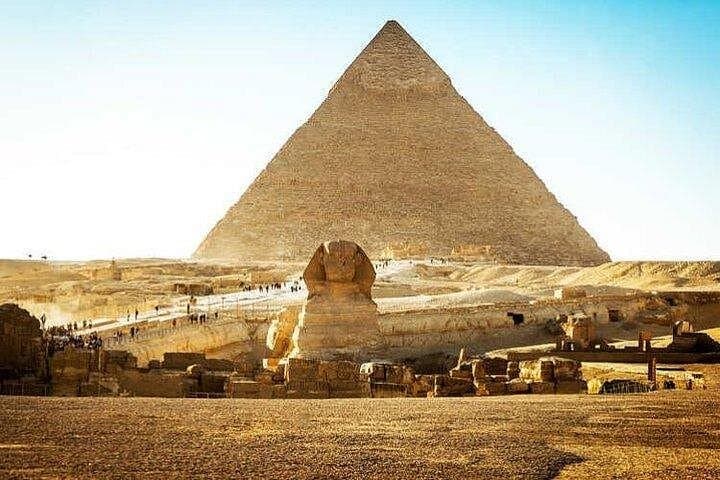

The morning sun cuts across the Giza Plateau like a broad hand, warming limestone faces that have watched the Nile flood and cities rise. Visitors step from an air-conditioned vehicle into a sweep of open desert where the Great Pyramid of Khufu dominates the skyline, the Sphinx stares into an endless horizon, and a trace wind dares you to walk its terraces.
The morning sun cuts across the Giza Plateau like a broad hand, warming limestone faces that have watched the Nile flood and cities rise. Visitors step from an air-conditioned vehicle into a sweep of open desert where the Great Pyramid of Khufu dominates the skyline, the Sphinx stares into an endless horizon, and a trace wind dares you to walk its terraces.
This route follows the Old Kingdom’s spine: the Giza Pyramid complex (4th Dynasty), the ancient capital of Memphis with its colossal statues and alabaster sphinx, then west to Saqqara where Djoser’s Step Pyramid marks a pivotal moment in funerary engineering. The geology is simple—limestone bedrock and wind-scoured sand—but that simplicity allowed precise stonecutting and monumental scale.
Culturally, the tour frames pharaonic funerary practice—valley temples, mortuary complexes, and the evolution from mastaba to stepped pyramid—while guides connect modern Egyptian life to millennia-old craft traditions.
Practical guidance: expect an 8-hour day with moderate walking on uneven stone and sand; bring sun protection, a refillable water bottle, comfortable closed-toe shoes, and small-change for site fees or extras like the Solar Boat Museum or pyramid interior ticket. Photography is allowed but watch for restricted areas. Start early to avoid heat and crowds, and honor local rules—no climbing on monuments. With a bit of planning, this is a compact, vivid survey of Egypt’s Old Kingdom that puts iconic ruins in clear historical and physical context.