THE ADVENTURE COLLECTIVE® · Independent discovery and booking for outdoor travel

Walk beneath towering live oaks and past Greek Revival columns on a two-hour guided tour of New Orleans’ Garden District. Learn how 19th‑century development, architecture, and civic life shaped this elegant neighborhood while picking up practical tips for a comfortable, respectful visit.
Walk beneath towering live oaks and past Greek Revival columns on a two-hour guided tour of New Orleans’ Garden District. Learn how 19th‑century development, architecture, and civic life shaped this elegant neighborhood while picking up practical tips for a comfortable, respectful visit.
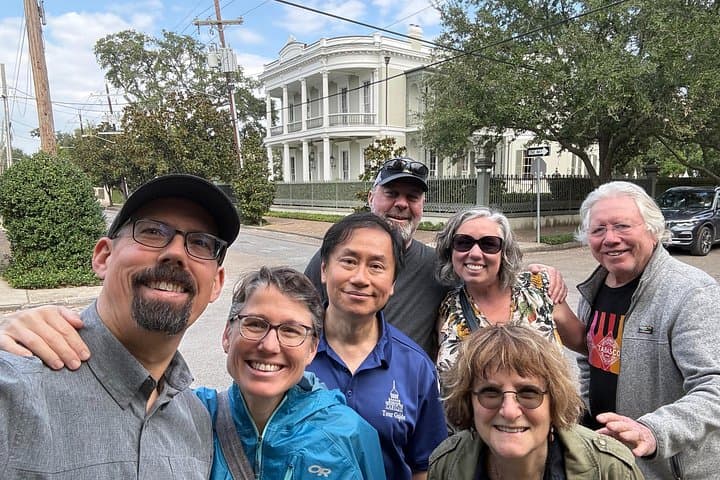
You turn off St. Charles Avenue into a corridor of live oaks that seem to lean in and mark each intersection—Spanish moss brushing the air like a slow handshake. The streetcar’s distant clang fades as columns, cast-iron balconies and broad porches step forward, each mansion announcing a different chapter of mid-19th‑century ambition. Volunteers from the Friends of the Cabildo guide the two-hour walk, pointing out carved lintels, Italianate bracketwork and the small markers that link homes to political figures and mercantile fortunes.
Verified experiences and guided adventures in the surrounding area.
Operated by Friends of the Cabildo · New Orleans, Louisiana
You turn off St. Charles Avenue into a corridor of live oaks that seem to lean in and mark each intersection—Spanish moss brushing the air like a slow handshake. The streetcar’s distant clang fades as columns, cast-iron balconies and broad porches step forward, each mansion announcing a different chapter of mid-19th‑century ambition. Volunteers from the Friends of the Cabildo guide the two-hour walk, pointing out carved lintels, Italianate bracketwork and the small markers that link homes to political figures and mercantile fortunes.
The Garden District’s story is civic as much as architectural: built largely by Americans after the Louisiana Purchase, it contrasts with nearby Creole neighborhoods through its Greek Revival and Italianate facades, straight streets, and private gardens. Geologically the ground is higher here than older parts of the city—sand and historic drainage made this area desirable for large lots and shade trees. Culturally, the neighborhood reflects shifting tastes of a growing 19th‑century port city and now balances preservation with active residential life.
Practicalities are straightforward. The route is flat, paved, and wheelchair accessible; expect roughly two hours of slow walking (about 1.5–2 miles) with frequent stops for interpretation. Wear sturdy, comfortable shoes, bring water and sun protection, and start in the morning to avoid heat and tour overlap. Photography is welcome but respect private property—stay on sidewalks and public right-of-way. The small-group format (max ~15) means questions are encouraged; guides are city-licensed volunteers who focus on architecture, local history, and conservation efforts that keep these streets livable for residents and vivid for visitors.
easy.
2 hours.
Suitable for most fitness levels; ability to stand and walk slowly for two hours is helpful.
Yes; the route is wheelchair accessible and suitable for strollers, though contact the operator ahead if you have specific mobility needs.
Expect about 1.5–2 miles over roughly two hours, with frequent stops for commentary.
Service animals are allowed; pets are not encouraged since the tour moves through residential streets.
Full refunds are available if you cancel at least 24 hours before the scheduled departure time.
The Garden District grew rapidly in the mid-1800s as Americans built grand Greek Revival and Italianate homes on higher ground, creating a contrast with Creole neighborhoods closer to the river.
Local organizations work to preserve historic façades and mature street trees; visitors help by staying on public paths, not trespassing, and minimizing noise in residential areas.
Friends of the Cabildo operates guided outdoor trips and adventures with an emphasis on safety, stewardship, and memorable experiences.
You turn off St. Charles Avenue into a corridor of live oaks that seem to lean in and mark each intersection—Spanish moss brushing the air like a slow handshake. The streetcar’s distant clang fades as columns, cast-iron balconies and broad porches step forward, each mansion announcing a different chapter of mid-19th‑century ambition. Volunteers from the Friends of the Cabildo guide the two-hour walk, pointing out carved lintels, Italianate bracketwork and the small markers that link homes to political figures and mercantile fortunes.
You turn off St. Charles Avenue into a corridor of live oaks that seem to lean in and mark each intersection—Spanish moss brushing the air like a slow handshake. The streetcar’s distant clang fades as columns, cast-iron balconies and broad porches step forward, each mansion announcing a different chapter of mid-19th‑century ambition. Volunteers from the Friends of the Cabildo guide the two-hour walk, pointing out carved lintels, Italianate bracketwork and the small markers that link homes to political figures and mercantile fortunes.
The Garden District’s story is civic as much as architectural: built largely by Americans after the Louisiana Purchase, it contrasts with nearby Creole neighborhoods through its Greek Revival and Italianate facades, straight streets, and private gardens. Geologically the ground is higher here than older parts of the city—sand and historic drainage made this area desirable for large lots and shade trees. Culturally, the neighborhood reflects shifting tastes of a growing 19th‑century port city and now balances preservation with active residential life.
Practicalities are straightforward. The route is flat, paved, and wheelchair accessible; expect roughly two hours of slow walking (about 1.5–2 miles) with frequent stops for interpretation. Wear sturdy, comfortable shoes, bring water and sun protection, and start in the morning to avoid heat and tour overlap. Photography is welcome but respect private property—stay on sidewalks and public right-of-way. The small-group format (max ~15) means questions are encouraged; guides are city-licensed volunteers who focus on architecture, local history, and conservation efforts that keep these streets livable for residents and vivid for visitors.