THE ADVENTURE COLLECTIVE® · Independent discovery and booking for outdoor travel

A private, full-day exploration of the Western Front that visits the Somme battlefields and the Canadian Memorial at Vimy Ridge. Expect guided trench walks, large craters, and time at multiple Commonwealth cemeteries with transport and a lunch stop included.
A private, full-day exploration of the Western Front that visits the Somme battlefields and the Canadian Memorial at Vimy Ridge. Expect guided trench walks, large craters, and time at multiple Commonwealth cemeteries with transport and a lunch stop included.
You step off the station platform into a low northern light and board an air-conditioned vehicle that will carry you across farmland scarred by a hundred years of artillery. Fields roll like green scars; craters puncture the landscape and the Vimy Memorial rises on a ridge that once commanded the surrounding plain.
Verified experiences and guided adventures in the surrounding area.
Operated by ALW Battlefield Tours · Arras, Hauts-de-France
You step off the station platform into a low northern light and board an air-conditioned vehicle that will carry you across farmland scarred by a hundred years of artillery. Fields roll like green scars; craters puncture the landscape and the Vimy Memorial rises on a ridge that once commanded the surrounding plain.
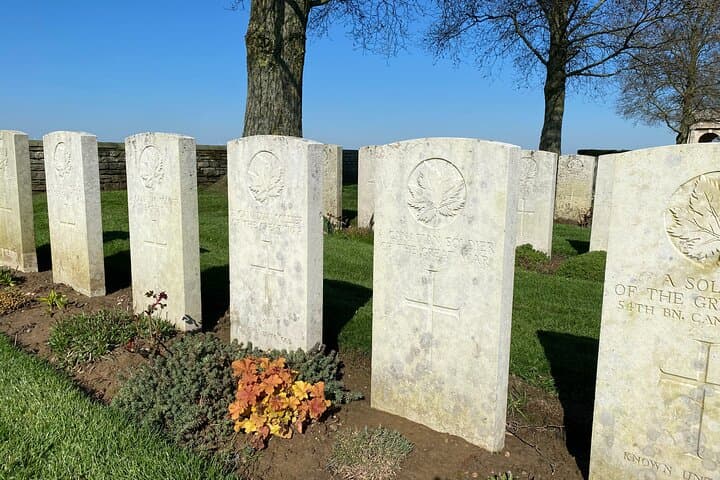
The day moves between place and narrative: the Battle of the Somme’s churned earth and the vast Lochnagar crater, preserved trenches where the Newfoundland Regiment fought, and the towering, white limestone of Vimy Ridge—the site of Canada’s defining 1917 assault. Your guide places actions on a map of hedgerows, explains how tunnelling and mining shaped the terrain, and points out German and Commonwealth cemeteries where names and dates crowd the headstones.
Geology here is simple and sharp—chalk under a thin loam—so drainage and mud vary by season; walking in trench sections means uneven boards, rutted tracks, and short climbs onto memorial slopes. The local culture retains a reserve: small towns, memorial services, and visitor centres that contextualize objects and oral histories.
Practicalities are straightforward. This is a private, full-day tour (9 hours) with transport and a lunch stop included; expect 2–4 km of walking spread across several sites, mostly on paved or compacted surfaces but with short uneven sections. Wear sturdy shoes, a layered jacket, and bring water and a notepad—histories and plaques are dense. Be prepared to observe quiet at memorials, and ask the guide in advance if you want bespoke research on a soldier or unit—the operator can adapt the route with notice.
easy.
9 hours.
Suitable for most fitness levels but requires the ability to walk short distances (2–4 km total) on uneven ground.
Yes. Tours are private and can be adapted—provide family names or special sites in advance so the guide can research and include them.
Admissions are generally included where required by the itinerary, but confirm specifics when booking; the tour description notes visits to visitors centres and memorials.
Walking is typically 2–4 km total with some uneven surfaces; while most cemetery grounds are accessible, preserved trenches and crater rims involve steps and uneven terrain, limiting access for some mobility aids.
Standard policy allows a full refund if cancelled at least 24 hours before departure; weather may also prompt cancellation.
This landscape was transformed by industrialised warfare in 1914–18—mining, artillery and infantry assaults reshaped fields and created permanent memorials commemorating Commonwealth and German losses.
Sites are maintained by bodies like the Commonwealth War Graves Commission; visitors are asked to stick to paths, avoid disturbing fragile trench features, and respect flora regrowth on crater rims.
ALW Battlefield Tours operates guided outdoor trips and adventures with an emphasis on safety, stewardship, and memorable experiences.



You step off the station platform into a low northern light and board an air-conditioned vehicle that will carry you across farmland scarred by a hundred years of artillery. Fields roll like green scars; craters puncture the landscape and the Vimy Memorial rises on a ridge that once commanded the surrounding plain.
You step off the station platform into a low northern light and board an air-conditioned vehicle that will carry you across farmland scarred by a hundred years of artillery. Fields roll like green scars; craters puncture the landscape and the Vimy Memorial rises on a ridge that once commanded the surrounding plain.
The day moves between place and narrative: the Battle of the Somme’s churned earth and the vast Lochnagar crater, preserved trenches where the Newfoundland Regiment fought, and the towering, white limestone of Vimy Ridge—the site of Canada’s defining 1917 assault. Your guide places actions on a map of hedgerows, explains how tunnelling and mining shaped the terrain, and points out German and Commonwealth cemeteries where names and dates crowd the headstones.
Geology here is simple and sharp—chalk under a thin loam—so drainage and mud vary by season; walking in trench sections means uneven boards, rutted tracks, and short climbs onto memorial slopes. The local culture retains a reserve: small towns, memorial services, and visitor centres that contextualize objects and oral histories.
Practicalities are straightforward. This is a private, full-day tour (9 hours) with transport and a lunch stop included; expect 2–4 km of walking spread across several sites, mostly on paved or compacted surfaces but with short uneven sections. Wear sturdy shoes, a layered jacket, and bring water and a notepad—histories and plaques are dense. Be prepared to observe quiet at memorials, and ask the guide in advance if you want bespoke research on a soldier or unit—the operator can adapt the route with notice.