THE ADVENTURE COLLECTIVE® · Independent discovery and booking for outdoor travel

Drive from Uyuni to the vast white of Salar de Uyuni for a full-day tour that mixes the town’s train graveyard, Colchani salt workshops, a hike on Isla Incahuasi and a dramatic sunset over the flats. Expect short walks, strong sun, and high-altitude conditions.
Drive from Uyuni to the vast white of Salar de Uyuni for a full-day tour that mixes the town’s train graveyard, Colchani salt workshops, a hike on Isla Incahuasi and a dramatic sunset over the flats. Expect short walks, strong sun, and high-altitude conditions.
A cold wind meets the truck as it pulls away from Uyuni at midmorning, and the town’s low adobe buildings recede into a horizon of blinding white. Within an hour the salt flats unfold — a hard, glossy plain that seems to challenge your footing and your sense of scale. The day moves in chapters: iron skeletons of the train graveyard; the salt workshops of Colchani; a picnic on the flat; a hike up Isla Incahuasi to stand among giant cacti and fossilized coral.
Verified experiences and guided adventures in the surrounding area.
Operated by Inti Travel · Uyuni, Potosí
A cold wind meets the truck as it pulls away from Uyuni at midmorning, and the town’s low adobe buildings recede into a horizon of blinding white. Within an hour the salt flats unfold — a hard, glossy plain that seems to challenge your footing and your sense of scale. The day moves in chapters: iron skeletons of the train graveyard; the salt workshops of Colchani; a picnic on the flat; a hike up Isla Incahuasi to stand among giant cacti and fossilized coral.
Geologically the Salar de Uyuni is the remnant of prehistoric lakes; beneath your boots is a thick crust of salt formed over millennia, underlaid by brine and, in places, lithium-rich sediments. Culturally the salt is part of local livelihoods—Colchani’s artisans cut and shape blocks into lamps and souvenirs, and the landscape holds Aymara and Quechua memory of high-altitude life.
Practicalities shape the experience: surfaces are reflective and harsh on eyes and skin, altitudes hover around 3,600–3,700 m, and most movement is done by 4x4 with short walks on uneven, salt-crusted ground. The island hike is steep in places but short; bring sun protection, warm layers for wind and sunset chill, and a solid pair of closed shoes for the rocky trail.
Photographers will spend part of the trip staging playful perspective shots on the salt, and all visitors should respect marked tracks and local guides who know where the crust is stable. The sunset here can turn the white plain molten pink—an elemental, patient show best seen near the end of a long, full day.
moderate.
9 hours (full day).
Light-to-moderate fitness; able to do short hikes (20–45 minutes) at high altitude and handle periods in a vehicle.
This full-day tour runs about 9 hours and typically departs Uyuni mid-morning (around 10:30 a.m.). Confirm exact pickup time with the operator.
The area sits around 3,600–3,700 m. Most travelers manage with rest, hydration, and moderate exertion—those with serious cardiovascular issues should consult a physician.
Yes, the tour includes 4x4 transportation and one lunch; vehicles usually have rooftop racks for luggage.
Absolutely—guides will help you find flat, safe spots for forced-perspective shots, but avoid damaging salt features or wandering off-track.
The Salar formed when prehistoric lakes evaporated; for centuries local communities harvested salt and used the high plain as seasonal grazing territory.
Stay on established vehicle tracks, do not collect salt or fossils, and dispose of waste properly—the crust and surrounding puna ecosystem are fragile.
Inti Travel operates guided outdoor trips and adventures with an emphasis on safety, stewardship, and memorable experiences.

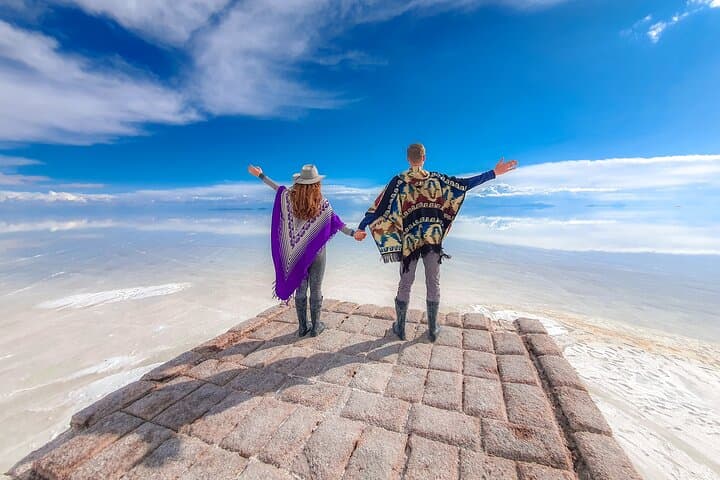


A cold wind meets the truck as it pulls away from Uyuni at midmorning, and the town’s low adobe buildings recede into a horizon of blinding white. Within an hour the salt flats unfold — a hard, glossy plain that seems to challenge your footing and your sense of scale. The day moves in chapters: iron skeletons of the train graveyard; the salt workshops of Colchani; a picnic on the flat; a hike up Isla Incahuasi to stand among giant cacti and fossilized coral.
A cold wind meets the truck as it pulls away from Uyuni at midmorning, and the town’s low adobe buildings recede into a horizon of blinding white. Within an hour the salt flats unfold — a hard, glossy plain that seems to challenge your footing and your sense of scale. The day moves in chapters: iron skeletons of the train graveyard; the salt workshops of Colchani; a picnic on the flat; a hike up Isla Incahuasi to stand among giant cacti and fossilized coral.
Geologically the Salar de Uyuni is the remnant of prehistoric lakes; beneath your boots is a thick crust of salt formed over millennia, underlaid by brine and, in places, lithium-rich sediments. Culturally the salt is part of local livelihoods—Colchani’s artisans cut and shape blocks into lamps and souvenirs, and the landscape holds Aymara and Quechua memory of high-altitude life.
Practicalities shape the experience: surfaces are reflective and harsh on eyes and skin, altitudes hover around 3,600–3,700 m, and most movement is done by 4x4 with short walks on uneven, salt-crusted ground. The island hike is steep in places but short; bring sun protection, warm layers for wind and sunset chill, and a solid pair of closed shoes for the rocky trail.
Photographers will spend part of the trip staging playful perspective shots on the salt, and all visitors should respect marked tracks and local guides who know where the crust is stable. The sunset here can turn the white plain molten pink—an elemental, patient show best seen near the end of a long, full day.