THE ADVENTURE COLLECTIVE® · Independent discovery and booking for outdoor travel

Spend a private full day beneath the Great Pyramids, explore the Egyptian Museum’s unrivaled antiquities, haggle through Khan el-Khalili, and float briefly on the Nile. This guided itinerary balances close-up history with practical pacing for a 7–8 hour Cairo experience.
Spend a private full day beneath the Great Pyramids, explore the Egyptian Museum’s unrivaled antiquities, haggle through Khan el-Khalili, and float briefly on the Nile. This guided itinerary balances close-up history with practical pacing for a 7–8 hour Cairo experience.
You step from an air-conditioned vehicle into sunlight that flattens the horizon and throws the Pyramids of Giza into stark relief—stone giants risen from wind-bleached sand. The plateau smells faintly of dust and diesel; vendors call from shaded stalls; camels stand patient against the sky.
Verified experiences and guided adventures in the surrounding area.
Operated by Egypt Tours Travel · Giza, Giza Governorate
You step from an air-conditioned vehicle into sunlight that flattens the horizon and throws the Pyramids of Giza into stark relief—stone giants risen from wind-bleached sand. The plateau smells faintly of dust and diesel; vendors call from shaded stalls; camels stand patient against the sky.
This private, 7–8 hour Cairo loop brings the three great pyramids and the Sphinx up close, then moves to the Museum of Egyptian Antiquities at Tahrir and ends with the historic Khan el-Khalili bazaar and a short felucca option on the Nile. Expect roughly two hours at the Giza complex (close views, photo stops and a brief camel ride option), about two hours inside the museum where Tutankhamun-era artifacts and monumental statuary draw most visitors, and an hour wandering Khan el-Khalili’s alleys—all paced with private transfers between sites.
Geologically the plateau is a limestone outcrop; archaeologically these monuments date to the Fourth Dynasty (c. 2600 BCE). Culturally, the route stitches ancient royal funerary landscapes to modern Cairo’s living marketplaces and river life. Locals reuse centuries-old crafts and negotiation remains the norm in the bazaar.
Practical guidance: wear closed shoes for walking on packed sand and uneven pavement, carry at least 1–2 liters of water, and bring sun protection—shade is scarce on the plateau. Museum galleries can be cool; a light layer is handy. Plan pickup early to avoid midday heat and allow time for Cairo traffic. Respect barriers around sensitive sites, and set aside cash for small purchases and tipping.
easy.
7–8 hours.
Suitable for most people who can walk on uneven ground for short periods and tolerate a full day of sightseeing.
The tour runs approximately 7–8 hours including transfers; on-site times typically include about two hours at Giza and two hours at the Egyptian Museum.
Yes—entrance fees, bottled water, and private pickup/return in an air-conditioned vehicle are included per the itinerary.
Many areas are wheelchair accessible and the vehicle can accommodate guests, but some zones on the plateau and bazaar alleys are uneven—check specific accessibility needs with the operator before booking.
A short camel ride is included as an option; entry into pyramid interiors usually requires a separate ticket and is subject to availability—confirm with the guide on the day.
The Giza pyramids date to Egypt's Fourth Dynasty (c. 2600 BCE); the Egyptian Museum houses the largest collection of Pharaonic artifacts, including much of Tutankhamun's treasure.
Archaeological conservation and visitor management are active concerns—stay on designated paths, avoid touching monuments, and minimize plastic waste to reduce local impact.
Egypt Tours Travel operates guided outdoor trips and adventures with an emphasis on safety, stewardship, and memorable experiences.


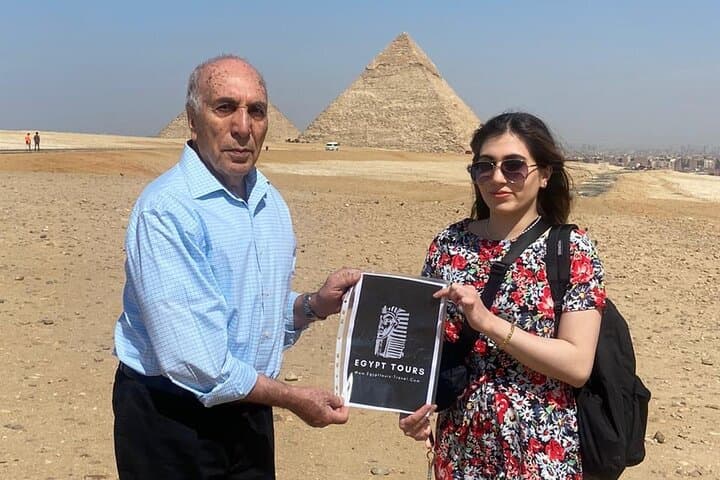
You step from an air-conditioned vehicle into sunlight that flattens the horizon and throws the Pyramids of Giza into stark relief—stone giants risen from wind-bleached sand. The plateau smells faintly of dust and diesel; vendors call from shaded stalls; camels stand patient against the sky.
You step from an air-conditioned vehicle into sunlight that flattens the horizon and throws the Pyramids of Giza into stark relief—stone giants risen from wind-bleached sand. The plateau smells faintly of dust and diesel; vendors call from shaded stalls; camels stand patient against the sky.
This private, 7–8 hour Cairo loop brings the three great pyramids and the Sphinx up close, then moves to the Museum of Egyptian Antiquities at Tahrir and ends with the historic Khan el-Khalili bazaar and a short felucca option on the Nile. Expect roughly two hours at the Giza complex (close views, photo stops and a brief camel ride option), about two hours inside the museum where Tutankhamun-era artifacts and monumental statuary draw most visitors, and an hour wandering Khan el-Khalili’s alleys—all paced with private transfers between sites.
Geologically the plateau is a limestone outcrop; archaeologically these monuments date to the Fourth Dynasty (c. 2600 BCE). Culturally, the route stitches ancient royal funerary landscapes to modern Cairo’s living marketplaces and river life. Locals reuse centuries-old crafts and negotiation remains the norm in the bazaar.
Practical guidance: wear closed shoes for walking on packed sand and uneven pavement, carry at least 1–2 liters of water, and bring sun protection—shade is scarce on the plateau. Museum galleries can be cool; a light layer is handy. Plan pickup early to avoid midday heat and allow time for Cairo traffic. Respect barriers around sensitive sites, and set aside cash for small purchases and tipping.