THE ADVENTURE COLLECTIVE® · Independent discovery and booking for outdoor travel

Spend a day moving through Cappadocia’s carved valleys and cave churches with a private Spanish or Portuguese guide. This full-day tour covers Göreme’s open-air museum, Pasabag, Uchisar Castle and Kaymaklı underground city with transport, lunch and museum entries included.
Spend a day moving through Cappadocia’s carved valleys and cave churches with a private Spanish or Portuguese guide. This full-day tour covers Göreme’s open-air museum, Pasabag, Uchisar Castle and Kaymaklı underground city with transport, lunch and museum entries included.
You step out of the air-conditioned car and the valley takes over — a horizon of pale rock spires, chimney stacks, and terraces carved by wind and time. Your guide, speaking Spanish or Portuguese, points out the first clues: a faint seam where harder basalt caps a column, a dark mouth in a tuff face that leads to a painted chapel. For the next six to eight hours Cappadocia will feel less like a region and more like a series of stages — volcanic plateau, carved monastery, underground city — each one folded into the next by human hands and slow geology.
Verified experiences and guided adventures in the surrounding area.
Operated by Gorgeous Travel - Daily Tours & Balloon Flights · Göreme, Nevşehir
You step out of the air-conditioned car and the valley takes over — a horizon of pale rock spires, chimney stacks, and terraces carved by wind and time. Your guide, speaking Spanish or Portuguese, points out the first clues: a faint seam where harder basalt caps a column, a dark mouth in a tuff face that leads to a painted chapel. For the next six to eight hours Cappadocia will feel less like a region and more like a series of stages — volcanic plateau, carved monastery, underground city — each one folded into the next by human hands and slow geology.
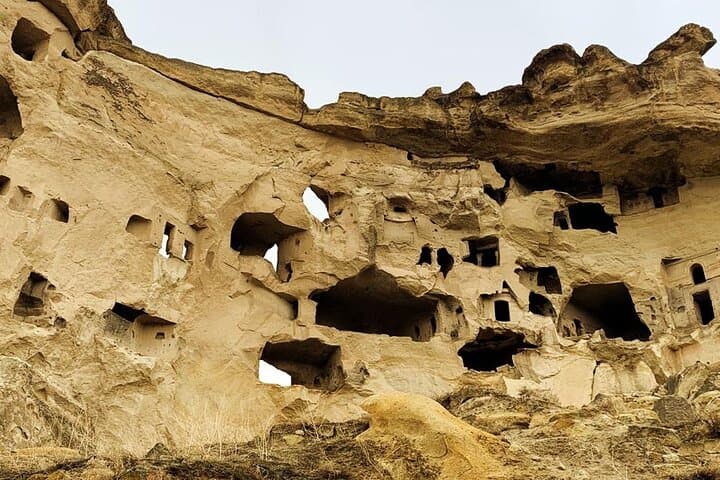
Cappadocia’s story began 60 million years ago when eruptions from Erciyes, Hasan and Güllü blanketed central Anatolia in ash and ignimbrite. Over millennia, rain and wind chewed those soft layers into the fairy chimneys and honeycombed cliffs you now walk beneath. Humans arrived early: Paleolithic camps gave way to Neolithic farmers whose pottery and agricultural experiments reshaped local life. By late antiquity the landscape became a refuge for Christians; cave churches in Göreme still hold 10th- and 11th-century frescoes that survive, fragile, behind guarded glass.
Culturally the area is a mix of agricultural rhythms and tourist pulse. In villages such as Mustafapaşa and Ortahisar, stone houses and Ottoman-era mansions stand beside workshops where potters and carpet weavers maintain centuries-old crafts. Pigeons, once a vital source of fertilizer, still inhabit carved dovecotes above fields — a small reminder of the practical traditions that sustained communities here.
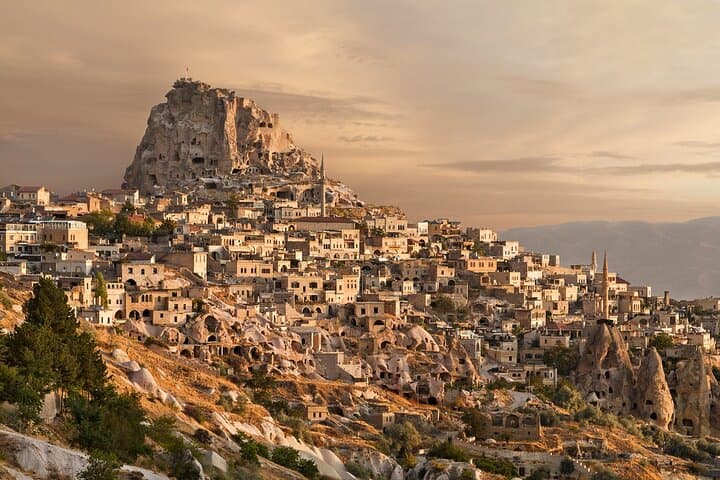
Practically, the private tour model removes a lot of friction: hotel pickup, a flexible schedule, entrance fees covered, and lunch included. Expect 360–480 minutes of travel and site time, with short walks at most stops — steps at Uchisar Castle and narrow corridors in Kaymaklı’s underground city. Guides will pause for context: geology diagrams, iconography in frescoes, and the engineering behind sliding stone doors underground.
Timing matters. Mornings are best for soft light and fewer buses; late afternoons warm the tuff into rich color. Wear sturdy walking shoes — surfaces are uneven and can be slippery after rain. Bring sun protection and at least 1–2 liters of water per person; shade is limited between sites. For the underground city, those with claustrophobia should plan accordingly — corridors are low and compact.
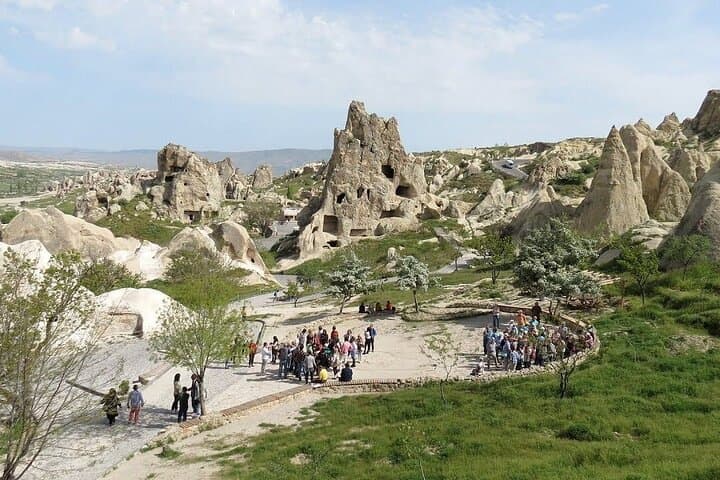
A private Spanish- or Portuguese-speaking guide is more than translation: they can adapt stops to your interests, whether you want an extended visit to the Göreme Open-Air Museum, time in pottery studios, or a detour to lesser-known valleys. For photographers, bring a wide-angle lens and be ready at sunrise if you hope to capture hot-air balloons skimming the chimneys.
In short: this tour hands you a roadmap through Cappadocia’s deep time and human stories, with local knowledge and practical support that make exploring the region’s cliffs, caves and underground passages both revealing and manageable.
moderate.
6–8 hours.
Suitable for travelers with basic mobility; some stair climbing and short hikes required.
Yes — hotel pickup in Göreme and surrounding towns is provided; confirm your pickup location when booking.
The guide will speak Spanish or Portuguese depending on your booking; guides are professional and provide cultural and historical context.
Admission to the major museums and sites listed in the itinerary is included in the tour price.
Yes — the private format allows flexibility; request additions or longer stops when you book or at pickup.
Families are welcome and the tour is labeled physically easy, but Kaymaklı’s underground city has narrow corridors that may challenge those with severe mobility issues or claustrophobia.
Balloons are visible at sunrise on most clear mornings, but they are weather-dependent and not part of the tour; your guide can recommend viewing spots.
Human settlement in Cappadocia dates back to the Paleolithic and expanded through Neolithic agriculture; later the area became a refuge for early Christian monastic communities.
Erosion and foot traffic threaten fragile tuff formations and frescoes; stay on marked paths, avoid touching painted surfaces, and follow local guide instructions.
Gorgeous Travel - Daily Tours & Balloon Flights operates guided outdoor trips and adventures with an emphasis on safety, stewardship, and memorable experiences.
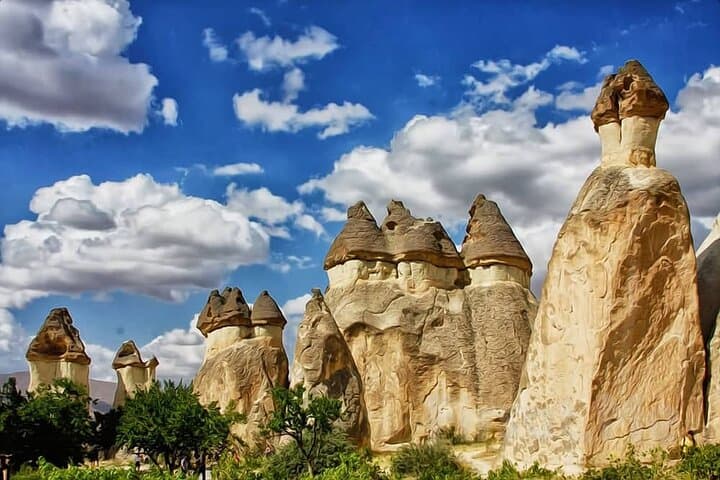
You step out of the air-conditioned car and the valley takes over — a horizon of pale rock spires, chimney stacks, and terraces carved by wind and time. Your guide, speaking Spanish or Portuguese, points out the first clues: a faint seam where harder basalt caps a column, a dark mouth in a tuff face that leads to a painted chapel. For the next six to eight hours Cappadocia will feel less like a region and more like a series of stages — volcanic plateau, carved monastery, underground city — each one folded into the next by human hands and slow geology.
You step out of the air-conditioned car and the valley takes over — a horizon of pale rock spires, chimney stacks, and terraces carved by wind and time. Your guide, speaking Spanish or Portuguese, points out the first clues: a faint seam where harder basalt caps a column, a dark mouth in a tuff face that leads to a painted chapel. For the next six to eight hours Cappadocia will feel less like a region and more like a series of stages — volcanic plateau, carved monastery, underground city — each one folded into the next by human hands and slow geology.
Cappadocia’s story began 60 million years ago when eruptions from Erciyes, Hasan and Güllü blanketed central Anatolia in ash and ignimbrite. Over millennia, rain and wind chewed those soft layers into the fairy chimneys and honeycombed cliffs you now walk beneath. Humans arrived early: Paleolithic camps gave way to Neolithic farmers whose pottery and agricultural experiments reshaped local life. By late antiquity the landscape became a refuge for Christians; cave churches in Göreme still hold 10th- and 11th-century frescoes that survive, fragile, behind guarded glass.
Culturally the area is a mix of agricultural rhythms and tourist pulse. In villages such as Mustafapaşa and Ortahisar, stone houses and Ottoman-era mansions stand beside workshops where potters and carpet weavers maintain centuries-old crafts. Pigeons, once a vital source of fertilizer, still inhabit carved dovecotes above fields — a small reminder of the practical traditions that sustained communities here.
Practically, the private tour model removes a lot of friction: hotel pickup, a flexible schedule, entrance fees covered, and lunch included. Expect 360–480 minutes of travel and site time, with short walks at most stops — steps at Uchisar Castle and narrow corridors in Kaymaklı’s underground city. Guides will pause for context: geology diagrams, iconography in frescoes, and the engineering behind sliding stone doors underground.
Timing matters. Mornings are best for soft light and fewer buses; late afternoons warm the tuff into rich color. Wear sturdy walking shoes — surfaces are uneven and can be slippery after rain. Bring sun protection and at least 1–2 liters of water per person; shade is limited between sites. For the underground city, those with claustrophobia should plan accordingly — corridors are low and compact.
A private Spanish- or Portuguese-speaking guide is more than translation: they can adapt stops to your interests, whether you want an extended visit to the Göreme Open-Air Museum, time in pottery studios, or a detour to lesser-known valleys. For photographers, bring a wide-angle lens and be ready at sunrise if you hope to capture hot-air balloons skimming the chimneys.
In short: this tour hands you a roadmap through Cappadocia’s deep time and human stories, with local knowledge and practical support that make exploring the region’s cliffs, caves and underground passages both revealing and manageable.