THE ADVENTURE COLLECTIVE® · Independent discovery and booking for outdoor travel

Spend a full day exploring Preah Khan’s forest-wrapped galleries and Neak Pean’s healing pools with a private guide. This practical guide covers history, what to expect and how to prepare for an 8–9 hour temple tour from Siem Reap.
Spend a full day exploring Preah Khan’s forest-wrapped galleries and Neak Pean’s healing pools with a private guide. This practical guide covers history, what to expect and how to prepare for an 8–9 hour temple tour from Siem Reap.
A warm, humid morning in Siem Reap dissolves into the shadowed corridors of Preah Khan, where carved doorways frame shafts of light and the scent of damp earth hangs under the canopy. Walk the raised causeways and feel the weathered stones give way to roots: ancient masonry and living forest pushing at one another with slow insistence.
Verified experiences and guided adventures in the surrounding area.
Operated by Kampoul Adventure Tour · Siem Reap, Siem Reap Province
A warm, humid morning in Siem Reap dissolves into the shadowed corridors of Preah Khan, where carved doorways frame shafts of light and the scent of damp earth hangs under the canopy. Walk the raised causeways and feel the weathered stones give way to roots: ancient masonry and living forest pushing at one another with slow insistence.
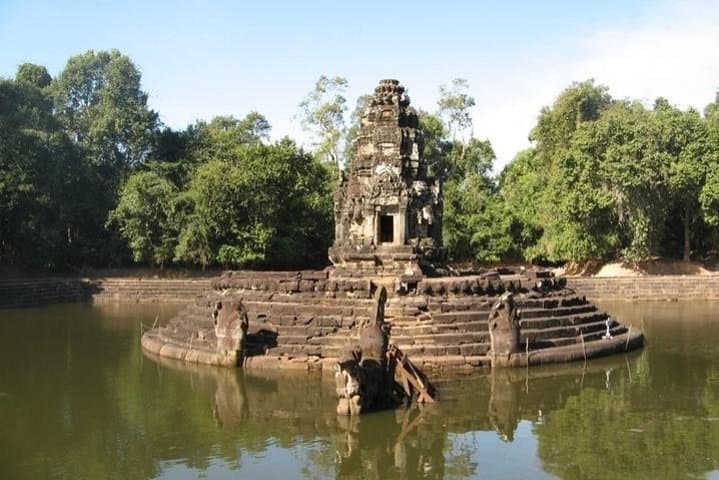
Preah Khan and Neak Pean belong to the late 12th-century expansion under King Jayavarman VII. Preah Khan served as a major administrative and religious complex; Neak Pean—a circular island temple in the Jayatataka Baray—was designed as a healing sanctuary with four connected pools representing the elements. The sites reveal sandstone reliefs, laterite foundations, and Khmer engineering that redirected water across the plains.
Culture here is present in small acts: monks in saffron robes at nearby wats, vendors selling cooled palm fruit, and guides explaining the iconography of lintels and apsaras. Geologically, the region’s low-lying red-earth plains and shallow barays concentrate seasonal water, which shaped Khmer city layouts and temple ornamentation.
Practical guidance: expect an 8–9 hour private tour with hotel pickup in an A/C sedan or minivan, moderate walking over uneven stone, and sun exposure between structures. Carry water, comfortable closed-toe shoes for rubble and roots, and a light cover-up for respectful temple entry. Plan mornings for softer light and afternoons for fewer crowds at quieter corners like the east gopura and the Neak Pean pools.
easy.
8–9 hours.
Basic mobility and the ability to walk short stretches on uneven surfaces; not strenuous but requires stamina for a full day.
Approximately 8–9 hours including hotel pickup and drop-off; expect several hours walking at the sites.
This tour description indicates admission is not included; plan to purchase Angkor Archaeological Park passes separately.
Yes—physically the tour is rated easy, but some uneven steps and rubble exist; request a slower pace or vehicle access between points if needed.
Private guides typically speak English; confirm at booking if you need another language or a specialist guide.
Both temples were expanded or built under King Jayavarman VII in the late 12th century; Neak Pean functioned as a ritual healing site tied to Khmer medical cosmology.
Heavy foot traffic stresses fragile stone and vegetation—stay on designated paths, avoid touching bas-reliefs, and support local guides who promote responsible visitation.
Kampoul Adventure Tour operates guided outdoor trips and adventures with an emphasis on safety, stewardship, and memorable experiences.
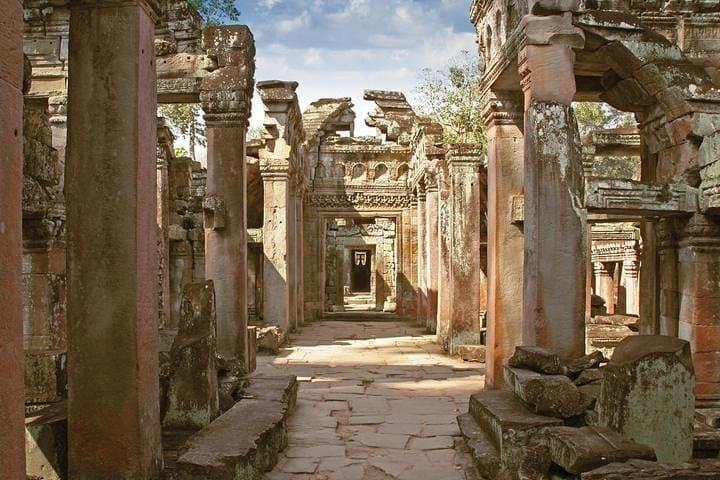
A warm, humid morning in Siem Reap dissolves into the shadowed corridors of Preah Khan, where carved doorways frame shafts of light and the scent of damp earth hangs under the canopy. Walk the raised causeways and feel the weathered stones give way to roots: ancient masonry and living forest pushing at one another with slow insistence.
A warm, humid morning in Siem Reap dissolves into the shadowed corridors of Preah Khan, where carved doorways frame shafts of light and the scent of damp earth hangs under the canopy. Walk the raised causeways and feel the weathered stones give way to roots: ancient masonry and living forest pushing at one another with slow insistence.
Preah Khan and Neak Pean belong to the late 12th-century expansion under King Jayavarman VII. Preah Khan served as a major administrative and religious complex; Neak Pean—a circular island temple in the Jayatataka Baray—was designed as a healing sanctuary with four connected pools representing the elements. The sites reveal sandstone reliefs, laterite foundations, and Khmer engineering that redirected water across the plains.
Culture here is present in small acts: monks in saffron robes at nearby wats, vendors selling cooled palm fruit, and guides explaining the iconography of lintels and apsaras. Geologically, the region’s low-lying red-earth plains and shallow barays concentrate seasonal water, which shaped Khmer city layouts and temple ornamentation.
Practical guidance: expect an 8–9 hour private tour with hotel pickup in an A/C sedan or minivan, moderate walking over uneven stone, and sun exposure between structures. Carry water, comfortable closed-toe shoes for rubble and roots, and a light cover-up for respectful temple entry. Plan mornings for softer light and afternoons for fewer crowds at quieter corners like the east gopura and the Neak Pean pools.