THE ADVENTURE COLLECTIVE® · Independent discovery and booking for outdoor travel

Spend a full day circling Koh Samui by air‑conditioned vehicle, moving from gilded temples and sweeping viewpoints to a freshwater plunge pool and an ethical-feeling elephant feeding experience. This guided tour pairs cultural context with easy walks and a beachfront Thai lunch.
Spend a full day circling Koh Samui by air‑conditioned vehicle, moving from gilded temples and sweeping viewpoints to a freshwater plunge pool and an ethical-feeling elephant feeding experience. This guided tour pairs cultural context with easy walks and a beachfront Thai lunch.
The morning starts humid and bright as the minivan eases away from Chaweng, the island already spread like a palm-leaf map below the coastal road. Coconut palms lean toward the Gulf of Thailand as if trying to hear the tide; the driver slips through a ribbon of traffic and soon the city noise thins to distant motors and birdsong. Over the next eight to nine hours the group moves through temple courtyards, coastal viewpoints and a freshwater pool where water seems to dare you to jump in.
Verified experiences and guided adventures in the surrounding area.
Operated by Koh Samui tours, excursions, trips and more - kohsamui.tours · Koh Samui, Surat Thani Province
The morning starts humid and bright as the minivan eases away from Chaweng, the island already spread like a palm-leaf map below the coastal road. Coconut palms lean toward the Gulf of Thailand as if trying to hear the tide; the driver slips through a ribbon of traffic and soon the city noise thins to distant motors and birdsong. Over the next eight to nine hours the group moves through temple courtyards, coastal viewpoints and a freshwater pool where water seems to dare you to jump in.
Koh Samui’s culture is visible in small, telling details: Chinese guardian figures at Wat Plai Laem, the gleam of lacquered statues, and incense clouds drifting above teak wood. Geologically the island is a rounded mass of granite and volcanic rock with a coastal plain ringed by a single road of roughly 50–60 kilometers; inland rises are gentle, giving the Na Muang waterfalls their sudden, theatrical drops where streams have carved pockets into bedrock over millennia.
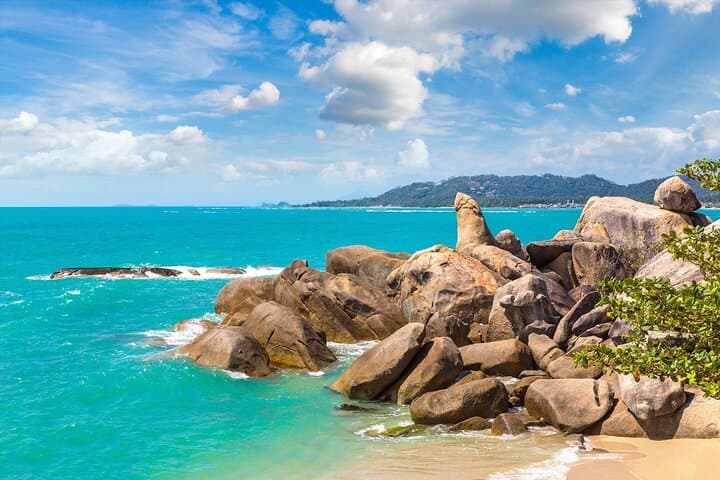
The tour stitches together local history and belief. Stops like Wat Bo Phuttharam and the Guan Yu Shrine show Samui’s Chinese-Thai heritage; Luang Phor Thuad’s legend at Wat Bo Phuttharam speaks to coastal communities who have long looked to faith for safety on the sea. At Hin Ta & Hin Yai visitors find prehistory written in wind-polished stone, and at the Mummified Monk shrine, an intimate view of Thai funerary and devotional practice.
Practically, the day is straightforward but full: plan for 8–9 hours, expect about 50–70 km of driving, and several short walks—temple stairs, a dirt spur to Na Muang, and a brief climb to Baby Buddha Jaidee (elevation gains are modest, typically under 150 meters). The waterfall has a well-graded path and a natural pool; the viewpoint at Lad Koh requires a handful of steps and offers the clearest look across Chaweng Bay.
A key moment is the elephant feeding visit. This operator’s program focuses on close, supervised contact—feeding and photographing rather than riding—but travelers should ask about animal care practices and choose interactions that prioritize welfare.
Timing and gear matter: start before 9 a.m. pickup, bring sun protection and a refillable bottle, and carry swimwear for a waterfall dip. Comfortable walking shoes and a light rain layer are wise in the wet season. Respect temple protocol—cover shoulders and knees and remove shoes before entering.
For photographers, the day offers layered contrasts: temple gold against tropical sky, the slow motion of falling water, and the deliberate gestures of caretakers feeding elephants. The trip is less about endurance and more about attention—look up, listen, and let the island’s everyday rhythms reveal themselves.
easy.
8–9 hours.
Suitable for most fitness levels; participants should be able to walk short uneven sections, climb temple steps, and stand during brief stops.
Pickup is between 9:00–9:45 a.m.; final pickup time is emailed by 18:00 the day before (or later for late bookings).
Yes — a beachfront Thai lunch with several traditional dishes and seasonal fruit is provided.
This tour offers supervised feeding and photo opportunities; riding is not part of the standard program—confirm with the operator if you have specific requests.
Yes — restrooms are available at most stops, including temples and the lunch restaurant; facilities at natural stops like the waterfall are basic.
The tour is not recommended for pregnant travelers or those with serious back or heart problems—check the booking restrictions and consult your physician if unsure.
Thai baht is standard; small tips for guides and drivers are appreciated. Carry some cash for souvenirs and small purchases.
Koh Samui’s cultural landscape reflects centuries of Chinese and Thai influence; temples like Wat Plai Laem blend Buddhist and Chinese iconography brought by island traders.
Visitors should prioritize interactions that support ethical animal care and minimize plastic use; choose operators who invest in habitat protection and humane elephant programs.
Koh Samui tours, excursions, trips and more - kohsamui.tours operates guided outdoor trips and adventures with an emphasis on safety, stewardship, and memorable experiences.


The morning starts humid and bright as the minivan eases away from Chaweng, the island already spread like a palm-leaf map below the coastal road. Coconut palms lean toward the Gulf of Thailand as if trying to hear the tide; the driver slips through a ribbon of traffic and soon the city noise thins to distant motors and birdsong. Over the next eight to nine hours the group moves through temple courtyards, coastal viewpoints and a freshwater pool where water seems to dare you to jump in.
The morning starts humid and bright as the minivan eases away from Chaweng, the island already spread like a palm-leaf map below the coastal road. Coconut palms lean toward the Gulf of Thailand as if trying to hear the tide; the driver slips through a ribbon of traffic and soon the city noise thins to distant motors and birdsong. Over the next eight to nine hours the group moves through temple courtyards, coastal viewpoints and a freshwater pool where water seems to dare you to jump in.
Koh Samui’s culture is visible in small, telling details: Chinese guardian figures at Wat Plai Laem, the gleam of lacquered statues, and incense clouds drifting above teak wood. Geologically the island is a rounded mass of granite and volcanic rock with a coastal plain ringed by a single road of roughly 50–60 kilometers; inland rises are gentle, giving the Na Muang waterfalls their sudden, theatrical drops where streams have carved pockets into bedrock over millennia.
The tour stitches together local history and belief. Stops like Wat Bo Phuttharam and the Guan Yu Shrine show Samui’s Chinese-Thai heritage; Luang Phor Thuad’s legend at Wat Bo Phuttharam speaks to coastal communities who have long looked to faith for safety on the sea. At Hin Ta & Hin Yai visitors find prehistory written in wind-polished stone, and at the Mummified Monk shrine, an intimate view of Thai funerary and devotional practice.
Practically, the day is straightforward but full: plan for 8–9 hours, expect about 50–70 km of driving, and several short walks—temple stairs, a dirt spur to Na Muang, and a brief climb to Baby Buddha Jaidee (elevation gains are modest, typically under 150 meters). The waterfall has a well-graded path and a natural pool; the viewpoint at Lad Koh requires a handful of steps and offers the clearest look across Chaweng Bay.
A key moment is the elephant feeding visit. This operator’s program focuses on close, supervised contact—feeding and photographing rather than riding—but travelers should ask about animal care practices and choose interactions that prioritize welfare.
Timing and gear matter: start before 9 a.m. pickup, bring sun protection and a refillable bottle, and carry swimwear for a waterfall dip. Comfortable walking shoes and a light rain layer are wise in the wet season. Respect temple protocol—cover shoulders and knees and remove shoes before entering.
For photographers, the day offers layered contrasts: temple gold against tropical sky, the slow motion of falling water, and the deliberate gestures of caretakers feeding elephants. The trip is less about endurance and more about attention—look up, listen, and let the island’s everyday rhythms reveal themselves.