THE ADVENTURE COLLECTIVE® · Independent discovery and booking for outdoor travel

Spend a full day leaving Hanoi to explore Quang Phu Cau’s colorful incense craft, glide through Tam Coc’s limestone canals, and visit Hoa Lu’s ancient temples. This practical guide covers what to expect, how to prepare, and the key sights along the route.
Spend a full day leaving Hanoi to explore Quang Phu Cau’s colorful incense craft, glide through Tam Coc’s limestone canals, and visit Hoa Lu’s ancient temples. This practical guide covers what to expect, how to prepare, and the key sights along the route.
A roadside dawn in Hanoi gives way to a slow, lacquered world: by midmorning the minivan slips into patchwork paddy fields and you arrive at Quang Phu Cau Incense Village, where bundles of dyed incense hang like flags and the air tastes faintly of resin and smoke.
Verified experiences and guided adventures in the surrounding area.
Operated by Authentic MAI CHAU · Ninh Binh, Ninh Binh
A roadside dawn in Hanoi gives way to a slow, lacquered world: by midmorning the minivan slips into patchwork paddy fields and you arrive at Quang Phu Cau Incense Village, where bundles of dyed incense hang like flags and the air tastes faintly of resin and smoke.
From here the landscape opens into Ninh Binh’s signature geometry—limestone karsts jutting from flat rice plains, rivers cutting deliberate courses. Tam Coc’s boatmen steer narrow sampans through a green corridor; the boat slips under three low caves, water nudging the hull as if urging the voyage forward. The geology is young limestone folded by tectonic pressure, weathered into towers and tunnels that shaped local settlement patterns and temple sites.
History appears in stone at Hoa Lu, Vietnam’s 10th–11th century capital. The Dinh and Le temples sit on a low rise, their carved beams and shaded courtyards linking imperial ritual to rice‑field life.
Practical guidance: expect a full 10–11 hour day with two hours’ driving each way from Hanoi; boat time is about 45–60 minutes on calm water covering roughly 2–3 km, and temple walks are flat and under 1 km with minimal elevation gain. Bring sun protection and a light rain layer during monsoon season, wear non‑slip shoes for boarding, and carry small bills for markets and tips. Meals and entrance fees are included; travel is suitable for most fitness levels but involves stepping into low boats and short, uneven paths. Plan to leave early from Hanoi, charge cameras, and let the steady rhythm of river and road set the pace of the day.
easy.
10–11 hours.
Suitable for most fitness levels; requires boarding low boats and short walks on flat but uneven terrain
Yes — hotel pickup and drop-off in Hanoi Old Quarter are included; confirm your pickup point when booking.
Yes — the tour includes a set lunch and entrance fees as listed in the itinerary.
The typical boat ride lasts about 45–60 minutes covering roughly 2–3 km while passing through three caves and rice paddies.
Children are accommodated but boats require stepping down into low sampans; people with limited mobility may find boarding and narrow paths challenging.
Hoa Lu was Vietnam’s capital in the 10th–11th centuries and houses temples dedicated to the Dinh and Early Le emperors.
Tour operators are encouraged to minimize plastic waste and support local communities by hiring village guides and buying local crafts sustainably.
Authentic MAI CHAU operates guided outdoor trips and adventures with an emphasis on safety, stewardship, and memorable experiences.
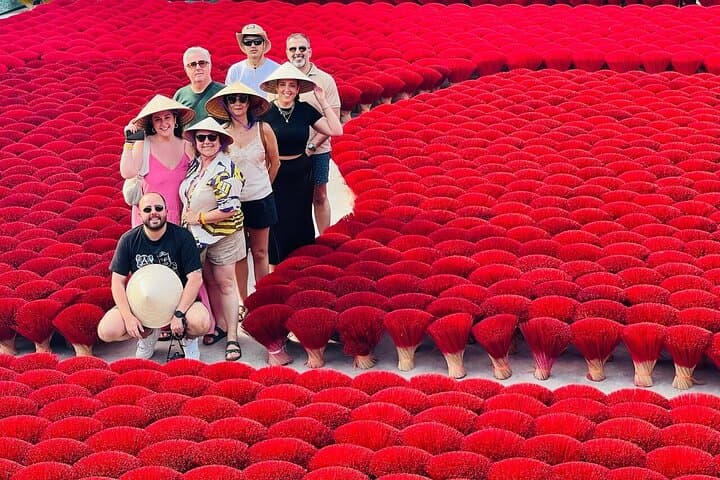
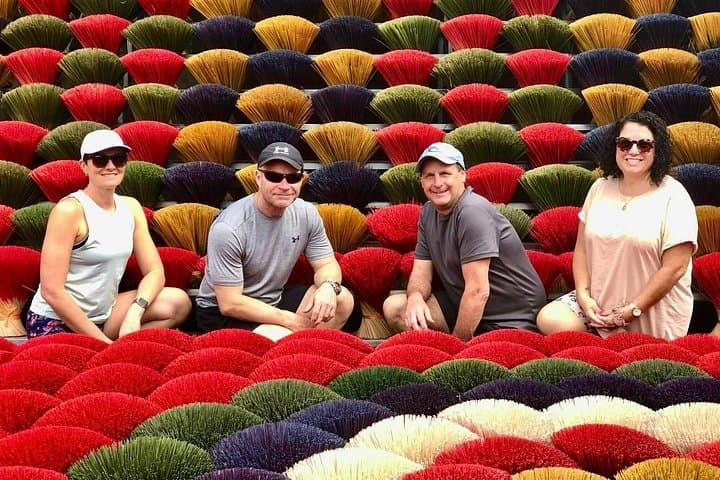


A roadside dawn in Hanoi gives way to a slow, lacquered world: by midmorning the minivan slips into patchwork paddy fields and you arrive at Quang Phu Cau Incense Village, where bundles of dyed incense hang like flags and the air tastes faintly of resin and smoke.
A roadside dawn in Hanoi gives way to a slow, lacquered world: by midmorning the minivan slips into patchwork paddy fields and you arrive at Quang Phu Cau Incense Village, where bundles of dyed incense hang like flags and the air tastes faintly of resin and smoke.
From here the landscape opens into Ninh Binh’s signature geometry—limestone karsts jutting from flat rice plains, rivers cutting deliberate courses. Tam Coc’s boatmen steer narrow sampans through a green corridor; the boat slips under three low caves, water nudging the hull as if urging the voyage forward. The geology is young limestone folded by tectonic pressure, weathered into towers and tunnels that shaped local settlement patterns and temple sites.
History appears in stone at Hoa Lu, Vietnam’s 10th–11th century capital. The Dinh and Le temples sit on a low rise, their carved beams and shaded courtyards linking imperial ritual to rice‑field life.
Practical guidance: expect a full 10–11 hour day with two hours’ driving each way from Hanoi; boat time is about 45–60 minutes on calm water covering roughly 2–3 km, and temple walks are flat and under 1 km with minimal elevation gain. Bring sun protection and a light rain layer during monsoon season, wear non‑slip shoes for boarding, and carry small bills for markets and tips. Meals and entrance fees are included; travel is suitable for most fitness levels but involves stepping into low boats and short, uneven paths. Plan to leave early from Hanoi, charge cameras, and let the steady rhythm of river and road set the pace of the day.