THE ADVENTURE COLLECTIVE® · Independent discovery and booking for outdoor travel

A single-day loop from Hanoi that pairs a 500-step climb to Mua Peak with a three-hour boat passage through Trang An’s karst caves and a visit to Hoa Lu’s 10th-century temples. Expect dramatic limestone panoramas, village scenes and practical tips for an 8–10 hour outing.
A single-day loop from Hanoi that pairs a 500-step climb to Mua Peak with a three-hour boat passage through Trang An’s karst caves and a visit to Hoa Lu’s 10th-century temples. Expect dramatic limestone panoramas, village scenes and practical tips for an 8–10 hour outing.
You step off the bus into a flat expanse of rice and water, the Ngo Giang and Tam Coc rivers slicing the plain like ink on paper. Above, steep limestone karsts rise abruptly—pale cliffs scored with caves and draped in scrub—while the climb up Mua Peak demands both breath and attention: nearly 500 stone steps that reward with a wide, clean panorama of rice paddies, winding waterways and the Trang An cave complex.
Verified experiences and guided adventures in the surrounding area.
Operated by Transpacific Travel · Ninh Binh, Ninh Bình
You step off the bus into a flat expanse of rice and water, the Ngo Giang and Tam Coc rivers slicing the plain like ink on paper. Above, steep limestone karsts rise abruptly—pale cliffs scored with caves and draped in scrub—while the climb up Mua Peak demands both breath and attention: nearly 500 stone steps that reward with a wide, clean panorama of rice paddies, winding waterways and the Trang An cave complex.
The day tour threads history and geology. Hoa Lu, the 10th–11th century capital, offers compact temples to the Dinh and Le dynasties where carved stone and wooden beams mark Vietnam’s early statecraft. The karst landscape itself is a living geological museum—limestone folded, dissolved and sculpted over millions of years into caves and blind valleys that the boat trip through Trang An shows best: low, ducking tunnels and open chambers that feel designed to test a rower’s rhythm.
Culturally the route is intimate: small riverside villages, working water buffalo, and village temples that still host local ceremonies. Practicalities are straightforward: expect a full 8–10 hour day including 3 hours of boat time, paved steps and short walks on uneven trails. Bring steady shoes for the stair climb, a refillable water bottle, sun protection and modest clothing for temple visits.
Timing matters—early light improves views and keeps the climb cooler, while late afternoon brings softer colors for photography. The trip balances easy-pace sightseeing with a handful of physical moments; it’s a compact, tactile way to read Ninh Binh’s landscape and history in a single day.
moderate.
8–10 hours.
Moderate fitness—able to climb roughly 500 stone steps and remain on your feet for a full day including a 3-hour boat ride.
The scheduled boat portion is about three hours, covering a sequence of caves and river channels; individual stretches require sitting low and sometimes ducking to pass.
The climb involves almost 500 stone steps; children and older travelers who are steady on stairs can do it, but take it slowly and avoid peak heat periods.
Typical day tours include entrance fees and a set lunch; confirm when booking if dietary needs or special menus are required.
Yes, but avoid the busiest holiday windows (Tet) and consider the hot, wet summer months—early spring and autumn offer cooler weather and clearer skies.
Hoa Lu served as Vietnam’s capital in the 10th–11th centuries and preserves compact royal temples for the Dinh and Le rulers.
Boat operators in Trang An work under eco-tourism guidelines—avoid single-use plastics and follow guides’ directions to reduce disturbance to nesting birds and fragile cave features.
Transpacific Travel operates guided outdoor trips and adventures with an emphasis on safety, stewardship, and memorable experiences.



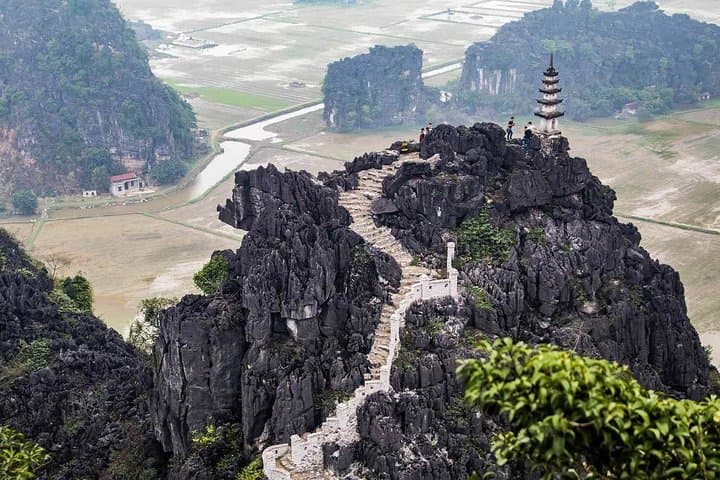
You step off the bus into a flat expanse of rice and water, the Ngo Giang and Tam Coc rivers slicing the plain like ink on paper. Above, steep limestone karsts rise abruptly—pale cliffs scored with caves and draped in scrub—while the climb up Mua Peak demands both breath and attention: nearly 500 stone steps that reward with a wide, clean panorama of rice paddies, winding waterways and the Trang An cave complex.
You step off the bus into a flat expanse of rice and water, the Ngo Giang and Tam Coc rivers slicing the plain like ink on paper. Above, steep limestone karsts rise abruptly—pale cliffs scored with caves and draped in scrub—while the climb up Mua Peak demands both breath and attention: nearly 500 stone steps that reward with a wide, clean panorama of rice paddies, winding waterways and the Trang An cave complex.
The day tour threads history and geology. Hoa Lu, the 10th–11th century capital, offers compact temples to the Dinh and Le dynasties where carved stone and wooden beams mark Vietnam’s early statecraft. The karst landscape itself is a living geological museum—limestone folded, dissolved and sculpted over millions of years into caves and blind valleys that the boat trip through Trang An shows best: low, ducking tunnels and open chambers that feel designed to test a rower’s rhythm.
Culturally the route is intimate: small riverside villages, working water buffalo, and village temples that still host local ceremonies. Practicalities are straightforward: expect a full 8–10 hour day including 3 hours of boat time, paved steps and short walks on uneven trails. Bring steady shoes for the stair climb, a refillable water bottle, sun protection and modest clothing for temple visits.
Timing matters—early light improves views and keeps the climb cooler, while late afternoon brings softer colors for photography. The trip balances easy-pace sightseeing with a handful of physical moments; it’s a compact, tactile way to read Ninh Binh’s landscape and history in a single day.