THE ADVENTURE COLLECTIVE® · Independent discovery and booking for outdoor travel

See Cairo’s headline sites in a single long day: an hour in the Egyptian Museum and close-up time at the Giza pyramids and Sphinx, with lunch and hotel transfers from Hurghada. Expect a 14–15 hour coach excursion with guided stops and short walks on uneven surfaces.
See Cairo’s headline sites in a single long day: an hour in the Egyptian Museum and close-up time at the Giza pyramids and Sphinx, with lunch and hotel transfers from Hurghada. Expect a 14–15 hour coach excursion with guided stops and short walks on uneven surfaces.
You step off the coach into a city that keeps its history in the open air: a ribbon of roving vendors, the hush of limestone steps, and the desert wind pushing heat across Giza’s plateaus. The day begins in Tahrir’s bustle at the Egyptian Museum, where sun-warmed columns and glass cases hold funerary masks and carved stone—then moves west, into the broad, arid sweep of the Giza Plateau and the three pyramids watching the horizon.
Verified experiences and guided adventures in the surrounding area.
Operated by Ramashka Tours · Cairo, Cairo Governorate
You step off the coach into a city that keeps its history in the open air: a ribbon of roving vendors, the hush of limestone steps, and the desert wind pushing heat across Giza’s plateaus. The day begins in Tahrir’s bustle at the Egyptian Museum, where sun-warmed columns and glass cases hold funerary masks and carved stone—then moves west, into the broad, arid sweep of the Giza Plateau and the three pyramids watching the horizon.
The museum houses more than 120,000 artifacts, from Predynastic pottery to Tutankhamun’s gold mask, preserving millennia of centralized statecraft and funerary practice. The Giza Plateau sits on Pleistocene limestone; the pyramids themselves are engineering statements in ashlar blocks and precise orientation, while the nearby Sphinx anchors a human visage to the desert’s geology.
Culturally, expect lively bargaining at small stalls, teashops near museums, and friendly, multilingual guides who contextualize monuments for modern visitors. Local lunch stops often mirror 1970s hotel dining rooms—simple, hearty Egyptian mains with optional drinks at extra cost.
Practical guidance: this is a long day (14–15 hours) mostly by coach with multiple short walks on uneven stone and sand. Bring sun protection, a refillable water bottle, comfortable closed-toe shoes, and a small daypack. Carry your passport copy and expect security lines at major sites. Plan for early pickup and a late return to Hurghada; naps on the coach are a survival tactic. This trip suits travelers who want concentrated access to Cairo’s signature sights in a single, well-orchestrated day.
moderate.
14–15 hours.
Suitable for travelers in average fitness—ability to walk short distances on uneven ground and stand during site tours is required.
The tour runs about 14–15 hours; pickup in Hurghada early morning with return around 22:15, depending on traffic and final stops.
Entrance to the Egyptian Museum and Giza sites are included per itinerary, but optional extras (e.g., camel rides, special tomb entries) are usually extra.
Children are welcome but note long coach hours; travellers with significant mobility limitations may find uneven ground and steps challenging.
Lunch is included at a large Cairo restaurant; drinks are typically extra and small snacks are recommended for the coach ride.
The Egyptian Museum chronicles centralized burial practices and state power from the Pharaonic era; the Giza pyramids date to the Fourth Dynasty (c. 2600–2500 BCE) and reflect large-scale labor organization and astronomical alignment.
High visitor numbers stress fragile stone surfaces and artifacts; stick to paths, avoid touching exposed carvings, and support local conservation efforts by following guide instructions.
Ramashka Tours operates guided outdoor trips and adventures with an emphasis on safety, stewardship, and memorable experiences.


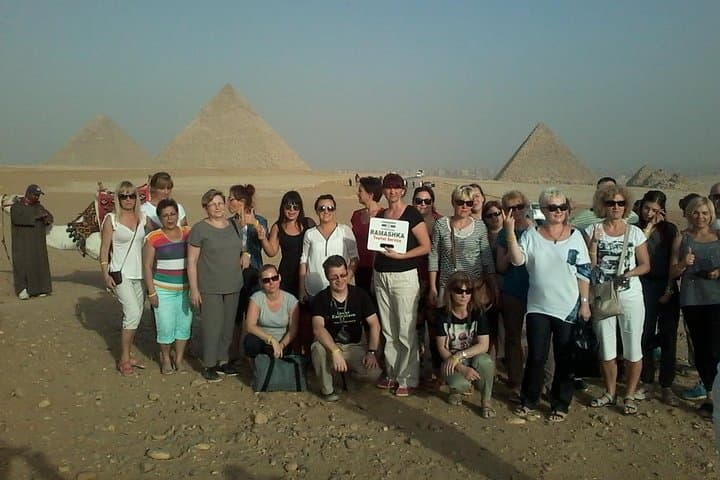
You step off the coach into a city that keeps its history in the open air: a ribbon of roving vendors, the hush of limestone steps, and the desert wind pushing heat across Giza’s plateaus. The day begins in Tahrir’s bustle at the Egyptian Museum, where sun-warmed columns and glass cases hold funerary masks and carved stone—then moves west, into the broad, arid sweep of the Giza Plateau and the three pyramids watching the horizon.
You step off the coach into a city that keeps its history in the open air: a ribbon of roving vendors, the hush of limestone steps, and the desert wind pushing heat across Giza’s plateaus. The day begins in Tahrir’s bustle at the Egyptian Museum, where sun-warmed columns and glass cases hold funerary masks and carved stone—then moves west, into the broad, arid sweep of the Giza Plateau and the three pyramids watching the horizon.
The museum houses more than 120,000 artifacts, from Predynastic pottery to Tutankhamun’s gold mask, preserving millennia of centralized statecraft and funerary practice. The Giza Plateau sits on Pleistocene limestone; the pyramids themselves are engineering statements in ashlar blocks and precise orientation, while the nearby Sphinx anchors a human visage to the desert’s geology.
Culturally, expect lively bargaining at small stalls, teashops near museums, and friendly, multilingual guides who contextualize monuments for modern visitors. Local lunch stops often mirror 1970s hotel dining rooms—simple, hearty Egyptian mains with optional drinks at extra cost.
Practical guidance: this is a long day (14–15 hours) mostly by coach with multiple short walks on uneven stone and sand. Bring sun protection, a refillable water bottle, comfortable closed-toe shoes, and a small daypack. Carry your passport copy and expect security lines at major sites. Plan for early pickup and a late return to Hurghada; naps on the coach are a survival tactic. This trip suits travelers who want concentrated access to Cairo’s signature sights in a single, well-orchestrated day.