THE ADVENTURE COLLECTIVE® · Independent discovery and booking for outdoor travel

Walk the French Quarter after dark with a guide who pairs documented history and local lore. This two-hour, wheelchair-accessible evening tour visits notorious houses and hidden alleys while explaining the cultural roots behind New Orleans’ haunted reputation.
Walk the French Quarter after dark with a guide who pairs documented history and local lore. This two-hour, wheelchair-accessible evening tour visits notorious houses and hidden alleys while explaining the cultural roots behind New Orleans’ haunted reputation.
You step off Decatur Street and the night presses close—the clapboard facades throw long shadows and the cough of the Mississippi is a distant, patient pulse. Lantern-lit corners, cast-iron balconies and narrow alleys become stages for stories that began centuries ago; on this two-hour walk the French Quarter’s architecture and atmosphere feel like characters in their own right.
Verified experiences and guided adventures in the surrounding area.
Operated by NOLA GhostRiders · New Orleans, Louisiana
You step off Decatur Street and the night presses close—the clapboard facades throw long shadows and the cough of the Mississippi is a distant, patient pulse. Lantern-lit corners, cast-iron balconies and narrow alleys become stages for stories that began centuries ago; on this two-hour walk the French Quarter’s architecture and atmosphere feel like characters in their own right.
The route threads past houses and theaters whose histories are blunt and public: 18th- and 19th-century Creole buildings altered by the Great New Orleans Fire of 1788, a city shaped by riverine geology and colonial trade, and neighborhoods where Creole, French, African and Spanish cultures collided and fused. Guides point out documented incidents—LaLaurie’s notorious residence, the Gardette-LePretre “Sultan’s House,” and the haunted lore of Le Petit Theatre—while explaining how rumor and oral history grew around real social trauma.
Expect paved sidewalks, brief stops at façades and stories woven with local context rather than paranormal proof. The mood combines history with dramatic retelling: voodoo’s cultural roots, funeral traditions, and how the city’s humid, low-lying geography feeds both folklore and practical city life.
Practical notes: tours meet at VooDoo Tavern & Poboys (1140 Decatur St), last ~2 hours, and are wheelchair/stroller accessible. Dress smart casual and wear comfortable shoes for uneven sidewalks. Bring a small light and water; night photos are fine but respect private property and residences. Tours run rain or shine — check cancellation rules and arrive early for check-in.
easy.
2 hours.
Able to stand and walk on paved urban sidewalks for two hours; suitable for most fitness levels
The tour meets at VooDoo Tavern & Poboys, 1140 Decatur St, New Orleans — arrive 30 minutes early for check-in.
Yes; the tour is family-friendly but includes mature historical topics—use parental discretion for young children.
No — guides present documented history, folklore and eyewitness accounts; it’s a narrative-focused walking tour, not an investigative ghost-hunt with equipment.
Yes; the operator notes wheelchair and stroller accessibility, though some streets may have uneven surfaces—contact the operator if you need specific accommodations.
The French Quarter grew from Spanish and French colonial settlement; fires in 1788 and 1794 reshaped its architecture and created the cast-iron balcony styles seen today. Many ghost stories grew from real events tied to slavery, disease and urban change.
Visitors should respect fragile historic fabric—avoid touching plasterwork and ironwork and keep noise and litter to a minimum. Responsible tourism helps preserve sensitive residential areas and nearby cemetery sites.
NOLA GhostRiders operates guided outdoor trips and adventures with an emphasis on safety, stewardship, and memorable experiences.


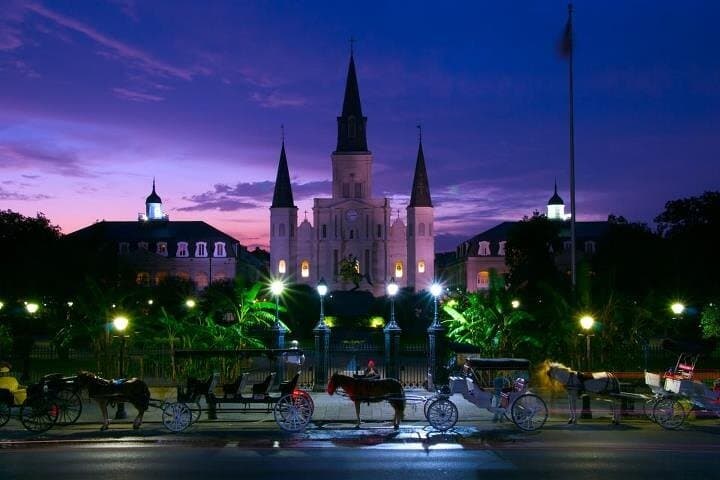

You step off Decatur Street and the night presses close—the clapboard facades throw long shadows and the cough of the Mississippi is a distant, patient pulse. Lantern-lit corners, cast-iron balconies and narrow alleys become stages for stories that began centuries ago; on this two-hour walk the French Quarter’s architecture and atmosphere feel like characters in their own right.
You step off Decatur Street and the night presses close—the clapboard facades throw long shadows and the cough of the Mississippi is a distant, patient pulse. Lantern-lit corners, cast-iron balconies and narrow alleys become stages for stories that began centuries ago; on this two-hour walk the French Quarter’s architecture and atmosphere feel like characters in their own right.
The route threads past houses and theaters whose histories are blunt and public: 18th- and 19th-century Creole buildings altered by the Great New Orleans Fire of 1788, a city shaped by riverine geology and colonial trade, and neighborhoods where Creole, French, African and Spanish cultures collided and fused. Guides point out documented incidents—LaLaurie’s notorious residence, the Gardette-LePretre “Sultan’s House,” and the haunted lore of Le Petit Theatre—while explaining how rumor and oral history grew around real social trauma.
Expect paved sidewalks, brief stops at façades and stories woven with local context rather than paranormal proof. The mood combines history with dramatic retelling: voodoo’s cultural roots, funeral traditions, and how the city’s humid, low-lying geography feeds both folklore and practical city life.
Practical notes: tours meet at VooDoo Tavern & Poboys (1140 Decatur St), last ~2 hours, and are wheelchair/stroller accessible. Dress smart casual and wear comfortable shoes for uneven sidewalks. Bring a small light and water; night photos are fine but respect private property and residences. Tours run rain or shine — check cancellation rules and arrive early for check-in.